


Bitcoin miners entered one of their longest periods of contraction by July 31, even as shares of several listed operators climbed on expectations for AI data-center revenue.
Bitcoin Magazine Pro calculated that mining difficulty had fallen 19.9% from its peak, making the decline the third deepest since application-specific integrated circuits replaced graphics processors as the industry’s main hardware.
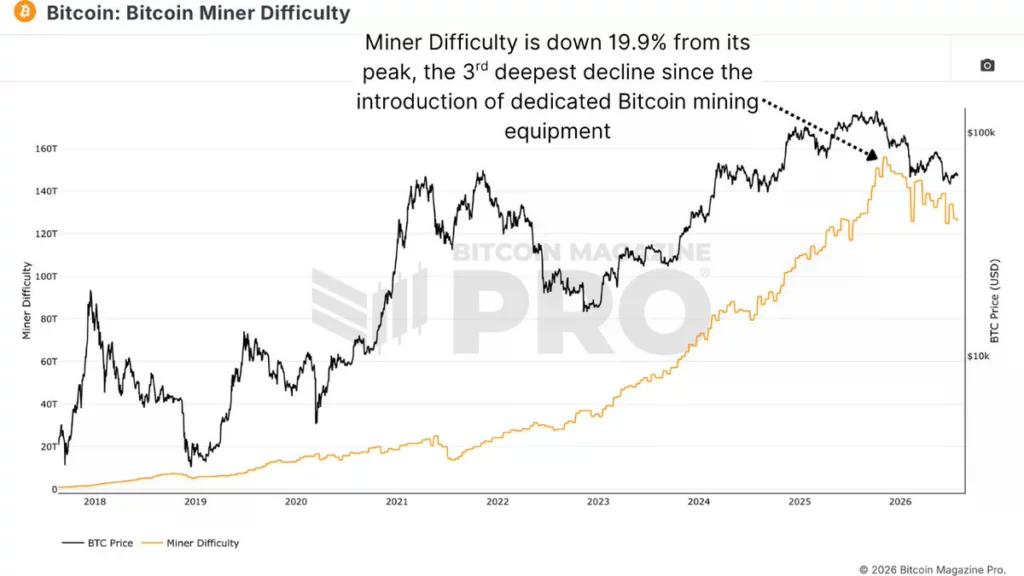
Independent network data confirm the broader contraction. Bitcoin’s difficulty fell 0.74% on July 25 to 126.23 trillion after a larger 5% cut on July 11. The current level is about 19% below the record of roughly 156 trillion set in November 2025.
Bitcoin traded near $63,100 on July 31, down about 47% over 12 months and almost 50% below its October 2025 record. That price decline has reduced dollar revenue for miners while the protocol continues issuing only 3.125 BTC per block.
Bitcoin’s seven-day average hashrate stood near 868 exahashes per second on July 29, down from more than one zettahash per second at its late-2025 peak. Hashrate Index placed the broader 30-day measure near 940 EH/s in its third-quarter review, about 12% below the December record of 1,066 EH/s.
Different data providers use different averaging windows, so they may not identify the same starting date for the decline. Bitcoin Magazine Pro’s claim that the drawdown had lasted 287 days reflects its chosen hashrate series. The precise duration may vary, but the downward direction is clear across public datasets.
Difficulty has also turned negative on a year-over-year basis for only the second time in Bitcoin’s history, according to Luxor’s Hashrate Index. The previous instance followed China’s 2021 mining ban, when a large share of global equipment shut down before relocating to other countries.
The present contraction has no single policy-driven cause. Hashrate Index attributes it to compressed mining revenue, Bitcoin’s lower price, less-efficient hardware shutting down and power capacity moving into AI and high-performance computing. It recorded two consecutive quarterly hashrate declines through June.
Hashprice, which measures expected daily revenue from one petahash of computing power, stood near $32 per PH/s per day late in July. Older fleets can struggle to remain cash-positive around $30 to $35 unless operators have electricity below roughly five cents per kilowatt-hour.
As previously reported, listed miners sold more than 32,000 BTC during the first quarter of 2026. The total exceeded their combined sales during all of 2025, as companies raised cash for debt, operating costs and data-center construction.
Mining stocks traditionally behaved like leveraged Bitcoin exposure. Rising Bitcoin prices improved mining revenue and lifted equity valuations, while falling prices compressed margins and pushed miner shares down faster than the asset.
That relationship has weakened because investors increasingly value some operators as energy and AI infrastructure companies. A basket of mining equities gained 56% during the early part of 2026 while Bitcoin fell 17%, according to research cited in related crypto.news coverage.
Hut 8 provides one of the clearest examples. On July 20, the company signed a second 15-year lease for 352 megawatts at its Beacon Point campus in Texas. The agreement raised the campus’s base-term contract value to $19.6 billion and Hut 8’s total contracted AI portfolio to $26.6 billion. Initial delivery for the second phase is scheduled for the second quarter of 2028.
Hut 8’s shares more than quadrupled over the preceding 12 months and rose 11% after the second Beacon Point agreement, according to market data reported by Barron’s. Those gains reflect expected future lease revenue rather than stronger Bitcoin-mining economics.
Core Scientific reported another large expansion on July 28. The company announced an AMD partnership anchored by 15-year agreements covering about 530 MW and more than $14 billion in potential base contracted revenue. It said its total leased customer capacity had reached roughly 1.1 GW, representing more than $24 billion in potential contracted revenue.
Meanwhile, TeraWulf’s AI and HPC lease revenue reached $21 million in the first quarter, overtaking its Bitcoin-mining revenue for the first time. Mining generated less than $13 million during the period.
These agreements help explain why falling hashrate and rising miner stocks can occur together. Operators can shut down inefficient mining equipment while preserving valuable power connections, land and data-center infrastructure for higher-value workloads.
However, announced contract values are not the same as revenue already received. Many projects require years of construction, outside financing and customer deployment. Delays, cost overruns or weaker AI demand could challenge valuations built around future capacity.
Bitcoin Magazine Pro wrote that miners had “found something more profitable to do with their hardware.” The statement captures the market’s current thesis, but it does not apply equally to every miner. Some locations cannot meet the networking, cooling or reliability standards required for AI workloads, while efficient mining sites may remain profitable.
Miner revenue consists of the fixed block subsidy and transaction fees. The subsidy has declined from 50 BTC in 2009 to 3.125 BTC after the April 2024 halving. It is expected to fall to 1.5625 BTC at the next halving, currently projected for 2028.
Bitcoin Magazine Pro said BTC-denominated block-reward revenue recently reached its lowest daily level on record. That claim requires context. Lower BTC-denominated issuance is largely a programmed outcome of halvings, while slower-than-target block production can temporarily reduce daily issuance before the next difficulty adjustment.
Dollar revenue can still rise when Bitcoin appreciates. Therefore, a record low measured in BTC does not automatically represent a record low security budget in U.S. dollar terms.
Transaction fees are providing little support. Miners collected about 20 BTC in fees during the seven days through July 13, equal to roughly 2.86 BTC per day. That was below the 3.125 BTC subsidy paid by a single block and represented only 0.69% of total block rewards for that week.
The comparison supports Bitcoin Magazine Pro’s broader point, although the exact result depends on the period measured. Fee demand can rise rapidly during congestion, token launches or other periods of intense blockspace competition.
For now, fees remain far from replacing issuance. At approximately 144 blocks per day, the network creates about 450 BTC in daily subsidy when blocks arrive on schedule. Fee income of less than 3 BTC per day covers only a small share of that amount.
This gap matters over decades rather than weeks. Every future halving will reduce issuance, requiring some combination of higher Bitcoin prices, greater fee demand, improved mining efficiency or a smaller amount of economically sustainable hashrate.
In related coverage, crypto.news reported that the long-term security-budget debate depends on several uncertain variables, including future fees, hardware efficiency, energy costs and Bitcoin’s market value. Current fee weakness does not prove that the network will face a security failure.
Bitcoin remains secured by hundreds of exahashes per second of computing power. The protocol also adjusts difficulty every 2,016 blocks to bring average block production back toward ten minutes when machines enter or leave.
Lower difficulty improves conditions for the miners that remain. Each unit of surviving hashrate competes against less total computing power and can earn a larger share of the fixed block rewards.
That mechanism can stabilize the network after a miner capitulation. Weak operators leave, difficulty falls and lower-cost miners gain revenue share. A 19.9% decline from the peak therefore signals industry stress, but it also shows that Bitcoin’s adjustment mechanism is responding as designed.
Still, the current cycle differs from earlier contractions. Some hardware is not merely being shut down temporarily. Power contracts and data-center sites are entering AI leases that can last 15 or 20 years, making their return to Bitcoin mining less likely.
Luxor described the trend as “a structural shift, not just a cyclical low.” Its research found that listed miners had announced more than $70 billion in AI and HPC contracts, while network hashrate experienced its second consecutive quarterly decline.
The next difficulty adjustment, expected around August 9 to August 11 depending on block production, will provide another network checkpoint. A further reduction would show that miners continued leaving after the July 25 reset. Stable or rising difficulty would suggest that the contraction had begun to slow.
Investors will also watch Hut 8’s second-quarter results on August 4, new AI-capacity delivery schedules and whether miners continue selling Bitcoin reserves.
Several listed miners now hold multibillion-dollar AI and HPC contracts. Investors are valuing their secured power, data-center land and future lease revenue rather than relying only on Bitcoin production.
Falling difficulty shows that less computing power is competing to produce blocks. Bitcoin still has a very large hashrate, and no verified evidence indicates an immediate security crisis. The protocol lowers difficulty to maintain block production when miners leave.
No. AI conversions require strong grid connections, fiber networks, advanced cooling and large amounts of capital. Efficient miners with cheap power may continue focusing on Bitcoin, while operators with suitable sites pursue AI contracts.
Key signals include stable hashrate, difficulty beginning to rise, hashprice moving above operating costs and reduced treasury selling. A sustained Bitcoin recovery would also improve dollar-denominated mining revenue.
Disclosure: This article does not represent investment advice. The content and materials featured on this page are for educational purposes only.
