
XRP Deep Dive: The Decentralization Fight, and the Risks No One Is Talking About
XRP has been in the spotlight for years, but the first quarter of 2026 brought a new kind of attention. A very public fight over whether the XRP Ledger (XRPL) is truly decentralized went viral on X. At the same time, institutional money kept flowing into XRP exchange-traded funds, and the token's available supply on exchanges hit multi-year lows. These events are happening at once, and they paint a complicated picture of where XRP stands today.
This article breaks down the technical architecture of the XRPL, the arguments on both sides of the decentralization debate, the institutional shifts reshaping XRP's market profile, and the risks that advanced market participants should keep on their radar.
How the XRP Ledger Actually Works Under the Hood
The XRP Ledger launched in 2012, built by David Schwartz, Jed McCaleb, and Arthur Britto. It was designed from the start to avoid the energy costs and slow confirmation times of Bitcoin's Proof-of-Work model. Instead of miners competing to validate blocks, the XRPL uses a federated consensus protocol. Validators on the network agree on the state of the ledger every 3 to 5 seconds, and the system can handle up to 1,500 transactions per second at an average fee of about $0.0002.
The ledger also has a built-in decentralized exchange (DEX) and supports custom token issuance. By February 2026, the network had closed over 70 million ledgers without a major outage. These numbers make the XRPL one of the most reliable and cost-effective settlement layers in the crypto space, at least from a pure performance standpoint.
But performance is only part of the story. The real question in 2026 is about who controls the network, and that question brings us to the biggest debate in XRP's recent history.
The Unique Node List: Why It's at the Center of the Decentralization Fight
The core of the XRPL consensus model is something called the Unique Node List, or UNL. Every node on the network uses a UNL to decide which validators it trusts. When enough of those trusted validators agree on a set of transactions, the ledger moves forward.
Here's where things get contentious. Ripple Labs publishes a default UNL, and most nodes on the network use that list. Critics say this setup gives Ripple outsized control over the network. If a node operator chose a different list of validators, their version of the ledger could diverge from the rest of the network, effectively creating a fork.
This design choice is what separates the XRPL from fully permissionless systems like Bitcoin or Ethereum, and it's what sparked the February 2026 clash between two well-known figures in the industry.
David Schwartz vs. Justin Bons: What Each Side Actually Said
In late February 2026, Justin Bons, the founder and CIO of Cyber Capital, posted a detailed thread on X calling the XRPL a "permissioned" blockchain. His argument boiled down to a few key claims.
Bons said the XRPL operates more like a Proof-of-Authority (PoA) system than a decentralized network. He pointed out that Ripple's published UNL acts as a central point of control. Any node that tries to use a different validator list risks splitting from the main chain. In his view, this gives Ripple "absolute power and control" over the ledger. He also grouped XRPL with Stellar, Hedera, Algorand, and Canton, calling them all "centralized blockchains" with structured governance models.
David Schwartz, the lead architect of the XRPL and Ripple's former CTO, fired back quickly. He called Bons' claims "objectively nonsensical" and argued that the system was built so no single entity could own or control it. Schwartz made the point that users are always free to adopt a new UNL if a majority of validators act dishonestly. He compared this to Bitcoin users hypothetically changing the mining algorithm if miners launched a 51% attack. In both cases, the community holds the ultimate power to walk away from a compromised set of actors.
This debate didn't resolve anything, but it did force the broader market to take a closer look at what "decentralization" really means in practice and whether the XRPL meets that standard.
Where the Decentralization Argument Stands Today
The honest answer is that this is not a black-and-white issue. The XRPL does not use Proof-of-Work or Proof-of-Stake in the traditional sense. Its consensus model relies on trust relationships between validators, and the default UNL published by Ripple plays a significant role in how most nodes operate.
At the same time, the protocol is open-source, and anyone can run a validator or publish their own UNL. The network does not require permission from Ripple to participate. The tension is between the theoretical openness of the system and the practical reality that most participants follow Ripple's default settings.
For crypto-native users who prioritize permissionless participation above everything else, this is a dealbreaker. For institutional players who value structured governance and regulatory clarity, it's actually a feature. This split in perspective is likely to define XRP's identity for years to come.
The way I see it, as of many things in life the subject is nuanced in the discussion and both sides do have points but it really comes down to what you believe are the important factors of decentralization.
How Institutional Money Changed the XRP Landscape
While the decentralization debate played out on social media, the institutional side of XRP's story kept growing. The launch of U.S. spot XRP ETFs in mid-November 2025 marked a turning point. Products from major issuers quickly attracted serious capital.
- 21Shares launched the TOXR ETF
- Grayscale introduced GXRP
- Franklin Templeton rolled out XRPZ
By mid-November 2025, these funds had already seen an 18-day streak of inflows totaling nearly $1 billion. By February 2026, XRP ETFs held $1.1 billion in net assets. During the same period, Bitcoin ETFs experienced year-to-date outflows, which suggests that some institutional capital was rotating out of BTC and into XRP.
Beyond ETFs, XRP also gained attention at the government level. Arizona lawmakers introduced the Arizona Digital Reserve Bill, which specifically names XRP as a potential state reserve asset. And in 2025, XRP was reportedly shortlisted for a proposed U.S. Federal Crypto Reserve basket under the Trump administration.
These developments represent a major shift. XRP is no longer just a payments token for cross-border remittances. It's becoming a vehicle for traditional finance exposure to digital assets, and that changes the calculus for how the market values it.
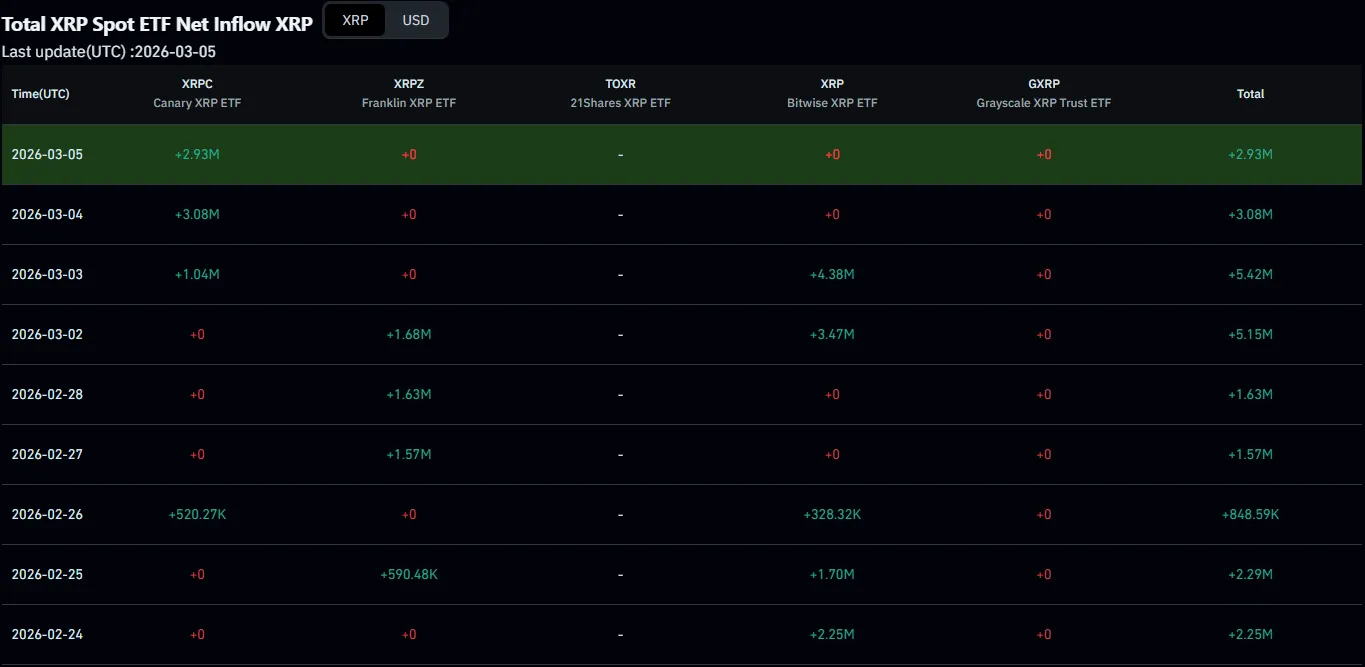
Image from Coinglass
XRP Price Action and the Supply Crunch Explained
As of late February 2026, XRP was trading around $1.42 after a 6% jump. The price had pulled back significantly from its January 5 high of $2.12, but the supply dynamics underneath tell a more nuanced story.
XRP exchange reserves have been falling steadily since November 2024. The total liquid supply on exchanges dropped from 3.76 billion tokens in October 2025 to roughly 1.66 to 1.7 billion by February 2026. That's a decline of about 700 million XRP. Less supply on exchanges generally means less immediate sell pressure, which can support prices if demand holds.
Whale activity has been a major driver of short-term price moves. On February 13, 2026, someone moved 200 million XRP (worth about $105 million) from Binance to an unknown wallet. The next day, XRP surged 10% to hit a local high of $1.55. Retail also showed up in force, with purchase volumes on Bitrue jumping 212% between February 23 and 24.
The picture isn't all bullish. Some whales holding over 100,000 XRP have been moving tokens back onto Binance, which typically signals selling intent. Traders are watching the $1.45 resistance level closely. Holding $1.40 to $1.42 as support is seen as critical for any push toward $1.57. A break below $1.37 could signal a false breakout and open the door to a deeper pullback.
Key Risks That Could Derail the XRP Narrative
The biggest risk for XRP right now isn't the price. It's the gap between the institutional story and the on-chain reality.
On-chain payment volumes collapsed by 90% from their early February 2026 peak. This is a problem because XRP's original value proposition was built on real-world payment utility. If the network isn't being used for actual transactions, the price becomes almost entirely driven by speculation and ETF flows. That's not a sustainable foundation.
The centralization narrative also presents a longer-term challenge. Even if institutions don't care about the UNL debate, the broader crypto community does. Continued attacks on the XRPL's governance model could limit XRP's adoption in decentralized finance (DeFi) ecosystems and reduce its appeal to developers who prioritize permissionless systems.
Market structure adds another layer of risk. In late January 2026, XRP saw $57 million in liquidations in a single day, the highest on record at that time. This kind of volatility signals that retail participation is thinning out and that price action is increasingly dependent on whale movements and ETF flows.
Timeline: Key XRP Events from 2024 to 2026
What This All Means for XRP Going Forward
XRP in 2026 is a study in contradictions. The token is gaining institutional legitimacy at a pace that few other altcoins can match, with over a billion dollars in ETF assets and serious legislative attention at both the state and federal level. But the network's on-chain utility is declining, the decentralization debate remains unresolved, and the price is increasingly shaped by whale behavior rather than organic demand.
For advanced market participants, the key question isn't whether XRP is "good" or "bad." It's whether the institutional inflows can sustain a price floor even as on-chain fundamentals weaken. The supply crunch on exchanges provides some structural support, but the 90% drop in payment volumes is hard to ignore.
The Schwartz-Bons debate also highlighted something important that goes beyond XRP. The crypto industry still doesn't have a shared definition of decentralization. Until it does, projects like the XRPL will continue to exist in a gray area: too structured for purists, too innovative for skeptics, and increasingly attractive to institutions that care more about performance than philosophy.