Why Smart Contracts Are No Longer Just a Crypto Experiment
For years, smart contracts lived mostly inside the crypto bubble. DeFi protocols used them. NFT marketplaces relied on them. But traditional institutions kept their distance. That era is officially over.
As of early 2026, smart contracts have become foundational infrastructure for global finance, energy markets, supply chains, and identity verification. The global smart contract market is now projected to reach $815.86 billion by 2034, and the Total Value Locked in institutional-grade DeFi has crossed $95 billion, with $55 billion of that sitting on Ethereum alone. These aren't speculative numbers driven by retail hype. They reflect banks, asset managers, and central banks embedding smart contract logic into their core operations.
The shift didn't happen overnight. It was built on decades of theoretical work, painful security lessons, and a slow but steady convergence between blockchain infrastructure and legacy financial systems. This article traces the full arc, from Nick Szabo's 1996 concept to the AI-driven smart contract agents emerging in 2026, and explains what it all means for the next phase of the digital economy.
The Origin Story: From Nick Szabo to Ethereum
The term "smart contract" first appeared in 1996, when cryptographer Nick Szabo described it as a "set of promises, specified in digital form, including protocols within which the parties perform on these promises." At the time, there was no platform capable of running this kind of logic in a decentralized way. The idea sat dormant for over a decade.
The first real breakthrough came in 2008, when Satoshi Nakamoto published the Bitcoin white paper. Bitcoin introduced a peer-to-peer electronic cash system that proved decentralized consensus was possible at scale. But Bitcoin's scripting language was intentionally limited. It could handle simple transactions, but it wasn't designed for complex programmable logic.
That gap closed in 2014 when Vitalik Buterin, Gavin Wood, and Jeffrey Wilcke founded Ethereum. Ethereum introduced a fully programmable blockchain where developers could write arbitrary logic using a language called Solidity. This was the moment smart contracts went from a theoretical concept to a deployable technology. Developers could now build decentralized applications (dApps) that handled lending, insurance, governance, and much more, all without relying on a central authority.
The Oracle Problem: Why Blockchains Can't See the Real World
One of the most important turning points in smart contract history was the discovery of a fundamental limitation. Blockchains are closed systems. They can verify on-chain data with extreme reliability, but they have no native way to access information from the outside world. They can't check stock prices, read weather data, confirm shipping deliveries, or pull from any external API.
This is known as the "Oracle Problem," and it nearly capped the potential of smart contracts entirely. If a contract can only react to data already on the blockchain, its use cases shrink dramatically. You can't build parametric insurance that pays out based on rainfall if the blockchain doesn't know how much it rained.
Decentralized oracle networks emerged as the solution. These systems act as secure middleware, feeding verified off-chain data into on-chain smart contracts. Chainlink became the dominant player in this space, and its infrastructure now underpins everything from DeFi price feeds to cross-border banking pilots. Without oracles, most of the real-world applications discussed in this article simply wouldn't exist.
How Smart Contracts Actually Work Under the Hood
At a technical level, smart contracts operate through conditional logic. They follow "if/when...then..." statements that execute automatically once a network of computers verifies that the conditions have been met. When a condition triggers, the contract carries out its programmed action, whether that's releasing funds, issuing a digital title, or updating a supply chain record.
Two properties make this model fundamentally different from traditional contracts:
- Trustlessness: No intermediary is needed to oversee or enforce the agreement. The code itself is the enforcement mechanism. Lawyers, escrow agents, and governmental third parties are removed from the process.
- Immutability: Once a smart contract is deployed on-chain, its code and outcomes are generally irreversible. No single party can alter the terms or tamper with the execution after the fact.
Developers write most smart contracts in Solidity, which runs on Ethereum Virtual Machine (EVM) compatible networks like Ethereum and Hedera. The execution cost on Ethereum is measured in "gas," a fee mechanism designed to prevent spam and allocate network resources fairly.
The Big Institutional Moves
The last 18 months have produced the most significant wave of institutional smart contract adoption in the technology's history. Three projects in particular stand out.
Project Guardian, led by the Monetary Authority of Singapore, brought together UBS Asset Management, Swift, and Chainlink to demonstrate how tokenized investment funds could be settled using existing fiat payment rails. The project proved that institutions don't need to abandon their current infrastructure to adopt blockchain. Smart contracts can layer on top of legacy systems and add efficiency without requiring a wholesale replacement.
The Drex CBDC Project took things a step further. The Central Bank of Brazil selected Chainlink and Microsoft to build trade finance solutions using tokenized Bills of Lading for the second phase of its digital currency initiative. This represents a sovereign central bank directly integrating decentralized oracle infrastructure into a national digital currency, a level of institutional commitment that would have been unthinkable even two years ago.
And in early 2026, Chainlink launched 24/5 U.S. Equities Streams, providing continuous on-chain pricing data for the entire U.S. stock market. This gives tokenized equity products access to reliable, real-time price feeds and removes one of the last major data infrastructure barriers to bringing traditional securities on-chain.
Real-World Use Cases Across Seven Major Sectors
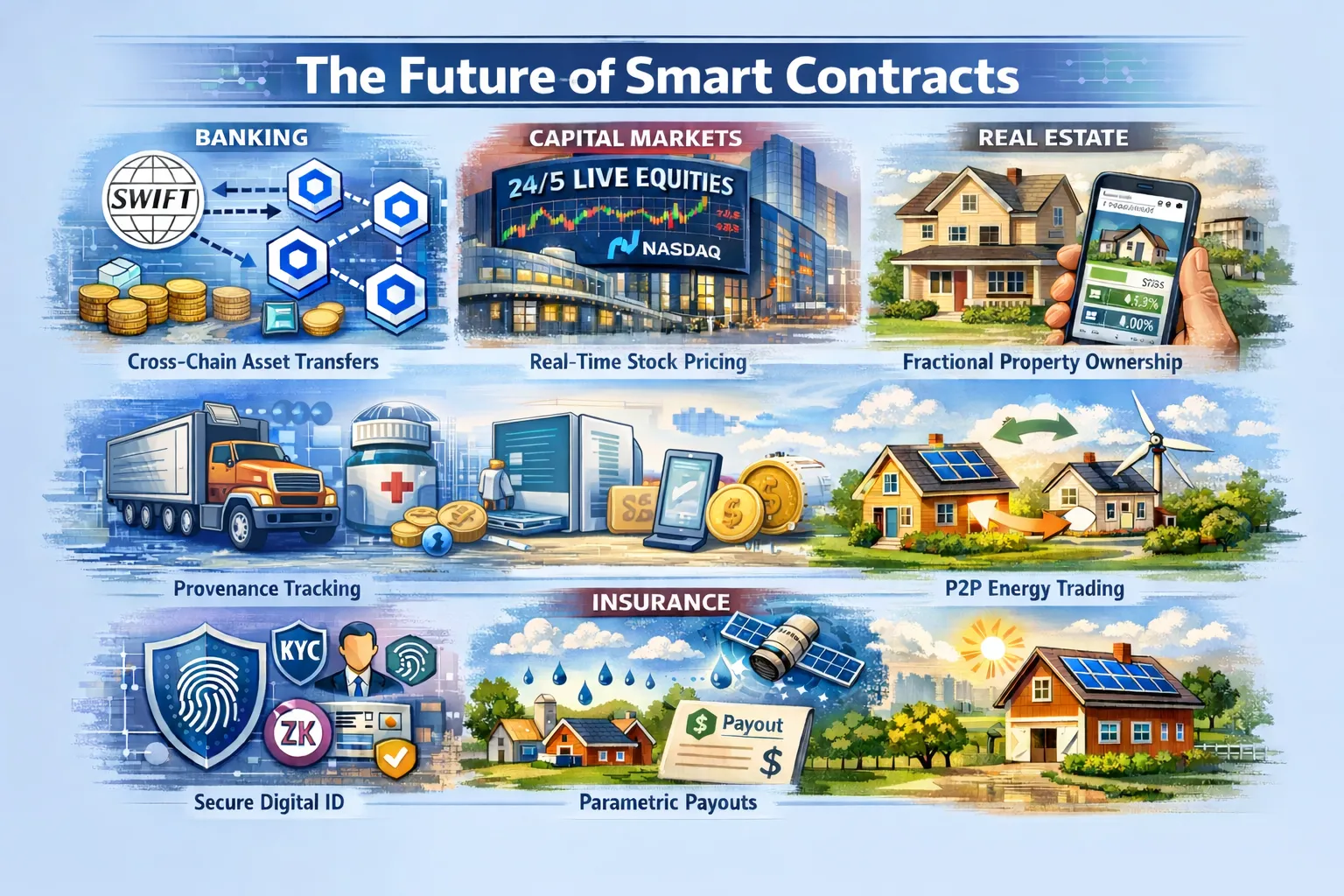
Here's how the technology is being deployed across key industries:
| Sector | Use Case | Recent Development |
| Banking | Cross-chain tokenized asset transfers | Swift uses Chainlink CCIP to move assets across public and private chains |
| Capital Markets | Continuous on-chain equity pricing | 24/5 Equities Streams provide real-time pricing for the $80 trillion U.S. stock market |
| Real Estate | Fractional property ownership | Platforms like RealT and Lofty divide properties into segments as small as $10 |
| Supply Chain | End-to-end provenance tracking | IBM Pharma Portal tracks temperature-controlled drugs; Maersk cut transit times by 40% |
| Energy | Peer-to-peer energy trading | PNNL's B-A TES framework enables grid balancing through smart contract auctions |
| Identity | Reusable KYC verification | Civic and World ID use Zero-Knowledge Proofs for private, on-chain authentication |
| Insurance | Parametric automatic payouts | Arbol triggers crop insurance payments using satellite rainfall data |
What stands out across all these sectors is a common pattern. Smart contracts are removing manual verification steps, cutting administrative overhead, and enabling transaction models that simply weren't possible before. Organizations adopting blockchain for supply chains alone report cost reductions of up to 30%.
Comparing Ethereum, Hyperledger Fabric, and Hedera
Not all smart contract platforms are built for the same purpose. The choice of network depends heavily on whether the use case is public, private, or somewhere in between.
Ethereum is the most widely used public smart contract platform. It has transitioned from Proof-of-Work to Proof-of-Stake and uses gas fees to manage network resources. Its strength is openness and composability. Its weakness is cost and throughput, especially during periods of high demand.
Hyperledger Fabric takes a completely different approach. It's a permissioned framework maintained by the Linux Foundation, and it requires identity registration before participants can interact with the network. Enterprises prefer it when privacy and access control are top priorities, like in healthcare or internal supply chain systems.
Hedera occupies a middle ground. It uses a Consensus Service designed for high-throughput institutional applications and is governed by a council of major global organizations. It runs Solidity-based contracts on an EVM-compatible layer, so developers familiar with Ethereum can build on it with minimal friction.
Each platform makes different tradeoffs between decentralization, privacy, performance, and governance. The trend in 2025–2026 is toward interoperability between these networks rather than competition between them, with protocols like Chainlink's CCIP serving as the connective tissue.
How 24/5 U.S. Equity Streams Are Changing with Smart Contracts
One of the most significant developments in early 2026 is the launch of 24/5 U.S. Equities Streams by Chainlink. This project solves a problem that has frustrated DeFi builders for years.
The U.S. stock market has always operated on a fixed schedule. Trading starts at 9:30 AM Eastern and ends at 4:00 PM. But blockchains never stop running. DeFi protocols that wanted to use stock prices as collateral or build trading products around equities had a "blind spot" every evening and weekend. When the New York Stock Exchange closed, on-chain platforms lost access to accurate pricing data. That gap created risk for lenders, traders, and anyone building financial products tied to traditional stocks.
The 24/5 Equities Streams fix this by delivering continuous, sub-second pricing for major U.S. stocks and ETFs directly to the blockchain. The data covers regular trading hours, pre-market sessions, post-market sessions, and even overnight windows. For the first time, DeFi platforms can offer exposure to the $80 trillion U.S. stock market at virtually any hour of the day during the trading week.
The impact of this development is already visible across several groups:
- Traders can now use traditional stocks as collateral for on-chain loans or trade equity-based derivatives outside of normal market hours.
- DeFi developers are building new products like equity perpetual futures with pricing that updates in under a second.
- Institutional platforms such as BitMEX and Orderly Network have already integrated these streams to power their markets.
- Risk managers benefit from built-in bid-ask data and volume metrics, which help keep liquidation engines accurate and fair even during low-liquidity overnight windows.
This is not just a technical upgrade. It represents a philosophical shift. The traditional stock market and the decentralized financial system are no longer running on separate tracks. The data bridge between them is now live, and it operates almost around the clock.
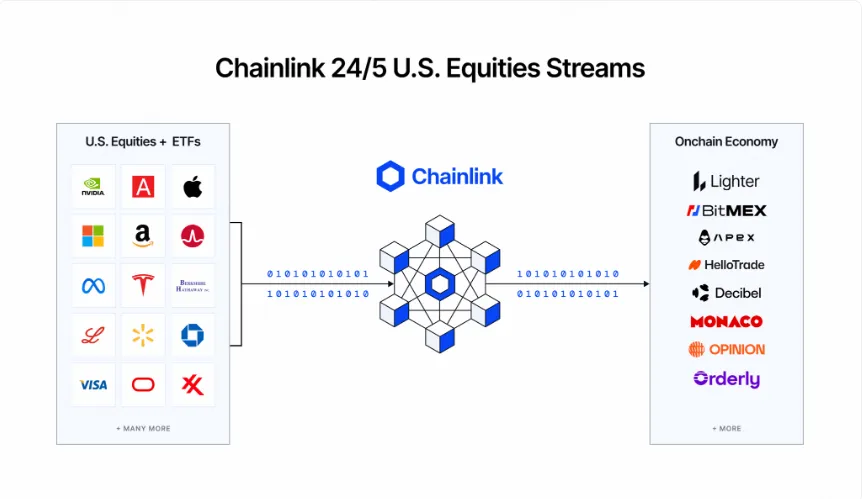
Image from Chainlink
AI Agents, Quantum Threats, and the Risks Ahead
Two of the most important emerging trends for smart contracts in 2026 are also among the most complex.
Agentic AI is reshaping how smart contracts operate in real time. AI-driven agents can now autonomously monitor risk parameters, adjust contract terms, and respond to market conditions without human intervention. This creates enormous efficiency gains, but it also introduces new attack surfaces and raises questions about accountability when an autonomous agent makes a costly mistake.
Quantum computing poses a longer-term but existential threat. IBM has announced IBM Quantum Starling, a fault-tolerant quantum system expected to arrive by 2029. Current blockchain encryption relies on mathematical problems that classical computers can't solve in reasonable time. Quantum computers could potentially break those protections, which means the entire industry needs to migrate to quantum-resistant cryptography before that threshold is crossed.
On the security front, history provides plenty of warnings:
- The D.A.O. hack saw an attacker siphon off one-third of a venture fund by exploiting a recursive call vulnerability in a smart contract.
- The CoinDash hack demonstrated how front-end manipulation could redirect funds during a token sale.
- Oracle manipulation attacks have become increasingly sophisticated, with attackers exploiting external data feeds to force favorable prices within smart contracts.
These incidents have pushed the industry toward more rigorous auditing practices, formal verification methods, and AI-augmented oracle systems that can detect and resist data manipulation in real time.
What the Next Phase of Smart Contracts Looks Like
The blockchain industry has a well-known adoption curve, and by most measures, smart contracts have now passed through the "Trough of Disillusionment." The hype-driven crashes, the headline-grabbing hacks, and the regulatory uncertainty haven't disappeared entirely. But they've been overtaken by a steady stream of institutional deployments that prove the technology works at scale.
The next phase will be defined by three forces working together. First, Real-World Asset tokenization will continue to accelerate as banks, real estate platforms, and asset managers bring trillions of dollars in traditionally illiquid assets on-chain. Second, cross-chain interoperability will mature to the point where moving value between Ethereum, Hedera, private enterprise chains, and legacy banking networks feels seamless. Third, AI-native smart contracts will shift from experimental to standard, with autonomous agents managing everything from portfolio rebalancing to insurance claim adjudication.
For anyone building, investing, or operating in this space, the signal is unmistakable. Smart contracts aren't an alternative financial system anymore. They're becoming the default infrastructure layer for how value moves, agreements execute, and trust gets established in the digital economy. The institutions that recognize this early will have a structural advantage. The ones that wait will spend the next decade catching up.