

The BLOK ETF holds Coinbase, Robinhood, Galaxy Digital, and Bitcoin miners in one NYSE-listed fund. Here is what it owns, how it performs, and why it matters in 2026.
What the BLOK ETF Is and the Problem It Was Built to Solve
The Amplify Blockchain Technology ETF, trading under the ticker BLOK on the NYSE, launched on January 16, 2018. At that moment, retail investors who believed in the long-term potential of blockchain technology had essentially two options: buy cryptocurrency directly, with all the volatility, custody, and tax complexity that entails, or stay on the sidelines and watch from traditional brokerage accounts.
BLOK was created to provide a third option. By building a portfolio of publicly traded companies with deep exposure to blockchain technology, including exchanges, miners, software companies, and fintech platforms, Amplify ETFs gave ordinary investors a way to get meaningful blockchain industry exposure through the familiar wrapper of an exchange-traded fund. It is purchasable through any standard brokerage account, including retirement accounts and advisory portfolios that cannot hold cryptocurrency directly.
The fund's formal mandate requires it to invest at least 80% of its net assets in equity securities of companies actively involved in the development and utilisation of blockchain technologies. The remaining 20% can include companies partnering with or investing in blockchain-focused firms, as well as indirect exposure to digital assets through vehicles like Bitcoin ETPs. The portfolio is actively managed, meaning human fund managers make ongoing decisions about what to hold, what to increase, and what to exit, rather than passively tracking an index.
That active management structure is both BLOK's primary differentiator and one of the reasons it carries a 0.70% annual expense ratio, higher than many passive ETFs but in line with other actively managed thematic funds.
A Pioneer That Predates the Crypto ETF Era
To appreciate what BLOK represented at its launch, the timeline matters. When BLOK went live in January 2018, Bitcoin spot ETFs were years away from regulatory approval in the United States. The SEC had rejected multiple Bitcoin ETF applications, citing concerns about market manipulation and the absence of regulated surveillance-sharing agreements. The institutional infrastructure that would eventually support direct crypto investment products simply did not exist.
BLOK was the first blockchain-focused equity ETF listed in the United States. It launched one week before the First Trust Indxx Innovative Transaction and Process ETF, making Amplify the trailblazer for an entirely new category of investment product. The fund's original name, the Amplify Transformational Data Sharing ETF, reflected the regulatory reality of 2018, when framing blockchain in terms of "data sharing" and "transformational technology" was more palatable to regulators than leading with cryptocurrency.
In October 2025, Amplify officially renamed the fund the Amplify Blockchain Technology ETF, acknowledging how dramatically the regulatory and mainstream perception of crypto had shifted since the fund's founding. By that point, Bitcoin spot ETFs were trading in the US with billions in daily volume, and the original positioning as a workaround had given way to a more direct statement of purpose.
The fund's eight-year track record as of early 2026 gives it something almost no competitor in its category has: a full market cycle of performance data, including the 2018 bear market, the 2020 COVID crash, the 2021 bull run, the 2022 crypto winter, and the subsequent recovery.
BLOK ETF vs BKCH vs DAPP: Blockchain ETFs Compared 2026

What BLOK Actually Holds: Inside the Portfolio
The BLOK ETF holds approximately 50 to 55 positions at any given time, spread across multiple categories of blockchain exposure. As of March 2026, the top 10 holdings collectively represent approximately 33.74% of total assets. The portfolio is deliberately diversified to avoid concentrating too heavily in any single name, which distinguishes it from more aggressive blockchain ETFs that may place 10% or more in a single position.
Galaxy Digital (GLXY) at 4.05%
Galaxy Digital is one of the most comprehensive institutional crypto companies in the market, operating as an asset manager, investment bank, trading desk, and blockchain infrastructure provider simultaneously. Founded by Mike Novogratz, Galaxy is heavily integrated across the crypto ecosystem. Its advisory work touches major token launches, its asset management arm holds significant Bitcoin positions, and its trading infrastructure serves institutional clients. For BLOK, Galaxy represents diversified crypto infrastructure exposure without the direct mining or pure-exchange risk of other holdings.
TeraWulf (WULF) at 3.80%
TeraWulf is a Bitcoin mining company with a notable differentiator: it mines Bitcoin using primarily nuclear and renewable energy sources. The company's Nautilus Cryptomine data centre operates adjacent to a nuclear generation facility in Pennsylvania, and its Lake Mariner facility is powered by hydroelectric generation. TeraWulf represents BLOK's exposure to the Bitcoin mining sector with a sustainability angle that differentiates it from pure fossil-fuel-dependent miners.
Cipher Mining (CIFR) at 3.51%
Cipher Mining is a Bitcoin mining company focused exclusively on large-scale US-based mining operations. Its inclusion alongside TeraWulf and Hut 8 reflects BLOK's significant weighting toward the Bitcoin mining sector, which has grown substantially as a component of the blockchain equity universe following the rise of institutional mining operations with public market listings.
Robinhood (HOOD) at 3.48%
Robinhood's presence in BLOK reflects the fund's broader definition of blockchain and crypto infrastructure. Robinhood's crypto trading revenue has grown significantly as a percentage of its total business, making it increasingly relevant as a crypto-adjacent holding. Robinhood also offers its users direct cryptocurrency trading including Bitcoin, Ethereum, and dozens of altcoins, and has been expanding its crypto product suite aggressively. Its positioning as a fintech platform with deep crypto integration sits in BLOK's secondary allocation category, covering companies that have invested substantially in blockchain-related revenue streams.
Hut 8 Corp (HUT) at 3.45%
Hut 8 is a North American digital asset mining company and one of the largest Bitcoin mining operations by hashrate in the industry. It has diversified its business model beyond pure mining into managed services, GPU computing, and data centre infrastructure, reflecting the evolution of mining companies into broader blockchain infrastructure providers.
Nu Holdings (NU) at 3.10%
Nu Holdings, the parent company of Nubank, represents BLOK's exposure to the intersection of fintech and crypto in emerging markets. Nubank is one of the largest digital-first banks in the world by customer count, operating across Brazil, Mexico, and Colombia. Its crypto product suite has been expanding, and its enormous Latin American retail customer base positions it as a significant potential driver of crypto adoption in markets with high unbanked populations. Nu Holdings is one of BLOK's more distinctive holdings, signaling the fund's active managers' conviction that crypto adoption in emerging market fintech is a meaningful sector theme.
IBM at 3.07%
IBM's inclusion in BLOK reflects the fund's commitment to holding enterprise blockchain technology alongside crypto-native companies. IBM has been one of the most active developers of enterprise blockchain applications through its Hyperledger Fabric work and the IBM Blockchain Platform, serving industries from supply chain to trade finance. IBM's blockchain revenue is entirely separate from cryptocurrency, focused on permissioned, enterprise-grade distributed ledger applications for large organizations. Its presence in BLOK gives the portfolio diversification against pure crypto market cycles and exposure to the institutional enterprise adoption of blockchain infrastructure.
Bed Bath and Beyond (BBBY) at 2.99%
The presence of Bed Bath and Beyond in a blockchain ETF looks surprising at first glance and deserves direct explanation. This position reflects a situation in which BLOK's active managers have taken a position tied to a corporate restructuring that involves digital asset or blockchain-related activities. Active ETF holdings like this are sometimes transitional positions or reflect specific restructuring thesis investments that go beyond the headline company name. Positions like this are one of the reasons why actively managed ETF holdings files warrant monthly review.
Core Scientific (CORZ) at 2.68%
Core Scientific is one of the largest publicly listed Bitcoin miners and data centre operators in North America. After emerging from bankruptcy in January 2024 following the 2022 crypto market collapse, Core Scientific has rebuilt its balance sheet and expanded its operations, including a major pivot toward AI and high-performance computing data centre services in addition to its Bitcoin mining. Its recovery trajectory has made it one of the stronger performing holdings in the mining sector.
Beyond the top 10, BLOK's portfolio includes other notable positions across the blockchain spectrum: Bitcoin mining companies including Riot Platforms and Marathon Digital Holdings, crypto-adjacent financial companies, international blockchain infrastructure players, and approximately 6.5% in Bitcoin ETPs directly, adding an additional layer of Bitcoin price sensitivity beneath the equity surface.
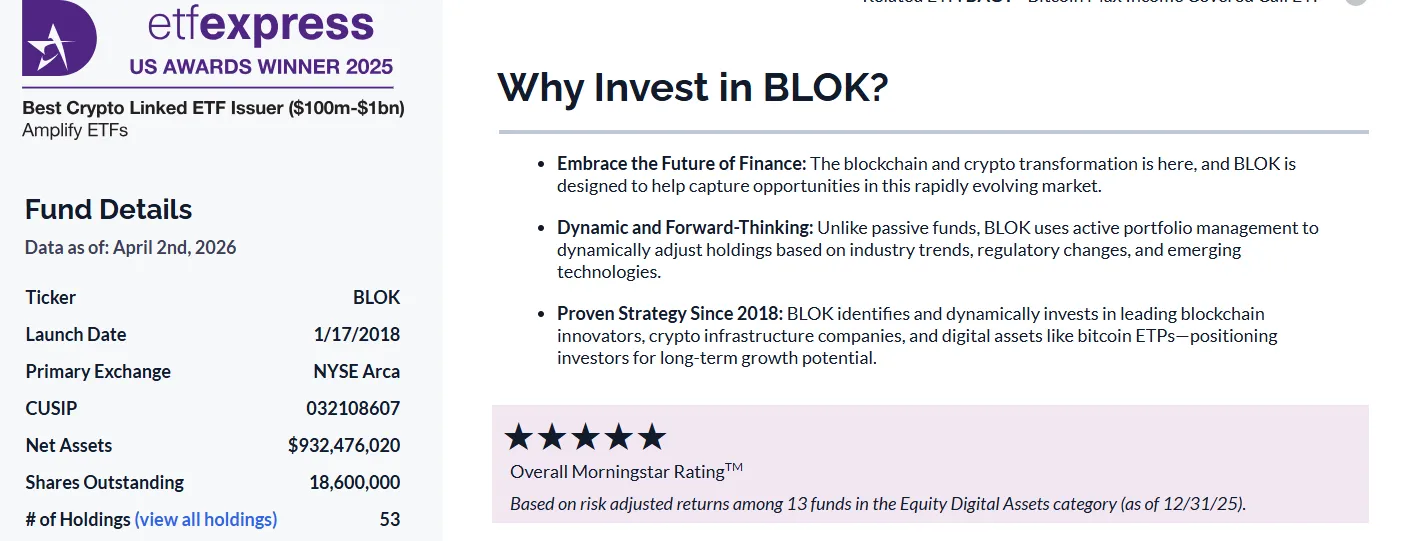
Image by Amplify ETF
The Sector and Geographic Breakdown
The BLOK ETF's portfolio divides approximately into two broad categories: technology companies at roughly 42% of the fund and financial services companies at roughly 39%, with the remainder spread across other sectors including energy and industrials where mining-adjacent companies sit.
Geographically, approximately 72% of the fund's holdings are North American companies. The remaining 28% provides international exposure, particularly to companies in Asia and Europe where blockchain infrastructure development, mining operations, and digital asset exchanges are headquartered. Metaplanet, the Japanese company that has adopted a Bitcoin treasury strategy similar to Strategy (formerly MicroStrategy), has appeared among top holdings in recent periods, reflecting the active managers' willingness to include international Bitcoin treasury plays alongside the core US-listed names.
Performance: What the Numbers Show
BLOK's performance history is one of the most useful things about it, precisely because eight years of data captures multiple market cycles.
Since its inception in January 2018 through early 2026, the fund has delivered an average annual return of approximately 15.33%, which compares favourably with the S&P 500's long-run average of approximately 10% annually, though with substantially higher volatility. The three-year annualised return stands at approximately 52.4% as of March 2026, reflecting the powerful bull run in crypto-adjacent equities from 2023 onward. The five-year annualised return sits at approximately 2.9%, a figure that captures the brutal 2022 drawdown's impact when crypto-related equities broadly fell 70% to 90% from peak to trough.
BLOK reached a 52-week high of $75.89 and a 52-week low of $31.32, a range that illustrates the volatility inherent in blockchain equity exposure. As of late March 2026, BLOK traded at approximately $50.66 to $52.01, with AUM of approximately $988 million to $1.02 billion depending on the data source. Since inception through late January 2026, the fund had increased in value by approximately 200.47% in total.
Amplify's own disclosure shows the fund was ranked first by risk-adjusted returns among 13 funds in the Equity Digital Assets category as of December 31, 2025. The fund was also nominated for multiple awards at the With Intelligence Mutual Fund and ETF industry ceremony in January 2026, and Amplify ETFs as a whole reported 70% AUM growth in 2025.
The beta of approximately 2.10 relative to the broader market tells the core risk story: BLOK tends to move roughly twice as much as the S&P 500 in both directions. When risk-on sentiment dominates and Bitcoin rallies, BLOK tends to dramatically outperform. When crypto sentiment deteriorates, BLOK can fall sharply even when the broader market is stable or rising. The 13.46% single-month decline during February 2026, when Bitcoin dropped roughly 19% in two days, illustrates this sensitivity directly.
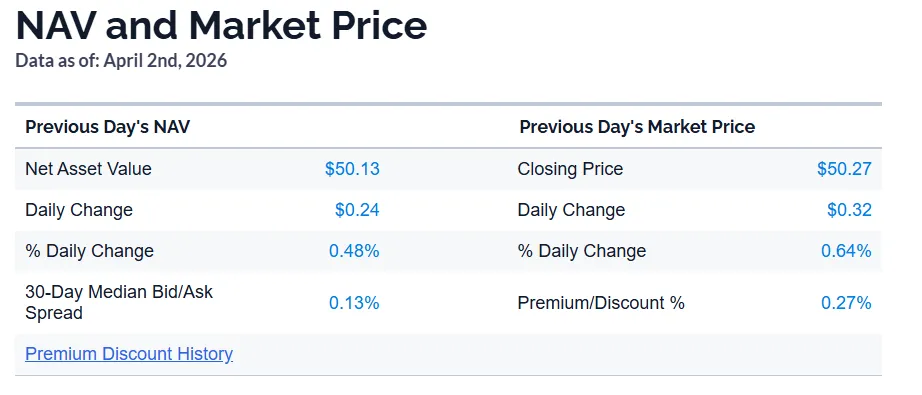
Image by Amplify ETF
Why the BLOK ETF Matters for the Crypto and Blockchain Community
The BLOK ETF's significance extends beyond its performance numbers. It represents something important for how the broader financial system interfaces with blockchain technology and crypto infrastructure.
It created a regulated, mainstream investment pathway. Before BLOK, an advisor managing a pension fund or a retirement account could not provide clients with blockchain industry exposure without recommending direct cryptocurrency purchases, which many fiduciaries were uncomfortable doing. BLOK created a familiar, regulated product wrapper around the same economic exposure, making blockchain industry investment accessible to the advisor community, registered investment advisers, and retirement account holders who operate under standards that constrain direct crypto investment.
It validated the blockchain infrastructure thesis. Every year that BLOK accumulated AUM, attracted institutional shareholders, and maintained analyst coverage was a year in which the investment community implicitly validated that the companies building blockchain infrastructure, including exchanges, miners, software platforms, and fintech integrators, represent a legitimate and investable sector. This institutional recognition feeds back into the credibility of the underlying companies and the technology they are building.
It forced transparency on blockchain company performance. Because BLOK invests exclusively in publicly listed companies, the economic performance of blockchain infrastructure has to be disclosed quarterly to regulators and shareholders. This creates a layer of accountability and performance transparency that purely crypto-native projects and private companies do not face. Investors in BLOK can read Coinbase's quarterly filings, Marathon Digital's revenue reports, and Galaxy Digital's balance sheets, all disclosed to the SEC, rather than relying solely on on-chain metrics.
It demonstrated that blockchain exposure does not require crypto custody. One of the persistent barriers to institutional crypto participation has been the technical and compliance complexity of cryptocurrency custody, including private key management, exchange counterparty risk, and regulatory uncertainty around asset classification. BLOK proved that meaningful economic exposure to blockchain technology growth can be obtained entirely within the existing securities infrastructure, with standard brokerage accounts and SIPC protections. This insight has informed the design of many subsequent blockchain equity ETFs.
It preceded the spot Bitcoin ETF era. When US spot Bitcoin ETFs launched in January 2024, the investment infrastructure for connecting traditional finance to crypto was already partially built, partly because funds like BLOK had been operating in the space for six years and training advisors and institutions to think about crypto exposure as an investable allocation within a traditional portfolio.
The Bitcoin Correlation: Understanding BLOK's Core Risk
One characteristic of BLOK that any potential investor must understand is its deep sensitivity to Bitcoin's price. This correlation runs through the fund in multiple layers.
The most obvious layer is direct: the fund holds roughly 6.5% in Bitcoin ETPs, giving it direct BTC price exposure. The second layer runs through the miners. TeraWulf, Cipher Mining, Hut 8, Core Scientific, Riot, and Marathon Digital all generate revenue in Bitcoin and hold Bitcoin on their balance sheets. When Bitcoin's price rises, their earnings and net asset values rise dramatically. When Bitcoin falls, mining margins compress and balance sheet values drop. The third layer runs through Coinbase, where trading volumes on crypto exchanges are closely correlated with Bitcoin price trends, meaning Coinbase revenue rises and falls with the market.
A Seeking Alpha analysis estimated that approximately 43% of BLOK's portfolio is tied to crypto-related assets. That concentration creates genuine upside in crypto bull cycles and genuine downside risk in bear periods. The fund's beta of 2.10 reflects this. BLOK is not a diversified technology fund that happens to include some blockchain exposure. It is a focused blockchain and crypto infrastructure fund that happens to sit within a traditional ETF wrapper.
For investors who understand this and deliberately want that exposure, hedged slightly by enterprise blockchain names like IBM and emerging market fintech like Nu Holdings, BLOK delivers that profile in a familiar and accessible format. For investors who want broader technology diversification without heavy crypto correlation, the fund is not the right tool.