The cryptocurrency derivatives market has evolved dramatically since Bitcoin's early days, and as of February 2026, with the total crypto market cap hovering around $2.3-2.6 trillion following a significant correction from October 2025's peak of $4.38 trillion, understanding the different types of futures contracts has become more critical than ever.
Two primary contract types dominate crypto derivatives trading on platforms like LBank: perpetual contracts and quarterly (delivery) futures. Each serves distinct purposes and suits different trading strategies. This comprehensive guide will help you understand both contract types, their key differences, and which one aligns best with your trading goals.
At a Glance: Perpetual vs. Quarterly Futures
Feature | Perpetual Contracts | Quarterly Futures |
|---|
Expiration | None (Indefinite) | Fixed Date (e.g., Dec 26) |
Price Anchor | Funding Rates | Convergence at Expiry |
Cost Basis | Variable (Funding payments) | Predictable (No funding) |
Best For | Active Scalping & Day Trading | Long-term Hedging & Basis Trading |
Max Leverage | 125x on LBank Futures | Typically lower/conservative |
What Are Futures Contracts in Cryptocurrency?
Before diving into the specific types, it's important to understand what futures contracts are and why they've become central to cryptocurrency trading.
A futures contract is an agreement to buy or sell an asset at a predetermined price on a specific future date—or in the case of perpetual contracts, an agreement without an expiration date that tracks the spot price through a different mechanism. Unlike spot trading, where you actually purchase and own the cryptocurrency, futures trading involves speculating on price movements without taking custody of the underlying asset.
Futures contracts offer several advantages, including leverage that allows you to control larger positions with less capital, the ability to profit from both rising and falling markets through long and short positions, superior liquidity on major platforms compared to spot markets, and hedging capabilities for protecting existing spot positions.
The cryptocurrency futures market has matured significantly. In 2026, institutional participation through spot Bitcoin and Ethereum ETFs has created interconnected derivatives markets where futures trading volume regularly exceeds spot volume, providing ample liquidity for both contract types.
Perpetual Contracts: No Expiration, Maximum Flexibility
Perpetual contracts, also called perpetual swaps or perpetuals, are the most popular derivative product in cryptocurrency trading. They were pioneered by crypto exchanges and represent an innovation not found in traditional financial markets.
How Perpetual Contracts Work
The defining characteristic of perpetual contracts is that they never expire. You can hold a perpetual contract position for as long as you want—hours, days, months, or even years—provided you maintain sufficient margin to avoid liquidation.
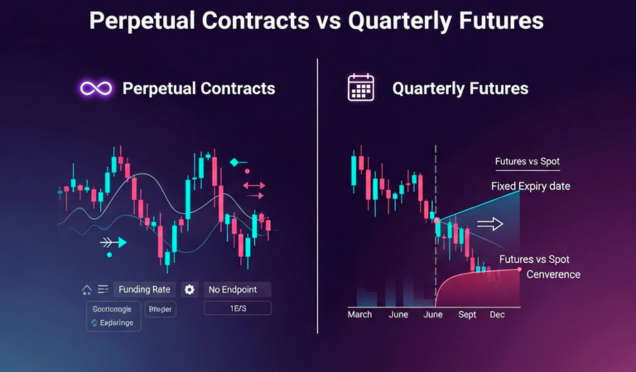
Since there's no expiration date and no settlement, perpetual contracts use a mechanism called the funding rate to keep their price anchored to the spot market price. The funding rate is a periodic payment (typically every 8 hours on LBank and most exchanges) exchanged between traders holding long positions and those holding short positions. Traders can monitor real-time LBank Funding Rates directly on the trading interface to anticipate potential costs or income before opening a position.
When the perpetual contract trades at a premium to the spot price (indicating more bullish sentiment), the funding rate becomes positive, meaning long position holders pay short position holders. This payment incentivises traders to open shorts and close longs, bringing the perpetual price back in line with spot.
When the perpetual contract trades at a discount to the spot price (indicating bearish sentiment), the funding rate becomes negative, meaning short position holders pay long position holders. This encourages traders to open longs and close shorts, again anchoring the price to spot.
Key Features of Perpetual Contracts
No Rollover Required: Unlike quarterly futures, you never need to close and reopen positions as contracts approach expiration. Your position remains open indefinitely as long as you maintain margin requirements.
High Leverage Availability: LBank offers up to 125x leverage on perpetual contracts, though beginners should start with much lower leverage (2x-10x) to manage risk appropriately. This high leverage enables significant capital efficiency but also amplifies both gains and losses.
Funding Rates as Cost/Income: Depending on market sentiment, you either pay or receive funding rates. During strong bull markets, long positions typically pay shorts, making it expensive to hold long positions for extended periods. In bear markets or neutral conditions, shorts often pay longs.
Immediate Price Response: Perpetual contracts react instantly to spot market movements and news events, making them ideal for active traders who want to capitalise on short-term volatility.
24/7 Trading: Like all crypto derivatives, perpetual contracts trade around the clock, allowing you to enter and exit positions at any time, regardless of traditional market hours.
Ideal Use Cases for Perpetual Contracts
Perpetual contracts excel in several trading scenarios. They're perfect for day trading and scalping, where traders make multiple trades within a single day or even an hour. The absence of expiration dates means you can hold positions for exactly as long as your trading setup requires without worrying about contract rollover.
Short-term speculation benefits from perpetuals' responsiveness to market movements. When you have a strong conviction about Bitcoin's direction over the next few days or weeks, perpetual contracts offer the most direct way to express that view with leverage.
Active position management is easier with perpetuals. Since you're not constrained by an expiration date, you can adjust your position size, move stop losses, or partially take profits without the complications of managing multiple contract months.
Hedging short-term spot holdings works well with perpetuals. If you hold Bitcoin on LBank's spot wallet but expect short-term volatility, opening a short perpetual position provides immediate downside protection without requiring you to sell your spot holdings.

IMAGE: by Author
Quarterly Futures: Defined Expiration, Convergence Pricing
Quarterly futures, also called delivery futures or dated futures, are traditional futures contracts with set expiration dates, typically at the end of each calendar quarter (March, June, September, December).
How Quarterly Futures Work
Quarterly futures have a predetermined settlement date when the contract expires and settles. On LBank and most crypto exchanges, these contracts settle in cash rather than physical delivery of cryptocurrency. At expiration, the futures price converges to the spot index price, and positions are automatically settled based on that final settlement price.
Unlike perpetual contracts that use funding rates, quarterly futures maintain their price relationship to spot through convergence dynamics. As the expiration date approaches, the futures price naturally converges toward the spot price because traders know the contract will settle at the spot price. This convergence eliminates the basis (the difference between futures and spot price) by the settlement date.
The futures price can trade at a premium (contango) or discount (backwardation) to the spot price based on market expectations. In bull markets, quarterly futures often trade at a premium reflecting expected price appreciation. In bear markets or during market stress, they might trade at a discount.
Key Features of Quarterly Futures
Defined Settlement Date: You know exactly when your position will settle. This certainty helps with planning multi-month strategies and understanding your risk horizon.
No Funding Rates: Unlike perpetuals, you never pay or receive funding payments. Your costs are limited to trading fees and the spread between futures and spot prices. This makes quarterly futures more cost-predictable for long-term positions.
Price Basis Management: The difference between futures and spot price (the basis) represents market sentiment and time value. Understanding and trading the basis can be a profitable strategy in itself.
Rollover Requirement: To maintain a position beyond expiration, you must close your current quarter's contract and open a new one in the next quarter. This rollover process involves trading costs and potential slippage.
Leverage Options: LBank typically offers substantial leverage on quarterly futures, though often slightly less than on perpetuals. The defined expiration provides a clear risk timeframe that some traders prefer.
Ideal Use Cases for Quarterly Futures
Quarterly futures shine in specific trading scenarios. They're excellent for long-term directional views where you believe Bitcoin or another cryptocurrency will move significantly over the next 1-3 months. The absence of funding rates means your view plays out without the daily cost of funding payments eroding your position.
Hedging long-term spot positions works better with quarterly futures when you have a specific time horizon in mind. If you hold a substantial Bitcoin position and want to hedge against a downturn until after a major regulatory decision in two months, a quarterly futures short matches that timeline perfectly.
Basis trading and arbitrage opportunities exist between quarterly futures and spot prices. Sophisticated traders exploit these price differences, buying spot and selling overpriced futures (or vice versa) to lock in risk-free profits.
Tax and accounting considerations may favour quarterly futures in some jurisdictions. The defined settlement dates create clear taxable events that simplify record-keeping compared to the ongoing funding payments of perpetuals.
Corporate treasury management and institutional hedging often prefer quarterly futures because they align with quarterly business cycles and reporting periods.

IMAGE: by Author
Direct Comparison: Perpetual vs. Quarterly Futures
To help you quickly understand the key differences, here's a comprehensive comparison:
Feature | Perpetual Contracts | Quarterly (Delivery) Futures |
|---|
Expiration | None; hold indefinitely | Fixed date (end of quarter) |
Price Anchor | Funding rates (every 8 hours) | Convergence to spot at expiry |
Rollover | Not required | Required to maintain position |
Funding Costs | Variable; can be income or expense | None; no funding payments |
Best For | Day trading, scalping, short-term trades | Long-term holds, hedging with a timeline |
Leverage on LBank | Up to 125x | Up to 100x (typically) |
Price Volatility | Tracks spot closely | Can diverge significantly from spot |
Cost Predictability | Low (funding varies daily) | High (only trading fees) |
Position Management | Continuous adjustment | Quarterly rollover events |
Ideal Holding Period | Hours to weeks | Weeks to months |
Market Liquidity | Generally higher | Lower but sufficient for most traders |
The 2026 Market Context: Why Contract Choice Matters More Now
The current market environment in early 2026 makes understanding these contract differences particularly important. Following the dramatic correction from October 2025's peak when Bitcoin reached $126,000, and the total crypto market cap exceeded $4.38 trillion, markets have entered a more volatile, uncertain phase.
Bitcoin has fallen nearly 50% from its peak, trading around $88,000 in early February 2026, while the total crypto market cap has declined to approximately $2.3 trillion. This heightened volatility creates both opportunities and risks for futures traders.
Funding Rate Dynamics in Current Markets: During the recent correction, perpetual funding rates have swung wildly. In the initial panic selling of late January, funding rates turned deeply negative as shorts dominated, meaning short position holders were paying longs. Astute traders who went long during this period not only potentially profited from the bounce but also collected funding payments.
However, during brief recovery rallies, funding flipped positive as retail FOMO returned, creating expensive conditions for maintaining long positions. This volatility in funding rates makes perpetual contracts more complex to manage in choppy markets.
Quarterly Futures as Volatility Shelters: The absence of funding rates makes quarterly futures more attractive during periods of high volatility and uncertainty. If you have a medium-term bullish or bearish view but don't want to pay daily funding rates in a choppy market, quarterly contracts provide cleaner exposure.
ETF Impact on Futures Markets: The ongoing maturation of Bitcoin and Ethereum spot ETFs has created tighter linkages between spot and derivatives markets. ETF flows now significantly influence futures pricing and basis dynamics. Large ETF outflows can pressure futures prices, creating temporary dislocations that skilled traders can exploit.
Leverage: Power and Peril in Both Contract Types
Both perpetual and quarterly futures offer substantial leverage on LBank, but this amplification cuts both ways. Understanding how leverage works differently in each contract type is crucial.
Leverage in Perpetual Contracts: With up to 125x leverage available, you can control $125,000 worth of Bitcoin with just $1,000 in margin. This extreme leverage means a 0.8% adverse price move can liquidate your entire position. While such high leverage creates opportunities for experienced traders, most should use much lower leverage (5x-20x) to maintain an adequate buffer against market volatility.
The ongoing funding payments at high leverage can significantly impact profitability. If you're 50x long Bitcoin and funding rates are 0.1% every 8 hours (not uncommon in strong bull markets), you're paying 0.3% daily or roughly 9% monthly on your position size. This erosion can turn profitable trades into losses if held too long.
Leverage in Quarterly Futures: Typically capped at around 100x on LBank, quarterly futures offer substantial leverage without the funding rate complexity. Your costs are predictable—entry fees, exit fees, and the basis between futures and spot. This simplification makes risk calculation more straightforward for position sizing.
However, as expiration approaches, the convergence to spot price can work for or against you depending on whether you're long or short and whether the contract was trading at a premium or discount. Understanding this convergence dynamic is essential for managing quarterly positions.
Risk Management Across Contract Types: Regardless of which contract type you choose, never use maximum available leverage. Professional traders typically use 2x-10x leverage even when much higher leverage is available. Higher leverage should be reserved only for very short-term trades with tight stop losses, and only by experienced traders who fully understand liquidation dynamics.
Trading Costs: Beyond the Spread
Understanding the total cost of holding positions helps you choose the right contract type for your strategy.
Perpetual Contract Costs: Trading fees on LBank for perpetual contracts typically consist of a maker fee (for adding liquidity with limit orders) and a taker fee (for removing liquidity with market orders). These fees are competitive across exchanges, usually ranging from 0.02% to 0.075% depending on your trading volume tier.
However, funding rates represent the primary ongoing cost or income. In strong trending markets, funding rates can reach 0.1% to 0.3% every 8 hours, translating to 0.3% to 0.9% daily. Over a month, these compounds have significantly. During the bull run of late 2025, long position holders sometimes paid 10-15% monthly in funding, substantially eroding profits.
Conversely, during market panics, funding rates flip negative, and holding long positions actually generates income. In early February 2026's selloff, longs received funding payments as shorts became overcrowded.
Quarterly Futures Costs: Trading fees for quarterly futures are similar to perpetuals. However, you pay these fees less frequently if holding positions long-term since you're not constantly entering and exiting.
The main cost consideration is the basis—the difference between the futures price and spot price. If you buy quarterly futures at a 5% premium to spot and hold to expiration, that 5% premium effectively disappears as the contract converges to spot. This can be viewed as a form of time-decay similar to options.
However, basis can also work in your favour. If quarterly futures are trading at a discount due to market fear, buying them cheap and holding to convergence provides additional profit beyond any price appreciation.
Cost Comparison Example: Suppose you want to hold a long Bitcoin position for 60 days during a bull market. With perpetual contracts at average funding rates of 0.05% per 8 hours (0.15% daily), you'd pay approximately 9% over 60 days in funding. With quarterly futures trading at a 6% premium to spot, your effective cost is limited to that 6% premium plus trading fees. In this scenario, quarterly futures would be cheaper for the long-term hold.
Conversely, if you're holding for just 3 days and quarterly futures have a 5% premium, you'd pay that full 5% plus fees. Perpetual funding over 3 days at 0.15% daily would only cost 0.45%. Here, perpetuals are clearly cheaper.
Practical Trading Strategies for Each Contract Type
Let's explore specific strategies suited to each contract type on LBank's platform.
Perpetual Contract Strategies
Momentum Scalping: Enter positions during strong directional moves, hold for minutes to hours, and exit at target profit levels. The lack of expiration allows you to stay in winning trades without worrying about rollover. Use tight stop losses and moderate leverage (10x-20x).
Funding Rate Arbitrage: When funding rates become extreme (above 0.2% per 8 hours), consider taking the opposite position to collect funding while hedging in spot or on other exchanges. This strategy profits from market extremes while staying relatively market-neutral.
News Trading: Perpetuals' instant responsiveness to news makes them ideal for event-driven trading. When major news breaks, perpetual contracts reflect the impact within seconds, allowing you to capitalise on volatility.
Multi-Timeframe Swing Trading: Use perpetuals for swing trades lasting days to weeks. Monitor funding rates daily and be prepared to close positions if cumulative funding costs threaten to exceed your profit targets.
Quarterly Futures Strategies
Carry Trade: When quarterly futures trade at significant premiums (contango), sophisticated traders can short the futures and buy spot, locking in the basis as profit when the contract converges at expiration. This requires adequate capital for both positions but offers relatively low-risk returns.
Seasonal Positioning: Bitcoin and crypto markets show some seasonal patterns (though less pronounced than in 2026's volatile environment). Using quarterly contracts allows you to position for expected trends (like year-end rallies or tax-loss selling) without paying daily funding.
Corporate Hedging: If you're a crypto business with revenue in cryptocurrency, quarterly futures allow you to lock in conversion rates for future expenses, providing predictable cash flow management aligned with quarterly business cycles.
Long-Term Directional Bets: When you have strong conviction about multi-month trends based on fundamental analysis (like upcoming halvings, regulatory changes, or institutional adoption waves), quarterly futures offer clean exposure without funding erosion.

IMAGE: by Author
Risk Management Essentials for Both Contract Types
Regardless of which contract type you trade, robust risk management is non-negotiable.
Position Sizing: Never risk more than 1-2% of your trading capital on any single trade. With leverage, this means your position size should be calculated to ensure your stop loss distance only risks 1-2% of your account. LBank's position calculator can help you determine appropriate sizing.
Stop Loss Placement: Always use stop losses. For perpetual contracts, place stops beyond key technical levels to avoid getting stopped out by normal volatility. For quarterly futures, account for basis volatility when setting stops—the futures price can move more than spot during volatile periods.
Liquidation Price Awareness: Constantly monitor your liquidation price. Market volatility in 2026 has resulted in rapid liquidation cascades where one liquidation triggers others. Keep your liquidation price far enough from the current price to weather normal volatility.
Diversification: Don't concentrate all capital in one contract type or one cryptocurrency. Spread risk across multiple positions, contract types, and assets to reduce correlation risk.
Market Condition Adaptation: Adjust your strategy and leverage based on market volatility. During the calm periods of late 2025, higher leverage was safer. In early 2026's volatile environment, reducing leverage and using wider stops makes sense.
Common Mistakes to Avoid
New derivatives traders frequently make costly errors that can be avoided with awareness.
Ignoring Funding Rates: Many beginners use perpetual contracts without understanding funding costs. They enter a profitable trade but watch gains erode over weeks due to funding payments. Always factor funding into your profit calculations and expected hold time.
Forgetting Expiration Dates: Quarterly futures traders sometimes forget their contract expires, resulting in unexpected settlements. Mark expiration dates on your calendar and decide in advance whether to close, rollover, or let the position settle.
Overleveraging: The availability of 125x leverage doesn't mean you should use it. Most professional traders use 5x-20x maximum. Higher leverage creates enormous stress and leads to emotional decision-making when positions move against you.
Poor Timing on Rollovers: Rolling quarterly futures positions from one contract to the next requires careful timing. Roll during periods of high liquidity and favourable basis to minimise costs. Don't wait until the last day before expiration when liquidity may be poor.
Neglecting Basis Dynamics: Failing to understand how basis affects your quarterly futures position leads to surprises. Monitor the basis regularly and understand whether you're paying or receiving a premium relative to spot.
Advanced Concepts: Combining Contract Types
Sophisticated traders often use both contract types simultaneously to optimise their strategies.
Long Perpetual + Short Quarterly: If you're bullish short-term but neutral long-term, you might hold a long perpetual position while also maintaining a short quarterly position. This combination profits from near-term upside while hedging against medium-term downside.
Calendar Spreads: Trading the difference between two quarterly contracts (like March vs. June futures) allows you to profit from changes in the term structure without taking directional risk. This advanced strategy requires a deep understanding of basic dynamics.
Perpetual for Entry, Quarterly for Hold: Enter positions using perpetual contracts for their liquidity and flexibility. Once the trade moves in your favour and you want to hold longer-term, close the perpetual and open an equivalent quarterly position to eliminate funding costs.
Resources and Tools on LBank
LBank provides comprehensive resources to help you succeed with both contract types.
Contract Specifications: Before trading, review LBank's detailed contract specifications for each trading pair. Understand the margin requirements, liquidation mechanisms, settlement procedures, and fee structures. This information is available in the Futures Trading User Guide on LBank's website.
Fee Structure Transparency: LBank publishes its complete fee schedule for perpetual and quarterly contracts. Higher-volume traders can qualify for reduced fees, improving profitability. Review the LBank Futures Fee Structure regularly to understand your actual trading costs.
Risk Calculators: Use LBank's built-in calculators to determine position size, liquidation price, and profit/loss scenarios before entering trades. These tools help you visualise risk and make informed decisions.
Educational Resources: LBank offers tutorials, webinars, and guides specifically for futures trading. Take advantage of these resources to deepen your understanding before risking significant capital.
Demo Trading: Practice with LBank's demo account to experience both contract types without real money at risk. This is invaluable for understanding funding dynamics, rollover procedures, and platform mechanics.
Conclusion: Choosing Your Contract Type
The choice between perpetual contracts and quarterly futures isn't about one being universally better—it's about matching the contract type to your specific trading style, time horizon, and market conditions.
Choose Perpetual Contracts if you're day trading or scalping, you want maximum flexibility without expiration concerns, you need to actively manage positions with frequent adjustments, you're comfortable monitoring and paying/receiving funding rates, or you're trading short-term volatility and news events.
Choose Quarterly Futures if you're holding positions for weeks to months, you want cost predictability without ongoing funding fees, you're implementing hedging strategies with specific time horizons, you're executing basis trading or arbitrage strategies, or you prefer quarterly settlement cycles for tax or accounting purposes.
Consider Using Both if you're an active trader managing multiple strategies, you want to optimise costs by using the cheapest contract for each situation, you're implementing complex hedging or arbitrage strategies, or you're building experience across all derivative types available on LBank.
The cryptocurrency derivatives market in February 2026, with its heightened volatility following the recent correction from all-time highs, offers tremendous opportunities for informed traders who understand their tools. Whether you choose perpetual contracts for their flexibility, quarterly futures for their cost predictability, or both for maximum strategic options, the key is understanding how each instrument works and applying them thoughtfully within a disciplined risk management framework.
Start with smaller positions, use conservative leverage, track your results meticulously, and continuously learn from both successes and failures. With the knowledge from this guide and the robust trading infrastructure LBank provides, you're well-equipped to navigate the exciting world of cryptocurrency futures trading in 2026 and beyond.
Ready to test your strategy? Whether you prefer the flexibility of LBank Perpetual Swaps or the predictable costs of Quarterly Futures, you can start today with as little as 5 USDT. Visit LBank Futures to view real-time funding rates and market depth