
Zora's token economy: how creators earn money, source: Zora
What is Zora? Why This Onchain Social Network Suddenly Matters
Zora is an onchain social network and decentralized protocol built for creating, discovering, and trading digital media. The project launched in 2020 as a traditional NFT marketplace, but it has since evolved into something much bigger. Today, Zora describes itself as a "hyperstructure" for the internet-native creator economy. This means it provides the foundational infrastructure that allows creators to tokenize their content and identity without relying on centralized platforms.
The ecosystem runs on two primary layers that work together. The first is the Zora Protocol, which is an open-source and permissionless smart contract infrastructure. The second is the $ZORA token, an ERC-20 token deployed on Base Network. This token incentivizes activities across the platform, rewards creators for their work, and provides liquidity for newly issued creator markets. The combination of these layers creates a system where social engagement directly translates into economic value.
How Much Funding Did Zora Raise and Who Backed It?
Zora has secured substantial funding to build its blockchain infrastructure. The company raised approximately $62.6 million across four preferred share rounds. The biggest milestone came in April 2022 when Haun Ventures led a $50 million Series C round. Coinbase Ventures and Kindred Ventures also participated in this funding. By May 2022, the project carried a valuation of $600 million.
The financial picture has improved significantly over the past few years. In 2023, the company changed its revenue model to charge a flat fee of roughly $1.44 per NFT mint. This shift proved successful. During 2024, Zora generated $17 million in revenue while recording a net loss of only $2.7 million. Compare this to 2022, when the company posted a net loss of $14.4 million. The numbers show clear movement toward financial stability.
How Zora Works on Base: Architecture, Fees, and Scalability Explained
Zora operates on Base, which is an Ethereum Layer-2 network built using the OP Stack. This choice matters because Base offers near-zero gas fees and high transaction throughput. For a social platform where thousands of micro-transactions happen every day, low costs are essential. Users can interact, create, and trade without worrying about expensive fees eating into their activities.
The technical design includes several important components:
- Optimistic Rollup: Base processes transactions off-chain and then batches them to Ethereum Mainnet. This approach inherits Ethereum's security while dramatically reducing costs for users.
- 0x Swap API Integration: The ecosystem involves complex multi-hop trades. For example, someone might swap USDC to $ZORA to a Creator Coin to a Post Coin. Zora uses 0x's custom routing architecture to handle these trades with low latency across millions of daily-created liquidity pools.
- Proof-of-Stake Consensus: The $ZORA token benefits from the energy-efficient PoS mechanism that powers the underlying Ethereum network.
Zora’s SocialFi Model Explained: How Creators Actually Make Money
Zora pioneered what many now call the "SocialFi" paradigm. This model directly connects social engagement with economic value. Every interaction on the platform has the potential to generate real financial returns for creators and participants.
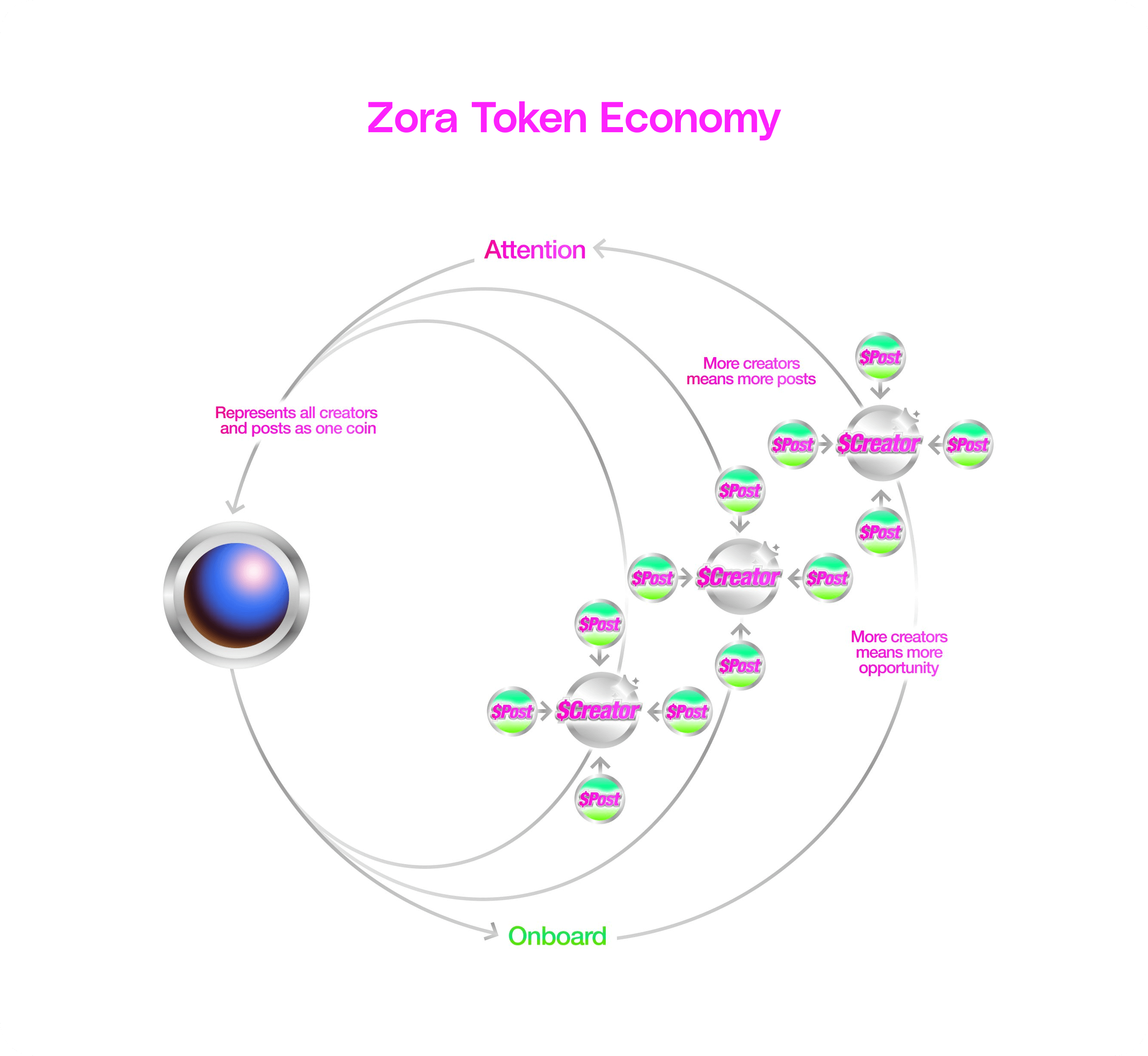
The system works through tokenized social elements. Every user profile exists as an ERC-20 token called a Creator Coin. Individual posts are also minted as tokens and linked back to their creator's token. This creates a layered token economy where value flows throughout the entire content ecosystem.
The economic flywheel gives creators ongoing incentives to participate. Creators earn 1% of every trade involving their tokens. On top of this, 50% of their Creator Coin supply streams to them over a five-year period. This design encourages long-term content creation rather than short-term speculation. Creators benefit most when they build genuine audiences and produce quality content consistently.
Who Built Zora? Inside the Team Behind the SocialFi Experiment
Jacob Horne serves as the CEO and co-founder of Zora Labs, Inc. Before starting Zora, he worked as a product lead at Coinbase and helped build USDC. His vision for Zora came from wanting to move beyond what he calls "platform capitalism." In traditional social media, centralized companies extract value from creators while controlling their content and audiences. Horne wanted to flip this model so creators could own everything they produce.
The leadership team also includes LaDarius "Dee" Goens as COO, who manages business operations and strategy. Tyson Battistella holds the CTO position and leads all technical development of the protocol. This combination of crypto industry experience and technical expertise has helped position Zora as a serious player in the SocialFi space.
How Zora is Redefining the Creator Economy | Jacob Horne
$ZORA Tokenomics Explained: Supply, Distribution, and What It Really Controls
The $ZORA token has a fixed total supply of 10,000,000,000 units. All of these tokens are currently in circulation. Zora Labs, Inc. retained 1,999,999,887 $ZORA tokens from the initial distribution. These numbers establish clear boundaries for the token economy.
| Metric | Value |
| Total Supply | 10,000,000,000 $ZORA |
| Circulating Supply | 10,000,000,000 $ZORA |
| Issuer Retention | 1,999,999,887 $ZORA |
| Network | Base (Ethereum L2) |
| Token Standard | ERC-20 |
Users hold their tokens in non-custodial wallets, meaning Zora Labs does not maintain custody of any holder funds. The $ZORA token contract is immutable after deployment. This means the company cannot modify, pause, or upgrade the contract once it goes live. This immutability provides security guarantees but also means any bugs discovered later cannot be patched.
Zora’s Recent Growth: Base App Integration, Mint.fun, and Usage Explosion
The past year brought several significant milestones for Zora. In July 2024, Zora integrated with Coinbase's Base App. This integration caused an explosion in activity. Daily token creation jumped from 6,000 tokens per day to nearly 50,000 tokens per day. The platform also acquired Mint.fun from Context Inc. during 2024, eliminating a competitor while expanding capabilities.
On the regulatory front, Zora Labs filed a whitepaper in August 2025 to comply with the EU's Markets in Crypto-Assets Regulation (MiCAR). This filing seeks admission to trading within the European Economic Area.
Is $ZORA Risky? Key Regulatory, Market, and Technical Risks
Investing in $ZORA comes with several critical risks that deserve attention. The official documentation explicitly states these concerns, and anyone considering the token should evaluate them carefully.
Regulatory uncertainty remains a major factor. Laws in both the US and EU continue evolving. MiCAR implementation could impose new restrictions or require licenses that Zora Labs might not secure. Market volatility also poses challenges. The documentation describes $ZORA as intended for "entertainment and social engagement." The token may lose some or all of its value.
Technical risks deserve special consideration. Because the token contract is immutable, any bugs or vulnerabilities discovered after deployment cannot be patched by Zora Labs. The company has "no admin keys," so they cannot reverse fraudulent transactions or recover lost private keys for users. Additionally, $ZORA is not covered by EU investor compensation or deposit guarantee schemes.
Zora vs Traditional Social Media: Why Creators Are Paying Attention
The differences between Zora's approach and traditional social media reveal why this project attracts attention from the crypto community.
| Feature | Traditional Social Media | Zora Protocol |
| Content Ownership | Platform owns content and data | Creators own content via tokens |
| Monetization Model | Ad-based revenue and subscriptions | Trading fees (1%) and token equity |
| Architecture | Siloed "walled gardens" | Permissionless, composable hyperstructure |
| Value Distribution | Platform captures most value | Creators capture ongoing revenue |
| Data Portability | Limited or none | Full portability through token ownership |
Traditional platforms operate as landlords who control the buildings and collect rent from everyone inside. Zora works differently. It provides the foundational infrastructure that lets creators build their own economic structures and earn from them directly.
What Zora Means for the Future of Creator Economies
Zora represents a fundamental shift in how creators can relate to platforms and audiences. Instead of renting space on someone else's network, creators on Zora own the tokens that represent their content and identity. Every trade and interaction generates value that flows back to them rather than to platform shareholders.
The financial trajectory suggests this model can work sustainably. Moving from a $14.4 million loss in 2022 to only a $2.7 million loss in 2024 shows real progress. The explosive growth following the Base App integration demonstrates genuine user demand for this type of platform.
For advanced users and investors, Zora offers an interesting case study in SocialFi economics. The immutability of the contract provides security but also locks in limitations. The regulatory path through MiCAR shows the team takes compliance seriously. Whether this model becomes the standard for creator economies or remains a niche experiment will depend on continued execution and broader market adoption.