Cryptocurrency is a secure, decentralized digital currency based on the principles of cryptography. Unlike traditional currencies, it operates without intermediaries like banks, facilitating direct transactions between individuals.
Though commonly referred to as being "stored" in wallets, cryptocurrencies are actually recorded on the blockchain. Wallets or trading platforms hold the private keys, which are crucial for accessing cryptocurrencies.
Bitcoin, created in 2009 by the enigmatic Satoshi Nakamoto, is the first and most well-known cryptocurrency. Since the advent of Bitcoin, thousands of cryptocurrencies have emerged globally, each with unique features and functions.
Initially, cryptocurrencies mainly served as mediums of exchange. Over time, their applications have expanded to include smart contracts, decentralized finance (DeFi), value storage, governance, and non-fungible tokens (NFTs), among others.
Cryptocurrencies employ complex mathematical algorithms to ensure transaction security, mainly through hash functions and digital signatures to maintain user privacy and verify the authenticity of transactions. This ensures transactions are not only secure but also difficult to trace back to specific individuals.
Cryptocurrencies operate on blockchain, a decentralized digital ledger stored across a global network of computers (nodes). Each node holds a copy of the ledger, and consensus algorithms ensure all copies are consistent, enhancing network security.
When a transaction is initiated, the sender signs it with their private key and sends a transaction request through the network. Nodes verify the signature and funds; once verified, the transaction is packed into a new block and added to the blockchain, completing the funds transfer.
The distributed architecture of blockchain makes it difficult for attackers to control enough nodes to alter transaction records, significantly enhancing network resistance to attacks. Decentralization not only improves security but also eliminates intermediaries, reducing transaction costs.
Miners validate transactions and add them to the blockchain by solving complex mathematical puzzles, ensuring transaction validity and immutability. While transparent to users, miners' contributions are vital for network maintenance.
One of the most prominent features of cryptocurrency is its decentralized nature. This means that the cryptocurrency network operates independently of any central authority, resulting in greater autonomy and resistance to censorship.
Another core characteristic of blockchain technology is the transparency and immutability of its transaction records. Every transaction is permanently logged on the blockchain, accessible to anyone, ensuring the system's transparency and security.
The programmability of cryptocurrency allows developers to create smart contracts and decentralized applications (dApps) on the blockchain, driving innovation in finance and technology.
Cryptocurrencies facilitate easy cross-border transfers, offering convenience for global trade and remittances, breaking free from the geographical and policy restrictions of traditional financial systems.
Most cryptocurrencies have a limited supply, a design principle intended to prevent inflation and promote long-term value stability. In contrast, the supply of fiat currencies can be controlled by central banks, potentially leading to inflation.
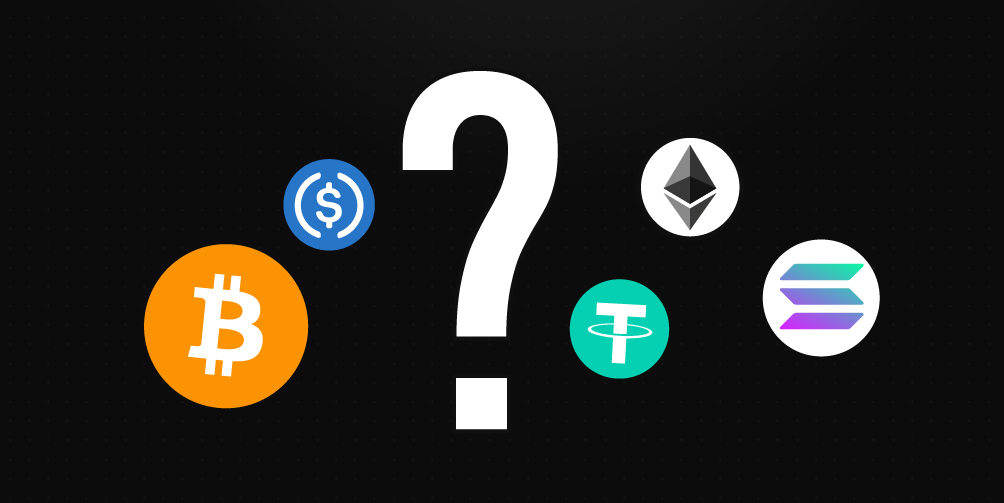
Bitcoin, the first and most famous cryptocurrency, uses a proof of work (PoW) mechanism, where miners compete to solve complex algorithms to verify transactions and maintain network security. Its total supply is capped at 21 million coins, and this scarcity design often likens Bitcoin to digital gold.
Ethereum introduced the concept of smart contracts, enabling not just value transfer but also the running of decentralized applications (DApps) on the blockchain. It is transitioning from PoW to a proof of stake (PoS) mechanism, aimed at increasing network efficiency and reducing energy consumption.
USDT is a stablecoin designed to keep its value pegged 1:1 with the US dollar, offering users a less volatile cryptocurrency option. It facilitates easy conversion between crypto markets and the traditional financial system, reducing uncertainty in transactions.
Solana is known for its high throughput and low transaction costs, a high-performance blockchain platform designed to support the creation and operation of large-scale decentralized applications (DApps). SOL, its native token, plays a crucial role in the network for transaction fees and governance.
Ripple aims to provide a fast, low-cost solution for cross-border payments. XRP can complete transactions in seconds, significantly reducing the cost and time compared to traditional cross-border payment methods. The Ripple network supports instant transfer of currencies and can handle other types of assets as well.
LBK is a newer cryptocurrency project aimed at providing innovative financial services, including but not limited to trading platforms, lending services, and asset management. LBK seeks to overcome the limitations of traditional finance and existing cryptocurrency markets by offering unique solutions.
Cryptocurrency market cap is a key metric for assessing the total value of a cryptocurrency, calculated by multiplying the current market price of a single token by the total number of tokens in circulation. This figure provides investors with a quick reference for value.
Market cap serves not only as a basis for ranking the relative size of cryptocurrencies but is often viewed as an indicator of a cryptocurrency's stability and market acceptance. Cryptocurrencies with larger market caps are considered more stable and less risky in the market.
While market cap is an important metric for evaluating cryptocurrencies, it does not fully reflect the potential or risk of a cryptocurrency project. Therefore, investment decisions should also consider technical strength, team background, token economics, and real-world application scenarios.
The first task before investing in cryptocurrencies is to thoroughly understand the market. This means mastering the basics of blockchain technology and studying the background, development teams, and technical features of various cryptocurrencies. Utilize books, online courses, and crypto community resources to build your knowledge.
Given the high volatility of the cryptocurrency market, starting with small investments and gradually increasing your investment is a wise strategy. Also, don't put all your money into one cryptocurrency. Instead, reduce risk and enhance the robustness of your overall investment portfolio by diversifying your investments.
The rapid changes in the cryptocurrency market make it crucial to regularly update your knowledge and stay on top of market trends for timely investment decisions. Joining communities, following news, and keeping abreast of technical updates and regulatory policy changes can help you stay ahead of the market.
Security is the primary criterion for choosing a cryptocurrency trading platform. Research and compare different platforms' security measures, fee structures, customer service, and trading options to ensure the safety of your funds and transactions.
Proper risk management is key to avoiding significant losses. This includes allocating funds appropriately based on your financial situation, setting stop-loss orders to limit potential losses, and developing take-profit strategies to lock in gains.
This article thoroughly explores the essence, operation, uniqueness, diverse types, the importance of market cap, and strategies for safe investing in cryptocurrencies. From the inception of Bitcoin to the introduction of Ethereum's smart contracts, and the rise of stablecoins and high-performance blockchain platforms, we've witnessed how cryptocurrency has evolved from a conceptual innovation into a diversified and complex ecosystem. Looking ahead, as technology advances and the regulatory landscape matures, cryptocurrencies are expected to play an increasingly significant role in the global economy. Investors, while enjoying the opportunities presented by cryptocurrencies, should also adopt prudent risk management measures to ensure the security of their assets.