What is Fogo and Why is It So Fast?
Fogo is a high-performance Layer 1 blockchain built using the Solana Virtual Machine architecture. The network is designed specifically to provide institutional-grade speed and latency for trading applications. Fogo launched its public mainnet on January 13, 2026, after months of testing and community building.
The project utilizes a custom Firedancer client to achieve block times as low as 40 milliseconds. This performance positions Fogo as a direct competitor to high-throughput networks like Solana and Sui. The team claims their network is 18 times faster than these established chains based on testnet benchmarks.
Fogo's primary mission is to prove that decentralization and high performance can coexist. The project aims to deliver a real-time experience at scale for demanding applications like perpetual trading and high-frequency DeFi. The network recorded a maximum of 136,866 transactions per second during testnet, setting ambitious performance targets for mainnet operations.
How Much Funding Has Fogo Raised So Far?
Fogo has raised a total of $20.5 million through three primary funding rounds. The funding structure reflects the project's stated commitment to community ownership alongside institutional backing.
Seed Round
Raised $5.5 million by December 31, 2024. Distributed Global and CMS Holdings led this initial investment. The seed funding provided capital for core development and team expansion.
Community Round
Raised $8 million at a $100 million valuation. This round was conducted via Echo, a protocol created by Jordan Fish, known in crypto as Cobie. Over 3,000 participants joined the raise, which filled in under two hours. Notable participants included CMS Holdings, Kain Warwick, and Larry Cermak.
Public Sale
Raised $7 million at a $350 million valuation through a CEX Prime Sale. This round occurred alongside the mainnet launch and airdrop distribution on January 15, 2026.
The project made headlines in December 2025 by canceling a planned $20 million token presale. Instead of taking additional VC money, the team allocated those tokens to a community airdrop. This decision reinforced their community-first messaging and generated significant goodwill among potential users.
Who Founded Fogo and Why Traders Care About the Team
Fogo was founded in 2024 by veterans of institutional finance and quantitative trading. The founding team brings deep experience from Wall Street and established blockchain infrastructure companies. This background shapes the project's focus on institutional-grade performance.
Robert Sagurton
Serves as Co-Founder. He previously held the position of Global Head of Digital Asset Sales at Jump Crypto. His role at Jump provided deep insight into Firedancer's development since Jump Crypto built the Firedancer client. This connection gives Fogo a technical advantage in optimizing the client for their specific use case.
Douglas Colkitt
He is the other Co-Founder. He worked as a quantitative researcher at Citadel before entering crypto. Colkitt also built Ambient Finance, which now operates as Fogo's native perpetuals exchange. His background in quantitative trading influences the network's focus on low-latency trading applications.
Michael Cahill
Contributes to the project as CEO of Douro Labs and Pyth Network. His involvement ensures native integration of Pyth's real-time financial oracles into the Fogo ecosystem. Accurate price feeds are essential for the trading applications Fogo targets.
Joey Stewart
Serves as Community Lead. His role became especially important given Fogo's community-first funding approach and the large-scale airdrop distribution.
Robert Sagurton: Why I Built an L1 for Traders (Fogo)
How Fogo Works Under SVM and Firedancer
Fogo achieves its performance through the Solana Virtual Machine combined with the Firedancer client. Understanding these technical components explains why the network can deliver such low latency.
The Solana Virtual Machine
Provides the execution environment for smart contracts. By building on SVM, Fogo maintains compatibility with Solana's developer tooling and programming model. Developers familiar with Solana can deploy applications on Fogo with minimal modifications.
Firedancer
Firedancer is a high-performance validator client originally developed by Jump Crypto. The client was built from scratch to maximize throughput and minimize latency. Fogo uses a custom implementation optimized specifically for their network requirements.
The combination delivers 40-millisecond block times. For comparison, Solana currently operates with approximately 400-millisecond block times. This order-of-magnitude improvement matters significantly for latency-sensitive applications like trading.
Testnet benchmarks recorded 136,866 transactions per second as the maximum throughput. While real-world mainnet performance may vary, these numbers demonstrate the theoretical capacity of the architecture. The team claims this makes Fogo 18 times faster than Solana and Sui.
FOGO Token Price, Market Cap, and Supply
The $FOGO token serves multiple functions within the network. It acts as native fuel for transaction gas fees. Users can stake tokens to earn yield from network activity. Revenue-sharing mechanisms distribute value to ecosystem partners.
Current Market Status:
- Current FOGO Price: Approximately $0.0379 (decreased 30.09%, 1D)
- Market Cap: Approximately $141.7 million (circulating)
- Total Supply: Approximately 9.93 billion FOGO
- Fully Diluted Value: Approximately $374.5 million
The price decline reflects typical volatility following a new token launch and airdrop distribution. Many airdrop recipients sell immediately, creating downward pressure. Long-term price trajectory will depend on network adoption and ecosystem development.
FOGO Tokenomics: Allocation, Unlocks, and Sell Pressure
The token distribution allocates supply across multiple stakeholder groups with varying unlock schedules. Understanding this breakdown helps evaluate potential selling pressure over time.
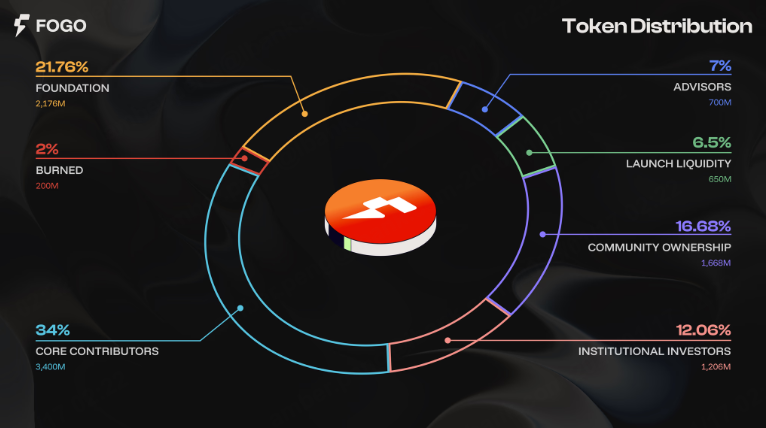
FOGO token distribution, image source: Fogo
Core Contributors
Receive 34% of total supply. These tokens follow a 4-year linear unlock schedule with a 12-month cliff. This means core team members cannot sell any tokens for the first year, and then receive portions gradually over the following three years.
Foundation
Holds 21.76% of supply. These tokens are fully unlocked at launch for grants and ecosystem incentives. The foundation can deploy these tokens to fund development, attract partners, and grow the ecosystem.
Community Ownership
Accounts for 16.68% of supply. This category includes Echo round participants (locked with 4-year vesting), Binance sale participants (unlocked), and airdrop recipients (unlocked).
Institutional Investors
Hold 12.06% of supply. These tokens remain fully locked until September 26, 2026. This lockup prevents early investors from selling during the initial trading period.
Advisors
Receive 7% with a 4-year linear unlock and 12-month cliff, matching core contributor terms.
Launch Liquidity
Represents 6.5% and is fully unlocked to support trading on exchanges.
Burned Tokens
Account for 2% that has already been removed from circulation.
Fogo Ecosystem: What dApps Are Live Today?
The public mainnet launched with approximately 10 decentralized applications ready for users. This initial ecosystem provides core functionality across trading, lending, and token creation.
Valiant operates as a decentralized exchange for spot trading. DEXs form the foundation of any DeFi ecosystem by enabling permissionless token swaps.
Ambient Finance serves as the native perpetuals exchange. Co-founder Douglas Colkitt built this protocol, making it a flagship application for demonstrating Fogo's low-latency capabilities.
Moonit functions as a token launchpad. Projects can use this platform to distribute new tokens to the Fogo community.
Brasa provides liquid staking services. Users can stake FOGO while receiving liquid tokens they can use elsewhere in DeFi, maintaining capital efficiency.
Pyron and Fogolend offer lending and borrowing functionality. These protocols enable users to earn yield on deposits or borrow against their holdings.
The presence of Pyth Network integration ensures reliable oracle data for these applications. Accurate price feeds are critical for lending protocols and perpetual exchanges to function correctly.
The FOGO Airdrop, image source: Fogo
FOGO Airdrop Details, Eligibility, and Deadline
The FOGO airdrop distributed tokens to 22,300 unique users on January 15, 2026. The average allocation was 6,700 $FOGO per eligible address. This distribution rewarded early supporters and testers who engaged with the project before mainnet.
Eligibility was divided into several categories. "Flames" recipients qualified based on trading activity and staking participation. "Early Fishers" earned allocations by testing the fishing game the team created for community engagement. Discord participants and Lil Fogees NFT holders received allocations for their community involvement.
The airdrop deadline is April 15, 2026. Users must claim their tokens before this date or forfeit their allocation. Unclaimed tokens typically return to the foundation or get burned depending on project policy.
The decision to cancel the $20 million presale in favor of expanding the airdrop generated positive sentiment. Many projects face criticism for prioritizing VC investors over communities. Fogo's approach attempted to address this concern directly.
What is Fogo Sessions and Why Does It Matter?
Fogo Sessions is a specialized infrastructure layer designed to bridge the gap between Web2 usability and Web3 security. The system enables gasless, signature-free, and security-first trading on the Fogo network. This feature eliminates the friction that typically slows down blockchain transactions.
The primary value proposition targets traders who need speed. Repetitive signature prompts and gas fee requirements create latency that costs money in fast-moving markets. Fogo Sessions removes these hurdles to provide what the team calls a "trading edge" through reduced latency and tighter pricing.
The architecture combines account abstraction with paymaster infrastructure. Account abstraction allows users to interact with dApps without signing every individual action. Paymaster infrastructure lets applications cover transaction fees so users don't need SOL for gas during trades.
How Session Keys Work
The system uses a master key and temporary keycard model to balance convenience with security.
The Master Key is your primary wallet. You use it only once to authorize the session. This single signature creates the temporary permissions that power your trading session.
The Session Key is a temporary key stored in your browser. It signs actions on your behalf within strictly defined limits. The key expires automatically after a set period, limiting risk exposure.
Trading Advantages
Fogo Sessions provides functional advantages beyond simple UX improvements. Latency reduction comes from skipping transaction pop-ups. The system saves critical time between trade intent and execution. For high-frequency traders, these milliseconds matter.
Tighter pricing results from waiving gas fees. Small transaction costs normally erode profit margins on frequent trades. Removing these costs allows for cleaner execution and better overall returns.
Wallet agnosticism means the system works with existing Solana wallets. Users don't need to install new software or migrate to proprietary solutions. Any SVM-compatible wallet can authorize a Fogo Session.
Security Safeguards
Convenience doesn't compromise safety in the Fogo Sessions design. Multiple protective layers ensure assets remain secure.
- Scoped Permissions: Session keys only work for the specific app you authorized. A key for one trading dApp cannot perform actions in another application.
- Ephemeral Nature: Keys are temporary with automatic expiry. This limits the damage window if a session is ever compromised.
- Human-Readable Intents: Clear messages replace ambiguous transaction requests. Users see exactly which domain they're authorizing, like "fogo.io" instead of cryptic hex data.
- Session Limits: Guardrails restrict trading actions to predefined permission boundaries.
User Workflow
The gasless experience follows four steps. First, you connect a standard Solana wallet to the dApp. Second, you sign once to approve the session with a human-readable request tied to the application domain. Third, you trade without interruptions as the session key handles all subsequent actions. Fourth, the application covers all gas fees automatically.
Future updates will add SPL token support including memecoins, smarter trading guardrails with active warnings, and improved session expiry handling with clear renewal prompts.
Fogo vs Solana: Speed, Decentralization, and Ecosystem Compared
Fogo positions itself as an institutional-grade upgrade over existing Layer 1 networks. The comparison with Solana is especially relevant given both networks use the same virtual machine architecture.
Block Times
Represent the most significant difference. Fogo achieves 40-millisecond blocks versus Solana's approximately 400-millisecond blocks. This 10x improvement matters for trading applications where latency determines profitability.
Throughput
Based on testnet data shows Fogo reaching 136,866 TPS maximum. Solana's theoretical maximum is lower, though both networks rarely operate at peak capacity in practice.
Firedancer Adoption
Creates an interesting dynamic. Solana is currently integrating Firedancer on its own mainnet. As this integration progresses, Solana's performance will improve. Fogo's speed advantage may narrow over time.
Ecosystem Size
Heavily favors Solana. The established network has thousands of applications, significant liquidity, and a large developer community. Fogo launches with approximately 10 dApps and must build from there.
Decentralization
Currently favors Solana despite its own centralization criticisms. Fogo's initial validator set is curated and located in a single data center. Solana operates validators across multiple geographic locations.
Fogo Risks and Concerns Investors Should Know
Despite impressive performance metrics, several structural risks could impact Fogo's long-term viability. Advanced users should understand these factors before participating.
Centralization concerns arise from the initial validator configuration. Validators are handpicked by the team and collocated in a single data center in Tokyo. This setup optimizes for speed by minimizing network latency between validators. But it creates a physical point of failure. A natural disaster, power outage, or regulatory action in Tokyo could take down the entire network.
Foundation Influence is significant given the token distribution. Over 30% of supply is controlled by the Foundation and fully unlocked at launch. This concentration gives the team substantial market and governance influence. Decisions about grant distribution and token sales could significantly impact price.
SVM Dependency ties Fogo's fate to the Solana Virtual Machine. If Solana's runtime encounters fundamental bugs or security issues, Fogo inherits those problems. The project benefits from SVM improvements but also shares its vulnerabilities.
Competitive Pressure will intensify as Solana adopts Firedancer. Fogo's primary advantage is performance derived from the Firedancer client. When Solana runs Firedancer natively, the speed gap narrows. Fogo will need additional differentiation to justify its existence as a separate network.
Network Effects favor established chains. Developers and users congregate where liquidity and applications already exist. Bootstrapping a new ecosystem requires overcoming significant inertia even with superior technology.
Fogo Timeline: Key Events From Launch to Token Unlocks
Is Fogo Worth Watching as a High-Performance Layer 1?
Fogo represents an experiment in pushing blockchain performance to institutional trading standards. The 40-millisecond block times demonstrate what's technically possible with optimized infrastructure and concentrated validators.
The project's success or failure will provide lessons for the industry. If Fogo attracts meaningful trading volume and DeFi activity, other projects may adopt similar approaches. If the network struggles to gain traction despite superior performance, it will reinforce that technology alone doesn't determine blockchain adoption.
The community-first funding approach offers an alternative model to VC-dominated token launches. By canceling the presale and expanding the airdrop, Fogo tested whether broad distribution creates stronger network effects than concentrated institutional backing.
For traders and DeFi users seeking the lowest possible latency, Fogo provides a new option. The network's perpetuals exchange and oracle integrations target sophisticated users who care deeply about execution speed. Whether enough of these users migrate from established venues remains to be seen.
The coming months will reveal whether Fogo can overcome its centralization concerns, build a robust validator network, and develop an ecosystem that justifies using a separate chain from Solana. The team has funding, technical credentials, and initial momentum. Converting those advantages into sustainable adoption is the challenge ahead.