
What is Official Trump Coin ($TRUMP)?
Official Trump coin refers to the $TRUMP memecoin launched on January 17, 2025, just three days before Donald Trump's second presidential inauguration. The token is hosted on the Solana blockchain and operates as a speculative digital asset. The official crypto name is simply $TRUMP.
The token's logo features a digitally-stylized image of Trump raising his fist. This image references the July 2024 assassination attempt against him. The project describes itself as a "novelty" or "bit of fun" with no inherent utility beyond speculation. Critics argue the primary purpose is enriching Trump and his family.
The Trump crypto ventures extend beyond just the meme coin. World Liberty Financial launched in September 2024 as a more formal decentralized finance project. WLFI focuses on a USD1 stablecoin and governance tokens for a peer-to-peer financing platform. Donald Trump and Steven Witkoff serve as "co-founders emeritus" for this project.
Together, these ventures represent a significant pivot for the Trump family business. Cryptocurrency now accounts for over 90% of their total income. This rapid expansion into digital assets has generated both massive profits and intense controversy.
Trump Coin Controversies and Investigations
The Trump crypto ventures have generated unprecedented ethical concerns and triggered multiple investigations. The scale and nature of the controversies exceed typical crypto project disputes.
Dinner with the President represented the most explicit mixing of tokens and access. The top 220 $TRUMP holders received dinner invitations at Trump National Golf Club. The highest holders got White House tours. Critics described this as blatantly selling access to the presidency.
The Raskin Report formalized congressional concerns. Representative Jamie Raskin's November 2025 document was titled "Trump, Crypto, and a New Age of Corruption." The report found that Trump "dismantled anti-corruption safeguards to build a multi-billion-dollar crypto empire."
Legislative Response
Legislative response emerged through the MEME Act. The Modern Emoluments and Malfeasance Enforcement Act would prohibit presidents and senior officials from endorsing financial assets. The bill directly targets Trump's crypto activities.
Executive Actions
Executive actions raised additional concerns. Trump pardoned Binance founder Changpeng Zhao (CZ) shortly after the MGX deal involving Trump's stablecoin USD1 was announced. The timing suggested potential quid pro quo.
Pump and Dump
Pump and dump allegations followed the price collapse. With 813,000 wallets losing $2 billion while creators profited $100 million, the trading pattern resembled classic market manipulation. Retail investors bore the losses while insiders captured gains.
The History $TRUMP Coin
The history of "Trump coins" didn't start with the official $Trump token in 2025. It began years earlier as a decentralized, chaotic movement driven by internet culture. Long before the Trump family officially embraced crypto, anonymous developers were launching thousands of unauthorized memecoins bearing the former president's name and likeness.
Tokens like "MAGA Coin" and "Super Trump" flooded decentralized exchanges on Ethereum and Solana throughout 2023 and 2024. These were wild, unregulated assets. They surged whenever Trump made headlines—whether for a rally speech or a court appearance—and crashed just as quickly. During this period, Donald Trump was publicly skeptical of cryptocurrency, famously calling Bitcoin a "scam against the dollar."
The narrative flipped in mid-2024. Seeing the massive volume and fervent community behind these unauthorized tokens, the Trump campaign began to soften its stance. The turning point was the realization that crypto wasn't just a financial asset; it was a voter base and a fundraising machine.
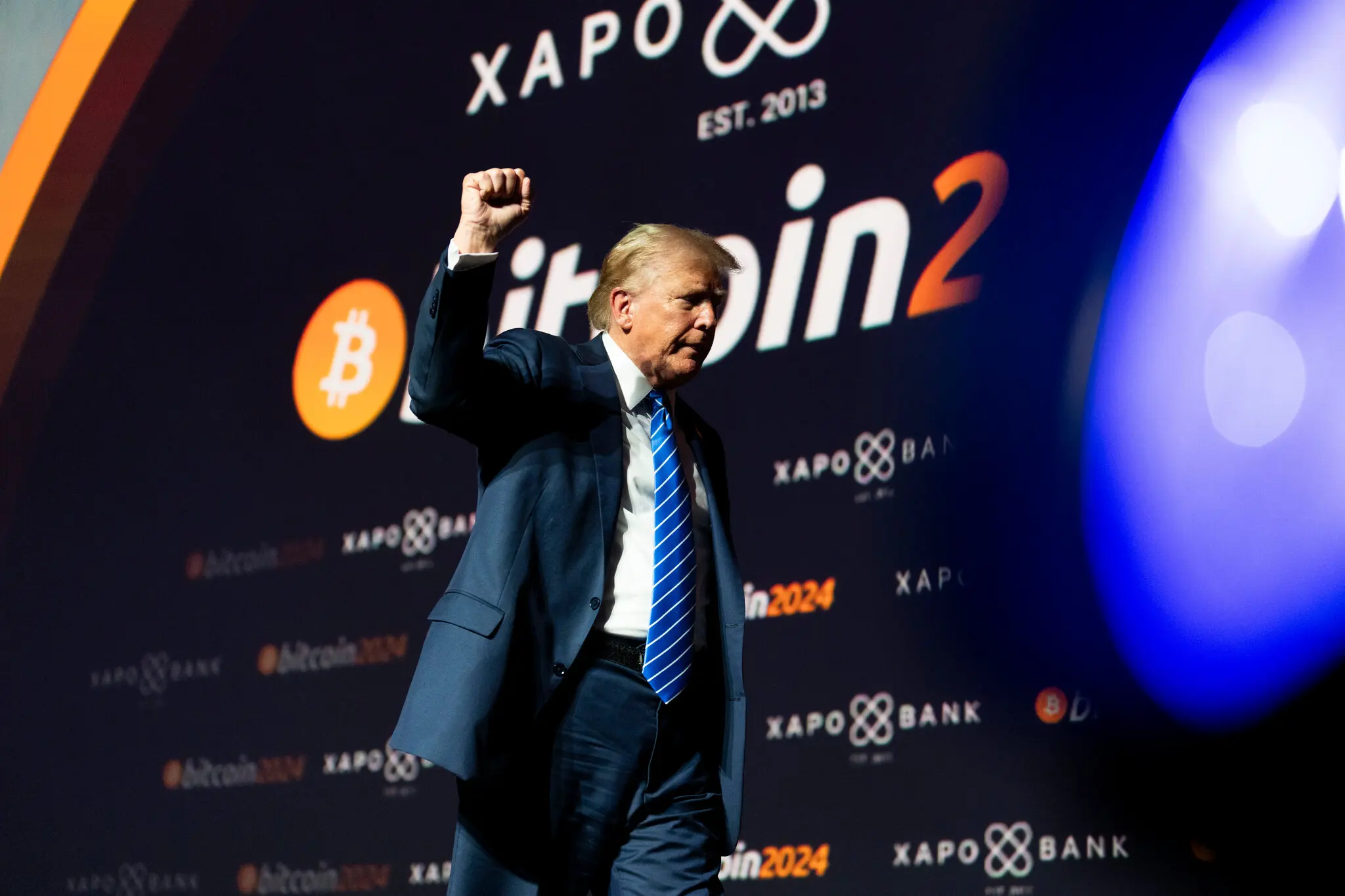
President Donald J. Trump at Bitcoin Conference in Nashville, image by Doug Mills/The New York Times
This shift culminated in the official launch of the $Trump memecoin on January 17, 2025. It wasn't just another unauthorized token anymore. This was the "official" entry. The launch was timed perfectly for maximum impact, dropping just three days before his second inauguration. The marketing was aggressive, positioning the coin not as an investment, but as a digital badge of loyalty. The iconic image of Trump raising his fist after the assassination attempt became the token's visual anchor, transforming a moment of political survival into a tradable asset.
This move marked a historic first: a sitting U.S. President directly launching a cryptocurrency. It blurred the lines between political merchandise, financial speculation, and presidential power, setting the stage for the massive volatility and controversy that followed.
Trump Coin History: Launch Timeline and Major Events
The Trump crypto empire developed rapidly over a span of months. Understanding the timeline helps explain how these ventures grew and interconnected.
Trump Coin on Solana: Why It Launched on Solana Instead of Ethereum
The $TRUMP token launched on the Solana blockchain rather than Ethereum or other networks. This choice reflects practical considerations for a memecoin aiming for viral adoption.
Solana offers significantly lower transaction fees than Ethereum. When thousands of retail traders want to buy small amounts of a memecoin, high gas fees become prohibitive. Solana's near-zero fees enabled mass participation in the initial offering.
Transaction speed was another factor. Solana processes transactions in under a second with high throughput capacity. During the launch frenzy, the network handled massive volume without the congestion issues that plagued Ethereum during previous memecoin launches.
The Solana ecosystem had already established itself as a home for memecoins. Previous successful tokens like Bonk and Dogwifhat built community on Solana. Launching $TRUMP on this blockchain tapped into an existing culture of memecoin trading and speculation.
The technical choice also created some limitations. Solana has experienced network outages in the past. Traders dependent on quick exits during volatile periods face risks if the network goes down. This proved relevant as $TRUMP experienced extreme price swings.
Trump Coin Price History: Launching Price and All Time High
The $TRUMP token experienced extraordinary price volatility from its first hours of trading. The price action followed a pattern common to celebrity-endorsed meme coins but at unprecedented scale.
The token launched at a relatively low price during the initial coin offering. Early buyers who participated in the ICO captured the largest gains. Within hours, speculative demand drove prices dramatically higher as news of the launch spread.
Within two days of launch, the aggregate market value exceeded $27 billion. The token reached a peak price of $75.35 during this initial surge. This represented one of the fastest market cap expansions in meme coin history.
The meteoric rise attracted both retail traders and media attention. Social media amplified the frenzy as traders posted screenshots of massive gains. Fear of missing out drove additional buying pressure at increasingly elevated prices.
The crash came almost as quickly as the rise. The price began declining as early buyers took profits. Without utility or underlying value, nothing supported the elevated prices once buying pressure subsided. The pattern followed classic meme coin dynamics but affected far more participants due to the Trump brand recognition.
Trump Coin Price USD: Current Price and Market Reality
As of late 2025, $TRUMP trades at approximately $5.59. This represents a decline of nearly 93% from the all-time high of $75.35. The collapse wiped out billions in paper wealth for late-stage buyers.
A forensic analysis of trading activity revealed devastating losses for retail participants. Over 813,000 wallets lost a combined $2 billion trading the coin. Meanwhile, the creators profited $100 million in trading fees alone. This asymmetry highlights the risks of meme coin speculation.
$WLFI Price
The WLFI governance token has also struggled. After trading began in September 2025, WLFI price rose to 46 cents before sinking to 14 cents. This represents a significant decline but less severe than $TRUMP's percentage drop.
$MELANIA Price
The $MELANIA token performed worst of the three Trump family tokens. Its price fell 99% by November 2025. The token never achieved the attention or trading volume of $TRUMP despite the famous name attached.
Trading volume for $TRUMP has declined significantly from launch levels. The initial frenzy attracted billions in daily volume. Current trading activity represents a fraction of peak levels. Many holders appear to be waiting for recovery rather than selling at losses.
Trump Coin Tokenomics: Supply, Distribution, and Who Controls It
Understanding who controls the token supply reveals important dynamics about $TRUMP's market structure. The distribution heavily favors Trump-connected entities.
One billion $TRUMP coins were created at launch. This fixed supply means no additional tokens can be minted. The total supply will never increase through inflation. Only 200 million tokens were released in the initial coin offering. This represents just 20% of total supply available for public trading. The limited float contributed to initial price volatility as demand exceeded available supply.
The remaining 800 million tokens are owned by Trump-controlled entities. CIC Digital LLC and Fight Fight Fight LLC hold these tokens. This means 80% of all $TRUMP remains under Trump family control.
This distribution creates significant overhang risk. If the controlling entities decide to sell, massive supply would enter the market. Retail holders have no protection against this potential dilution. The entities have no public vesting schedule or lockup commitments. The concentration of ownership also means trading fees and profits flow primarily to Trump interests. Every trade generates fees that benefit the token creators. The 813,000 wallets that lost money effectively transferred wealth to the project's controllers.
Who Invested in Trump Coin? Major Backers and Institutions
Several high-profile investors and entities have committed significant capital to Trump crypto ventures. These investments raise questions about motivations and potential conflicts of interest.

Justin Sun at an exclusive dinner with President Donald Trump. Image source: Tyrone Siu/REUTERS
Justin Sun
Invested $75 million in WLFI tokens. Sun is a crypto billionaire and founder of Tron. He faced a Securities and Exchange Commission investigation that was later paused. His investment made him one of the largest individual backers.
Alt5 Sigma
Raised $750 million specifically to purchase 7.5% of all WLFI tokens. This blockchain services company made the single largest institutional commitment to the Trump crypto ecosystem.
MGX
MGX is an Abu Dhabi state-controlled investment firm. The company used Trump's USD1 stablecoin for a $2 billion equity stake in Binance. This deal connected sovereign Middle Eastern wealth to both Trump ventures and the world's largest crypto exchange.
Aqua1 Foundation
Aqua1 Foundation purchased $100 million in WLFI tokens. This UAE-based entity is linked to Chinese businessman Guren "Bobby" Zhou. Zhou is reportedly under investigation in Britain for money laundering.
GD Culture Group
GD Culture Group announced a $300 million purchase of Bitcoin and $TRUMP. This firm has ties to China and TikTok. The investment raised concerns about foreign influence given Trump's position as president.
Trump Coin vs. World Liberty Financial: Key Differences Explained

$TRUMP operates purely as a speculative asset. Holders have no governance rights or claim to any revenue. The token provides no utility beyond trading and collecting. Its value depends entirely on market sentiment and continued interest.
WLFI attempts to provide actual financial infrastructure. The USD1 stablecoin aims to facilitate transactions and cross-border payments. Governance tokens theoretically give holders voting rights on business decisions. The project resembles traditional DeFi protocols more than a meme coin.
Despite the structural differences, both projects face similar criticisms. Skeptics argue both primarily enrich the Trump family while exposing retail participants to significant risks. The involvement of foreign investors in both ventures has generated congressional scrutiny.
Trump Coin International Deals: Foreign Partnerships and Concerns
The Trump crypto empire has actively pursued partnerships with sovereign states and foreign entities. These relationships extend the project's reach but amplify concerns about conflicts of interest.
Pakistan
Pakistan signed a memorandum of understanding (MoU) with a World Liberty Financial connected company in January 2025. The agreement explores using the USD1 stablecoin for cross-border payments. If implemented, a sovereign nation would depend on Trump-controlled financial infrastructure.

Pakistan Ministry of Finance signed an MoU with the World Liberty Financial, image source: @PakistanVARA on X
Abu Dhabi
Abu Dhabi became connected through the MGX investment. The state-controlled firm's use of USD1 for the Binance deal demonstrated practical utility for the stablecoin. It also intertwined UAE sovereign wealth with Trump's crypto ventures.
China
China-linked entities made significant purchases. GD Culture Group's $300 million commitment raised immediate red flags given the company's connections to China and TikTok. Critics questioned whether investments were seeking political influence.
Nexo
Nexo represents another concerning connection. The crypto firm sponsored a golf tournament at a Trump property. Its co-founder met with Trump to discuss a "joint vision for crypto." Shortly after, Nexo announced plans to resume U.S. operations.
Trump Coin Price Prediction: Factors, Risks, and Uncertainty
Predicting $TRUMP's future price requires understanding the unique factors affecting this particular token. Standard crypto analysis frameworks apply but with significant modifications.
Supply Dynamics
It creates ongoing pressure. With 80% of tokens controlled by Trump entities, massive selling could occur at any time. No vesting schedule or lockup protects holders from this overhang. Price recovery depends partly on controlled entity intentions.
Political Factors
Influence sentiment unusually. Trump's political fortunes directly affect token interest. Policy decisions, scandals, and election cycles create volatility unrelated to typical crypto market dynamics. The token is essentially a bet on Trump himself.
Regulatory Risk
Looms over the project. Congressional investigations could result in enforcement actions. The MEME Act or similar legislation could restrict the token's marketing and trading. Regulatory clarity remains absent.
Market Sentiment
Market for memecoins generally remains bearish. The broader memecoin sector has cooled significantly from 2021 peaks. $TRUMP must compete for speculative capital against thousands of other novelty tokens.
Institutional Interest
It could provide potential support. Major investors like Justin Sun and GD Culture Group have significant stakes. Their continued involvement provides some floor for demand. Their potential exits create corresponding risk.
Given these factors, $TRUMP remains an extremely high-risk speculative asset. The 93% decline from peak demonstrates how quickly value can evaporate. Any price predictions should acknowledge the unique political and structural risks this token carries.
What Trump Coin Means for Crypto Regulation and Politics
The Trump crypto ventures may significantly impact how governments approach cryptocurrency regulation. The unprecedented situation of a sitting president profiting from tokens creates pressure for new frameworks.
The MEME Act represents the most direct regulatory response. By prohibiting presidents from endorsing financial assets, Congress would prevent future similar situations. The bill faces uncertain prospects but establishes a legislative template. Conflict of interest standards may need updating. Existing ethics frameworks did not anticipate a president launching speculative tokens. Regulators and lawmakers must decide whether current rules adequately address digital assets.
Foreign investment scrutiny will likely increase. The involvement of UAE, China-linked, and other foreign entities in presidential business ventures raises national security questions. Crypto's borderless nature complicates traditional investment review processes. The SEC's approach remains unclear. The pause of the Justin Sun investigation coincided with his WLFI investment. Whether the agency will pursue enforcement against Trump-connected projects is uncertain given the political dynamics involved.
For the broader crypto industry, Trump's ventures create mixed implications. The attention brings mainstream awareness but associates crypto with controversy. Legitimate projects may face guilt by association as critics point to $TRUMP's outcomes. These partnerships blur the line between private business and presidential policy. When foreign governments and entities invest in a sitting president's ventures, distinguishing legitimate business from influence-seeking becomes nearly impossible.