Les moyennes mobiles ne servent-elles qu'à observer les croisements ? Guide rapide MA/EMA pour débutants en 3 minutes !
 LBank 官方中文2026-03-13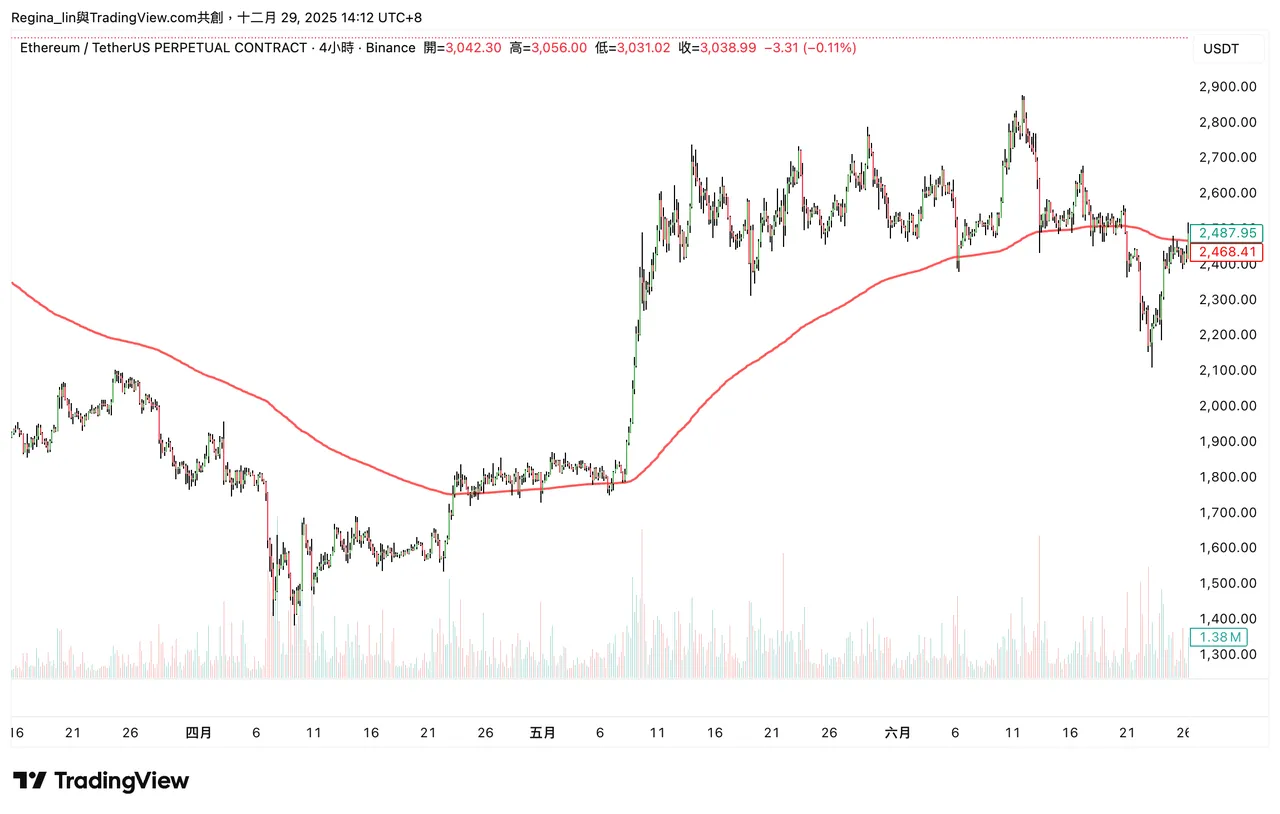
La moyenne mobile n'est pas destinée à entrer en position uniquement lors d'un croisement ; c'est une ligne de coût moyen du marché, utilisée pour confirmer la direction, filtrer le bruit et réduire les risques d'être éliminé. Si vous utilisez la moyenne mobile uniquement pour attendre un croisement, votre réaction sera toujours en retard.
What is MA? Why is it more suitable for long-term trading?
MA stands for Simple Moving Average. What you typically see as a "moving average" is usually this.
The Logic of MA
Summing up the closing prices of N candlesticks and dividing by N = An "average cost line" = The "arithmetic mean" of candlestick closing prices Advantages: Stable, filters out noise. Suitable for observing major trends, filtering out short-term fluctuations, and less prone to being misled by one or two erratic candlesticks. Disadvantages: Not sensitive enough to sudden sharp rises or drops, tends to react with a delay. Therefore, the positioning of MA is very clear:
It is suitable for observing trends, confirming direction, and double-checking your judgment, but not for identifying turning points or direct entry/exit.
What is EMA? Why do short-term traders prefer it?
EMA (Exponential Moving Average) is a moving average that is more sensitive and reacts faster to market conditions than MA. The biggest difference from MA can be summed up in one sentence:
EMA gives "recent prices" a higher weighting.
This means that as soon as the market changes, EMA will reflect it faster on the moving average. In the volatile, fast-paced crypto market with many fake breakouts, this characteristic is highly advantageous.
Shorter EMA -> More sensitive, faster reaction, closer to current price, more prone to reversals Longer EMA -> More stable, fewer false signals, but slower reaction
An Example to Understand: Why EMA is Faster than SMA
Assume three days' closing prices are: 10, 12, 14 SMA (3-day): 10+12+14/3=12 EMA (3-day): Calculate smoothing constant k=2/3+1=0.5 Set the first EMA = the first price (10) [Initial value] Day 2: EMA2=(12×0.5)+(10×0.5)=6+5=11 Day 3: EMA3=(14×0.5)+(11×0.5)=7+5.5=12.5 It can be seen that EMA is closer to the latest price changes than SMA.
Differences Between EMA and SMA
IndicatorsReaction SpeedCharacteristicsUsageMA慢 (Slow)對所有價格平均 (Averages all prices)長期趨勢 (Long-term trends)EMA快 (Fast)最近價格權重更高 (Recent prices weighted higher)短線 / 趨勢盤 (Short-term / Trending market) In a nutshell:
For faster reaction -> Use EMA For stability and avoiding false signals -> Use SMA
Uses of Different Period EMAs
EMAFunctionUsageEMA 7 / 10最敏感 (Most sensitive)短線方向 (Short-term direction)EMA 12 / 20主流趨勢線 (Main trendline)交易者最常用的動能線 (Most commonly used momentum line by traders)EMA 30中期趨勢 (Medium-term trend)回踩買點、突破確認 (Retest buy point, breakout confirmation)EMA 100大級別力量 (Large-scale strength)多空切換 (Bull-bear transition)EMA 200超長期趨勢、生命線 (Super long-term trend, lifeline)牛熊分界、強弱判斷 (Bull-bear demarcation, strength/weakness judgment) You can backtest to find the EMA values best suited for your strategy. Newcomers are advised to prioritize using EMA 30 & 200. You can refer to the video tutorial -> https://youtu.be/K4MZ-y_6wp0?si=iDOveJ-5sp41Kko1
Simple Interpretation of Single EMA Signals
📍 EMA Turning Upward → Increased Bullish Momentum
📍 Price Above EMA → Bullish Dominance
* EMA acts as support * Retest holds = Continued upward trend
📍 EMA Turning Downward → Increased Bearish Momentum
📍 Price Breaks Below EMA → Bearish Dominance
* EMA becomes resistance * Rebound to EMA often leads to a drop
How to Interpret Double EMA Crosses? Treat Them as "Reminders" Only
Common Crossover Strategies: * Short EMA Crosses Above Long EMA → Golden Cross (Bullish signal) * Short EMA Crosses Below Long EMA → Death Cross (Bearish signal) Crossovers are not direct trading signals; they merely confirm a shift in the previous trend. Whether to enter a trade or not still needs to be combined with: * The current trend * Price position * Whether volume is confirming * Whether it's near key resistance/support levels
Multiple Moving Average System: Used to Determine Bull/Bear Trends
The most common is the short-term, medium-term, and long-term three-line system, with the following recommended periods: 20 / 50 / 200: ConditionInterpretation20 > 50 > 200超級多頭 (Super Bullish)20 < 50 < 200超級空頭 (Super Bearish)3 線糾結 (3 lines entangled)盤整、主力吸籌 (Consolidation, accumulation by major players) Uses: * Trend following * Determining if the market is bullish or bearish * Filtering out false breakouts / false reversals
Combining EMA with Candlesticks: Signals Become Much Clearer
EMA can help us assess the "stability of candlestick structures". The following examples demonstrate a bullish trend.
📍 Candlestick Far from EMA → Prone to Retracement (Price Tends to Revert to the Mean)
📍 Major Trend Moving Averages in Bullish Alignment, Price Retraces to EMA + Appearance of Bullish Candlestick (e.g., Hammer) → Strong Bullish Momentum, Buying Pressure Takes Over
Wait for the candlestick to close above the moving average (or break above the previous bullish candlestick), then consider entering a long position, with stop-loss 1% below the previous low.
📍 EMA Retest Fails, Candlestick Unable to Close Above EMA, Instead Breaks Down or Multiple "Barbed Wire" Formations Appear → Weakening Signal
At this point, if a bearish trend is not yet confirmed or if you are more conservative, you don't necessarily need to enter a short position; you can gradually offload spot holdings or close long positions.
Nine Common Moving Average Mistakes Made by Beginners
1. Trading solely based on a Golden Cross (very easy to be misled) 2. Too many EMA lines open (becomes confusing) 3. Only looking at moving averages without considering candlesticks & volume (false breakouts) 4. Using EMA for counter-trend trades (easily overwhelmed by the trend) 5. Ignoring time frame switching (1H and 4H yield different results)
Moving Averages are not Prophecies, but a Sense of Direction
Moving averages are not for prediction; they are for confirming whether we are aligned with the correct direction.
If you feel that moving averages often fail, it's usually not because the moving average is inaccurate, but because your expectations for it are too high, exceeding its capabilities. To learn more, you can refer to the instructional videos: https://youtu.be/jT8QlA9FkT8?si=_x96qUYJyEL5Pynk https://youtu.be/K4MZ-y_6wp0?si=4wuHb-4NC2GYwnwq https://youtu.be/BPzeUfzJrU4?si=_reQgbx6HNfkV0fw