What is Cardano (ADA)?
Cardano is a public, proof-of-stake Layer 1 blockchain designed to provide a more balanced and sustainable ecosystem than earlier blockchains. The network positions itself as a third-generation blockchain, building on lessons learned from Bitcoin (first generation) and Ethereum (second generation).
The blockchain is built using Haskell, a secure functional programming language favored in academic and high-assurance environments. Cardano uses the Ouroboros consensus protocol, which was developed through peer-reviewed academic research. This rigorous approach sets Cardano apart from competitors that prioritize speed over formal verification.
The native cryptocurrency is called ADA. It has a maximum supply of 45 billion tokens. ADA powers transactions, staking, and governance activities across the network. The project is currently pivoting from an academic-heavy focus toward a commercially driven "operating system" model for global finance.
Who Built Cardano and Who Controls It Today?
Four primary organizations manage and develop the Cardano ecosystem. Each plays a distinct role in the network's growth and maintenance.
IOHK (Input Output Global) develops the core technology. Charles Hoskinson, a co-founder of Ethereum, leads this organization. The team focuses on research-driven development and formal verification methods.
Cardano Foundation supervises development and promotes the network globally. This Swiss-based organization handles partnerships, education, and ecosystem growth initiatives.
Emurgo drives commercial adoption of Cardano technology. The company works with enterprises and developers to build real-world applications on the blockchain.
Intersect is a newer member-based organization tasked with maintaining network continuity. It oversees the Vision 2030 roadmap and coordinates community governance efforts. Intersect represents the shift toward decentralized decision-making.
Cardano Whiteboard; Overview With Charles Hoskinson | IOHK
How Cardano Works: Ouroboros Proof of Stake
Cardano uses the Ouroboros consensus protocol to validate transactions and secure the network. This proof-of-stake mechanism differs significantly from Bitcoin's energy-intensive proof-of-work system.
In Ouroboros, validators stake their ADA tokens to participate in block production. The protocol divides time into epochs and slots. Slot leaders are selected based on their stake proportion. This approach reduces energy consumption while maintaining security through economic incentives.
The protocol was developed through peer-reviewed academic research. This formal verification process aims to provide mathematical guarantees about the system's security properties. Critics sometimes argue this approach slows development, but supporters believe it creates a more robust foundation.
Stake Pool Operators (SPOs) run the nodes that produce blocks. ADA holders can delegate their tokens to pools without giving up custody. Delegators earn staking rewards proportional to their contribution. This system encourages broad participation in network security.
Cardano Development Phases: Byron to Voltaire Timeline
Cardano’s roadmap is divided into five major eras, each introducing new capabilities and moves the network toward full decentralization.
The Goguen era brought several important upgrades. Allegra introduced token locking mechanisms. Mary enabled native tokens without smart contracts. Alonzo deployed Plutus smart contracts, finally allowing decentralized applications on Cardano.
The Basho era focused on optimization. The Babbage ledger era, including the Vasil upgrade, added reference scripts and inline datums. These improvements reduced transaction costs and improved developer experience.
Voltaire represents the current phase. It encompasses the Conway ledger era with the Chang and Plomin hard forks. The Plomin upgrade was renamed to honor Matthew Plomin, a key figure in Cardano's financial technology development who passed away.
What is Cardano Vision 2030?
The Vision 2030 report was released on December 17, 2025, by the Intersect Product Committee. This document outlines Cardano's strategic pivot toward enterprise-grade reliability and commercial adoption. The vision redefines how the network measures success.
Cardano explicitly rejects the "speed at all costs" narrative of competitors like Solana. The network targets 99.98% uptime as its primary reliability metric. Any five-minute interval without a block is considered a "meaningful failure event." This focus on stability over raw throughput reflects Cardano's positioning as infrastructure for high-value transactions.
Key Performance Indicators for 2030:
- 324 million annual transactions
- 1 million monthly active wallets
- $3 billion Total Value Locked (TVL)
- Base layer throughput cap of approximately 27 million transactions per month
The vision acknowledges that the mainnet is designed primarily for high-value settlement. High-frequency activities like gaming and day trading are expected to migrate to Cardano-based Layer 2 solutions. Hydra is the primary L2 scaling solution being developed for these use cases.
This approach mirrors Ethereum's scaling strategy but raises questions about base layer revenue. For a deeper analysis of how these developments affect ADA valuation, check out our Cardano ETF updates and ADA price impact.
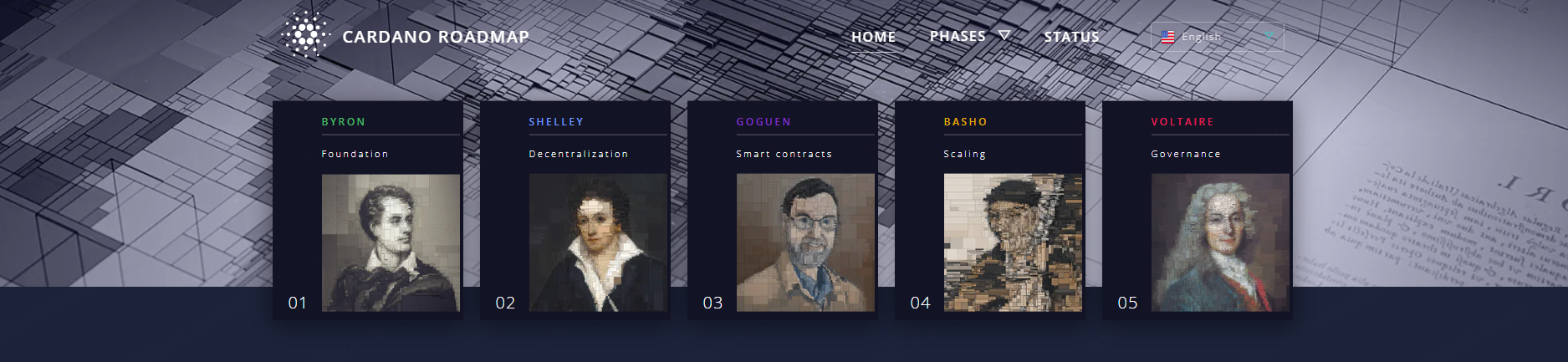
Cardano roadmap, source: cardano.org
How Cardano Governance Works: The Voltaire Era
The Voltaire phase marks Cardano's transition to decentralized self-governance. CIP-1694 provides the technical framework for on-chain participatory decision-making. This upgrade fundamentally changes how the network evolves.
The Chang and Plomin hard forks introduced the Conway ledger era. These upgrades enabled three key governance roles:
- Constitutional Committee: Reviews proposals for constitutional compliance
- Delegated Representatives (DReps): Vote on behalf of ADA holders who delegate to them
- Stake Pool Operators (SPOs): Participate in technical governance decisions
ADA holders can vote directly on proposals or delegate their voting power to DReps. This flexibility allows passive holders to still influence governance through trusted representatives. The system aims to balance broad participation with informed decision-making.
Treasury Seasons introduce a structured budgeting framework. Funding for projects is no longer open-ended. Instead, projects must justify their budgets based on measurable impact. Key metrics include TVL growth, transaction volume increases, and active wallet expansion. This accountability mechanism aims to ensure treasury funds generate real value for the ecosystem.
Cardano vs. Ethereum vs. Solana: How They Compare
Cardano competes with other major Layer 1 blockchains for developer attention and user adoption. Each network makes different tradeoffs between speed, security, and decentralization.
| Feature | Cardano (ADA) | Ethereum (ETH) | Solana (SOL) |
| Consensus | PoS (Ouroboros) | PoS (Post-Merge) | PoH/PoS |
| Max Supply | 45 Billion ADA | No Hard Cap | No Hard Cap |
| Throughput | ~27M per month | High (L2 focused) | ~70M per day |
| DeFi TVL | Lower but growing | Largest ecosystem | Significant |
| Primary Focus | Reliability and formal methods | First-mover advantage | Speed and low cost |
Cardano distinguishes itself through academic rigor and energy efficiency. The peer-reviewed approach provides theoretical security guarantees. But this methodology slows development compared to faster-moving competitors.
Ethereum benefits from first-mover advantage and the largest developer ecosystem. Its transition to proof-of-stake addressed energy concerns. Layer 2 solutions handle most high-frequency transactions while the mainnet provides security.
Solana prioritizes raw speed and low transaction costs. The network processes significantly more transactions per day than Cardano's monthly target. This throughput comes with tradeoffs in decentralization and has resulted in several network outages.
Cardano's recent integration with X402 protocol demonstrates its expanding capabilities. The network now supports AI-powered payment systems on the blockchain, opening new use cases beyond traditional DeFi. Learn more about how Cardano integrates X402 for AI payments.
Cardano Price Analysis and the Revenue Gap Problem
Recent analysis reveals a significant economic challenge for Cardano. The gap between protocol revenue and market valuation raises important questions for investors.
| Metric | Current State | 2030 Target |
| ADA Price | ~$0.36 | $5.00 (illustrative) |
| Annual Transactions | ~115 million | 324 million |
| Monthly Active Wallets | ~100k-300k | 1 million |
| TVL | ~$178-$180 million | $3 billion |
| Annual Protocol Revenue | ~$3.5 million | $81 million |
The Vision 2030 roadmap uses an illustrative ADA price of $5.00 to project annual protocol revenue of $81 million. This price assumption represents a 500% increase from current levels around $0.36. Critics argue this approach assumes massive speculative appreciation to mask revenue gaps.
For context, Ethereum currently generates approximately $600 million in annual fee revenue. Even at the ambitious $5.00 price target, Cardano would earn roughly one-seventh of Ethereum's current fees. This comparison highlights the challenge of building sustainable protocol economics.
The revenue model depends heavily on L1 transaction volume. But the Vision 2030 strategy explicitly pushes high-frequency activity to Layer 2 solutions. This creates potential tension between the scaling approach and revenue generation on the base layer.
What Are Cardano's Biggest Risks?
Several challenges could affect Cardano's path to its 2030 goals. Advanced investors should understand these risks before making allocation decisions.
Liquidity Gap
Cardano recently acquired institutional-grade infrastructure including Pyth oracle integration. But the network faces a $40 million liquidity gap that could stall DeFi growth. Deep liquidity is essential for functioning markets. Without it, large trades cause excessive slippage, discouraging institutional participation.
Technical Reset
The network is undergoing a "silent reset" led by Charles Hoskinson following a critical ledger error in November 2024. The error nearly fractured the network. Hoskinson proposed the "Pentad" initiative to address fundamental technical issues. This reset suggests underlying challenges that the formal verification approach did not prevent.
Layer 2 Value Leakage
As activity migrates to Layer 2 solutions, the base chain risks becoming a low-revenue settlement layer. Ethereum already faces this challenge. L2s capture transaction fees while L1 handles only periodic settlement. Cardano's explicit strategy of pushing activity to Hydra and other L2s could accelerate this dynamic.
Competitive Pressure
Solana processes approximately 70 million transactions per day compared to Cardano's monthly target of 27 million. This performance gap matters for applications requiring high throughput. While Cardano emphasizes reliability over speed, developers building certain application types may prefer faster alternatives.
Is Cardano a Good Investment?
Evaluating Cardano requires balancing its unique strengths against significant challenges. The network offers a differentiated approach but faces an uphill battle for adoption.
Potential strengths:
- Academic rigor provides theoretical security guarantees
- Proof-of-stake is energy efficient and sustainable
- Decentralized governance gives token holders real power
- Vision 2030 provides clear roadmap and metrics
- Enterprise focus could attract institutional adoption
- Formal methods appeal to regulated industries
Key concerns:
- Revenue projections require 500% price appreciation
- Network utilization remains lower than competitors
- Layer 2 migration may reduce base layer revenue
- $40 million liquidity gap threatens DeFi growth
- Recent technical issues required network reset
- Development pace slower than competitors
Think of the competitive landscape this way. If Bitcoin is a digital vault for storing value and Ethereum is a global playground for developers, Cardano is attempting to become the high-assurance operating system for global finance. The network prioritizes a stable, "blue screen of death"-free environment over the frantic speed of competitors.
This positioning may appeal to certain enterprise and government use cases. Regulated industries often value formal verification and reliability over raw performance. The question is whether enough of these use cases will materialize to justify the 2030 projections.
The Vision 2030 roadmap provides measurable targets that investors can track. Monthly active wallets, TVL, and transaction volume will indicate whether adoption is actually growing. The gap between these metrics and targets will reveal whether Cardano is on track or falling short.
For advanced investors, Cardano represents a high-conviction bet on a particular vision of blockchain's future. The network may succeed if enterprise adoption materializes and reliability proves more valuable than speed. But the revenue gap and competitive pressures present real challenges that the community must address.