

What Morpho Is and the Problem It Solves
Every major DeFi lending protocol that came before Morpho used the same fundamental model: pool-based lending. A lender deposits assets into a shared pool. A borrower draws from that pool. An algorithm sets the interest rate based on utilization. The model works, but it is inefficient. Because lenders share a pool with other lenders, their capital is not always deployed. Because the rate is set by a formula rather than by supply and demand, borrowers often pay more than they should and lenders earn less than they could.
Morpho was built to solve those inefficiencies without abandoning the security foundations that make pool-based lending trusted. It does this by operating as a permissionless lending primitive, a base layer that anyone can build on, rather than a single application that tries to do everything for everyone.
The numbers reflect how well this approach has worked. Morpho has grown from $5 billion in deposits at the start of 2025 to over $13 billion by year-end, reaching 1.4 million users in the process. By early 2026 it holds over $6.9 billion in total value locked, ranking it as the second-largest DeFi lending protocol behind Aave. Its daily fee revenue regularly exceeds $300,000. And in March 2026, the Ethereum Foundation made its second deposit into Morpho Vaults, totalling nearly $19 million, making Morpho the only DeFi protocol the Ethereum Foundation has backed twice under its current treasury strategy.
The Founders: Three Parisian Students Who Raised $18 Million Before Graduating
Morpho was founded in August 2021 in Paris by three students: Paul Frambot, Mathis Gontier Delaunay, and Merlin Egalité.
Paul Frambot, the CEO, encountered blockchain during his studies at the Institut Polytechnique de Paris, where he was completing a Master's degree in Parallel and Distributed Systems. He took blockchain courses at Télécom Paris and Polytechnique taught by Vincent Danos, a research director at CNRS. Those conversations about eliminating intermediaries from finance stayed with him. Before graduating, he had co-founded Morpho, raised €1.2 million in a seed round in late 2021, and then led an $18 million Series A in July 2022 co-led by a16z Crypto and Variant, while still a student. That fundraise, completed during a bear market at the height of the post-Terra crypto crisis, is a testament to how seriously institutional investors took the core thesis from day one.
Frambot's philosophy is unusually focused for the DeFi space. Morpho's founders are contractually forbidden from investing in or advising any other project. The team's stated approach is to do one thing — lending infrastructure — and do it at a level no competitor can match. That constraint has produced a tighter and more defensible product than protocols that spread across multiple financial primitives simultaneously.
Mathis Gontier Delaunay and Merlin Egalité
Both co-founded the project alongside Frambot, contributing technical and protocol design expertise as the team moved from concept to mainnet. The three built and shipped the first version of Morpho while still completing their degrees, which is one of the more credible origin stories in DeFi given how quickly the protocol gained genuine traction.
Morpho Labs
The research and development company, has since become a subsidiary of the Morpho Association, which is itself owned by MORPHO token holders. This structure means that the equity value of the company building the protocol is directly tied to the governance token, aligning team incentives with holders in a way that is unusual for DeFi projects.
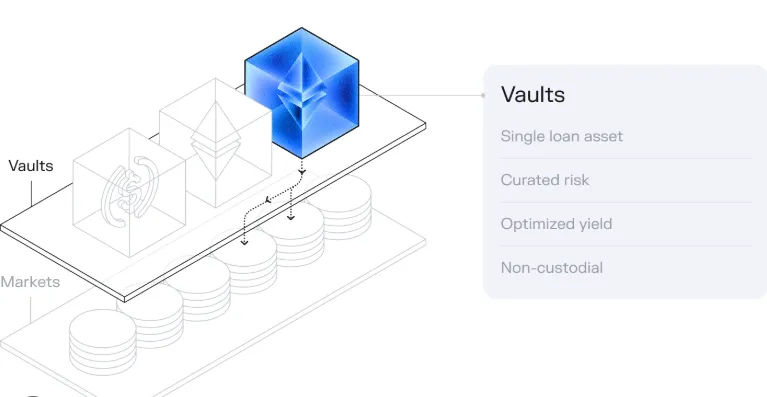
Image by Morpho
How Morpho Actually Works: Morpho Blue and Morpho Vaults
Morpho's architecture separates what most lending protocols bundle together: the base layer execution and the risk management layer. Understanding both is the key to understanding why Morpho has attracted the institutional attention it has.
Morpho Blue
The core protocol, described by the team as a lightweight and immutable lending primitive. It is a minimal set of smart contracts that enable anyone to permissionlessly create an isolated lending market. Each market is defined by four parameters: the collateral asset, the loan asset, the oracle used to price the collateral, and the liquidation loan-to-value ratio. Once deployed, a market is immutable — no one can change its parameters, not even the Morpho team. This design choice eliminates one of the most significant risks in DeFi: governance attacks that alter risk parameters on pools that users are already exposed to.
The immutability also means Morpho Blue has an extremely small codebase, roughly 650 lines of Solidity. Fewer lines of code means fewer attack surfaces. The contracts have undergone over 25 independent security audits and have been formally verified, meaning mathematical proofs have confirmed that the code behaves exactly as specified under all conditions. For institutional participants who need to satisfy compliance and risk management requirements before deploying capital, this level of security documentation is a prerequisite rather than a nice-to-have.
Morpho Vaults
Known as MetaMorpho vaults, are the abstraction layer built on top of Morpho Blue for users who want a simpler experience. A vault is an ERC-4626 tokenized vault managed by a curator, which is a third-party risk specialist. When a user deposits into a Morpho Vault, the curator allocates that capital across multiple Morpho Blue markets according to their risk strategy, automatically rebalancing to optimize yield while managing exposure. Curators include established DeFi risk managers like Gauntlet and B.Protocol, as well as traditional finance entities beginning to participate in on-chain lending.
The vault system comes with built-in safety mechanisms including supply caps per market, time-delayed rebalancing to prevent rapid capital shifts, and guardian roles for emergency interventions. For institutional depositors, these governance controls satisfy the kind of oversight requirements that would otherwise make direct DeFi participation impossible.
This two-layer architecture is Morpho's central innovation. Morpho Blue provides the raw, trustless, immutable foundation. Morpho Vaults provide the managed, user-friendly interface on top of it. The protocol is simultaneously appropriate for a sophisticated DeFi power user who wants to interact directly with individual markets and for an institution that needs a curated vault with documented risk parameters.
Morpho founded in Paris — seed round closes
Three Paris students founded Morpho in 2021. Here is the full milestone timeline from seed round to Apollo's $940B endorsement and the Morpho V2 era.
The Institutional Validation Story
No other DeFi lending protocol in 2026 has the institutional endorsement profile that Morpho has accumulated in the past twelve months, and it is worth examining each relationship in detail because together they tell a story about where on-chain lending is heading.
Coinbase integrated Morpho's infrastructure in January 2025 to power Bitcoin-backed loans on the Base network. Users could borrow USDC against their Bitcoin through Coinbase's interface, with the actual lending logic running on Morpho's smart contracts underneath. Within eight months, Coinbase had surpassed $1 billion in Bitcoin-backed loan originations through the protocol, with over $1.7 billion in collateral and over $450 million in USDC earning yield. This is the largest single integration in DeFi history by most measures, and it happened because Morpho's immutable, audited infrastructure was the only DeFi lending product that Coinbase's compliance team was comfortable integrating into a regulated consumer product.
Apollo Global Management, the asset management firm with $938 billion in assets under management, signed a cooperation agreement with the Morpho Association in February 2026. The agreement gives Apollo the option to acquire up to 90 million MORPHO tokens, representing 9% of total supply, over the next 48 months through open-market purchases and OTC transactions. The acquisition includes transfer and trading restrictions to prevent destabilizing the market. This is one of the largest institutional crypto token acquisition commitments in DeFi history, and the strategic intent is clear: Apollo gains long-term governance influence over the protocol that is becoming the backend for institutional on-chain lending.
The Ethereum Foundation has deposited into Morpho Vaults twice under its current treasury strategy, totalling nearly $19 million as of March 2026. Morpho is the only DeFi protocol to have received this dual endorsement. The Ethereum Foundation's treasury policy explicitly prioritises permissionless access, self-custody, immutability, and censorship resistance, a set of requirements that Morpho satisfies and that most other lending protocols — including its primary competitor Aave — have struggled to meet cleanly given their more complex governance structures.
Real-world asset deposits on Morpho grew from near zero at the start of 2025 to $400 million by Q3 2025, reflecting the protocol's expansion into tokenized private credit and other TradFi instruments.
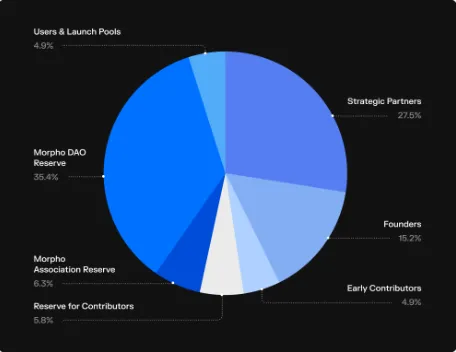
Image Morpho
MORPHO Token: Governance, Supply, and the 2025 Restructuring
The MORPHO token is the governance and utility token of the Morpho Protocol. Its total supply is fixed at 1 billion tokens. As of early 2026, approximately 404 million are in circulation, representing roughly 40% of the total supply.
The token distribution gives the community and DAO the largest share. The Morpho DAO treasury holds 35.4% of total supply. Strategic partners received 27.5%. The Morpho Association holds 6.3%. Founders and contributors hold approximately 15.2%. This allocation is notably more community-weighted than most DeFi protocols, where founding teams frequently retain 20-30% or more with favorable vesting terms.
A significant structural event occurred in 2025 when Morpho Labs became a formal subsidiary of the Morpho Association, which is itself owned by MORPHO token holders. This means MORPHO holders do not just control a DAO treasury — they own the equity of the company building the protocol. This is a more direct alignment between token value and business value than almost any other DeFi project has implemented.
The token became transferable and tradable in November 2024 after having been non-transferable during the protocol's early growth phase. It reached an all-time high of $4.17 in January 2025 before correcting alongside the broader altcoin market. As of late March 2026, MORPHO trades at approximately $1.49, with a market cap around $600 million against a TVL of $6.9 billion.
The token serves three functions. First, governance: MORPHO holders vote on protocol upgrades, fee structures, treasury allocations, and key parameter changes. Second, alignment: the restructuring ensuring Morpho Labs is subsidiary to the association means token holders have real economic claims on the entity building the protocol. Third, strategic positioning: Apollo's 48-month acquisition plan creates a sustained structural buyer for the token, which changes the supply dynamic in a way that is not typical for governance tokens.
Morpho vs Aave: DeFi's Two Largest Lending Protocols Compared

Morpho V2: What Is Coming and Why It Matters
Morpho V2 is the protocol's most significant development since Morpho Blue, and its 2026 launch represents the clearest signal of where the team believes on-chain lending needs to go.
The fundamental change in V2 is how interest rates are determined. In every version of DeFi lending to date, interest rates have been set by formulas embedded in the protocol itself. The formula adjusts based on utilization, but the formula itself is chosen by protocol developers and governance. Institutions operating in credit markets do not work this way. They express views on risk and return directly, negotiating rates based on their specific assessment of counterparty credit quality, collateral type, and duration.
Morpho V2 introduces a market-driven rate model where lenders and borrowers make offers specifying what terms they will accept, and the protocol matches them. This is how traditional credit markets have worked for centuries. It removes the ceiling that formula-driven rates impose on DeFi lending at institutional scale, because institutions are not willing to accept a rate that someone else's algorithm determined.
V2 also expands collateral flexibility substantially. Where Morpho Blue supports single-asset collateral per market, V2 supports single assets, multiple assets, or entire portfolios as collateral, including real-world assets and niche assets that would be impossible to model in a traditional DeFi market. Fixed-rate and fixed-term loans become possible, which are the loan structures that corporate treasuries and regulated institutions actually need to plan around.
Frambot described the philosophy in a CoinDesk interview: "V2 unlocks the potential of on-chain lending by introducing an open market where users are the ones to decide if a loan should be issued, not the protocol."
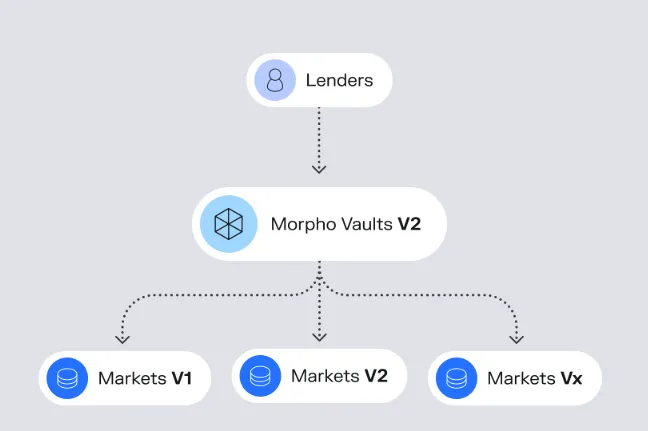
Image by Morpho
An Honest Assessment of the Risks
Morpho's fundamental trajectory is among the strongest in DeFi, but the risks deserve direct treatment.
The April 2025 frontend exploit is worth knowing about. A $2.6 million vulnerability in Morpho's frontend was successfully intercepted by a white-hat MEV operator, c0ffeebabe.eth, before any funds were stolen. The protocol's smart contracts were unaffected. Morpho Labs reverted the faulty update and confirmed all protocol funds remained safe. The incident was a narrow escape and a reminder that even the most audited smart contract stack can have vulnerable frontend components.
Token unlock pressure is a near-term dynamic to monitor. March 2026 was flagged as a significant unlock event for DAO reserves and contributor allocations, which can create short-term sell pressure regardless of fundamental strength. Apollo's 48-month acquisition plan provides a structural offset, but the timing of unlocks versus Apollo's purchase cadence will determine the net supply impact in the short term.
Competition from Aave remains meaningful, particularly as Aave introduces governance changes and new features designed to close the capital efficiency gap with Morpho. However, the recent Aave governance controversy, where protocol revenue was found in a wallet controlled by Aave Labs rather than the DAO treasury, has strengthened Morpho's positioning as the more trustlessly governed alternative.
Smart contract risk is inherent to any DeFi protocol regardless of audit count. Morpho's immutable contract design actually reduces ongoing governance risk but introduces a different consideration: if a serious vulnerability were discovered in Morpho Blue, the immutable architecture makes it impossible to patch. The team has mitigated this by building upgrade paths at the application layer, but the base layer risk is worth understanding.