
What is Ozonechain (OZONE)?
Ozonechain is a 5th-generation blockchain protocol and decentralized finance network. Developed by Automation Technology, the project aims to facilitate secure, low-cost global transactions without third-party intervention. The blockchain was founded in 2022 to address gaps in traditional financial systems like high costs and legislative barriers.
The primary mission of Ozonechain is to create a thriving marketplace for digital goods. It also aims to establish a standardized currency for industries including digital finance, the metaverse, travel, and eCommerce. The project positions itself as an "innovation hub" for interconnected products, websites, and applications.
The native token is called OZONE. It powers all transactions and activities across the network. The project specifically targets young minds, adventurers, and millennials who seek alternatives to traditional financial systems. According to its whitepaper, this demographic will represent 35-40% of the user base within three years.
Who Founded Ozonechain?
Ozonechain was established by Automation Technology in 2022. The company set out to solve problems with traditional banking systems. High transaction costs and regulatory barriers prevent many people from accessing standard financial services. Ozonechain aims to provide an alternative.
The project raised initial funding through two token sales. An ICO ran from July to August 2022 with tokens priced at 90 USDT. An IEO followed in September 2022 with tokens at 100 USDT. These early sales provided capital for development and marketing.
The team allocated raised funds across four main categories:
- 50% dedicated to technology development
- 30% allocated to marketing efforts
- 15% reserved for operations
- 5% set aside for security and legal matters
This allocation shows a heavy emphasis on building the technical infrastructure. The relatively small security and legal budget may raise questions for some investors considering the regulatory complexity of blockchain projects.
How Ozonechain Works: Five-Layer Architecture and dPOSA
Ozonechain uses a modular five-layer architecture designed for high performance and scalability. Each layer serves a specific function in the overall system.
| Layer | Name | Function |
| Layer 1 | Hardware Infrastructure | Peer-to-peer network where nodes verify transactional data |
| Layer 2 | Data Layer | Chain of blocks with digitally signed transactions for finality |
| Layer 3 | Network Layer | TCP/IP communication between nodes with distributed storage |
| Layer 4 | Consensus Layer | Delegated Proof-of-Authority (dPOSA) mechanism |
| Layer 5 | Application Layer | Support for dApps and smart contracts in Solidity |
The consensus mechanism is called Delegated Proof-of-Authority or dPOSA. The team also refers to it as the Ozone Consensus Mechanism (SOCM). This approach differs from energy-intensive Proof of Work systems. It aims to lower energy consumption while increasing transaction speeds.
The architecture is designed to separate concerns. Each layer handles specific tasks without interfering with others. This modular approach should make the system easier to upgrade and maintain over time.
What Is Ozone Virtual Machine (OVM)?
The Ozone Virtual Machine is a critical component of the Ozonechain ecosystem. OVM is Turing complete, which means it can run any computation given enough resources. This capability enables complex smart contracts and decentralized applications.
OVM is compatible with the Ethereum development ecosystem. Developers can use familiar tools like Remix to write and deploy smart contracts. The programming language is Solidity, which is the same language used for Ethereum smart contracts. This compatibility lowers the barrier for developers who already know how to build on Ethereum.
The Ethereum compatibility is strategically important. It means existing Ethereum developers can port their applications to Ozonechain without learning new languages or tools. It also means the large library of Ethereum development resources applies to Ozonechain development.
For users, OVM enables the decentralized applications that make the network useful. DeFi protocols, NFT marketplaces, and other Web3 applications all run on the virtual machine. The quality of OVM directly affects the user experience of every application built on the network.
OZONE Tokenomics: Supply, Distribution, and Burn Mechanism
The white paper lists an initial supply of 50,000 tokens and a maximum supply of 10,000,000 tokens. It also describes an auto-burn mechanism that removes 0.01% of tokens from each transaction. This deflationary mechanism should reduce supply over time.
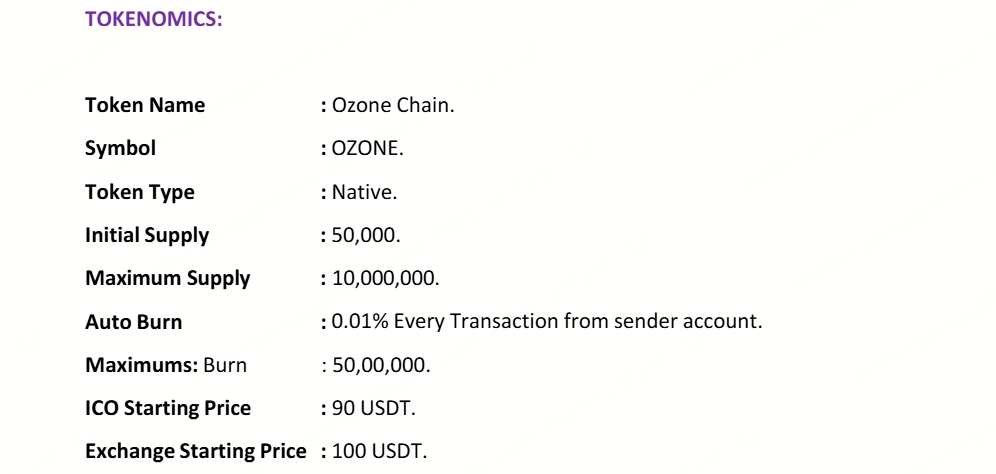
Ozonechain OZONE Tokenomics, source: Ozonechain Whitepaper
Token distribution according to the white paper breaks down as follows:
- 70% reserved for mining rewards
- 10% allocated to the team
- 10% dedicated to liquidity
- 5% for marketing and promotion
- 3% for research and development
- 2% for server maintenance
The heavy allocation toward mining rewards suggests the project prioritizes network security through validator incentives. The relatively small team allocation of 10% is lower than many comparable projects. This could indicate less potential selling pressure from team unlocks.
OZONE Price and Market Performance
The token has experienced extreme volatility since launch. Ozonechain price history shows a dramatic rise and subsequent crash.
The current OZONE price is approximately $3.87, represents a 97.8% decline from the August 2024 peak. This massive drawdown exceeds even typical crypto bear market losses. The token has somewhat recovered from its May 2025 low of $1.62.
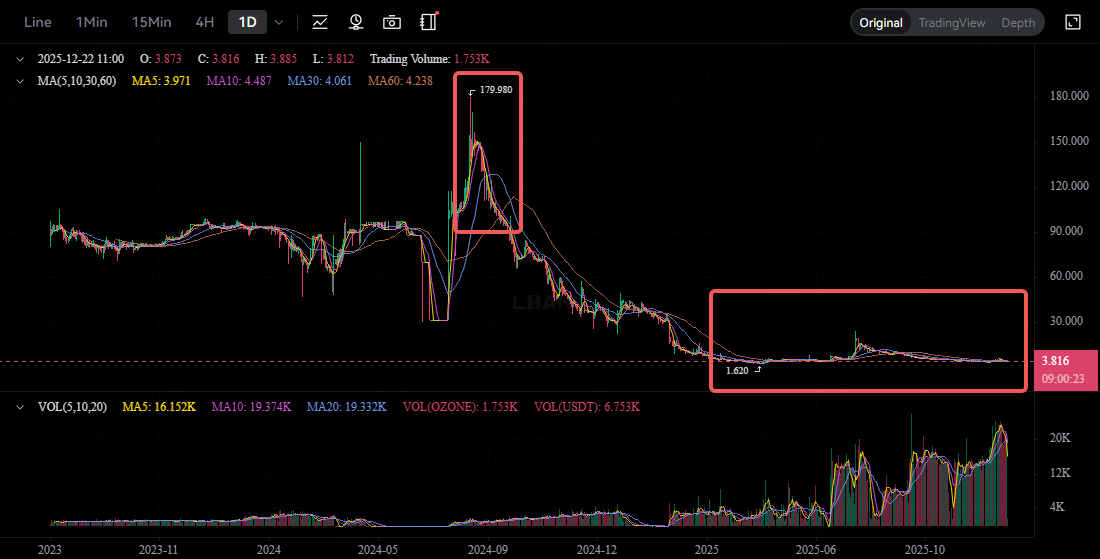
OZONE/USDT, Spot trading on LBank
Trading volume is extremely low at around $1,244 in 24-hour activity. This thin liquidity creates significant risks. Small orders can cause large price swings. Selling a meaningful position could be difficult without major price impact. The price chart shows the classic pattern of a speculative pump followed by an extended decline. Whether this represents a buying opportunity or a warning sign depends on the network's ability to generate real usage and adoption going forward.
Is Ozonechain Active? On-Chain Analysis
Recent on-chain analysis reveals a significant gap between Ozonechain's technical capacity and actual usage. The network functions but sees minimal real activity.
The network currently operates at under 1% utilization. Despite having over 450,000 wallet addresses, daily transaction volume sits at approximately 23,800 transactions. Many registered addresses appear dormant or programmatically generated rather than representing active users.
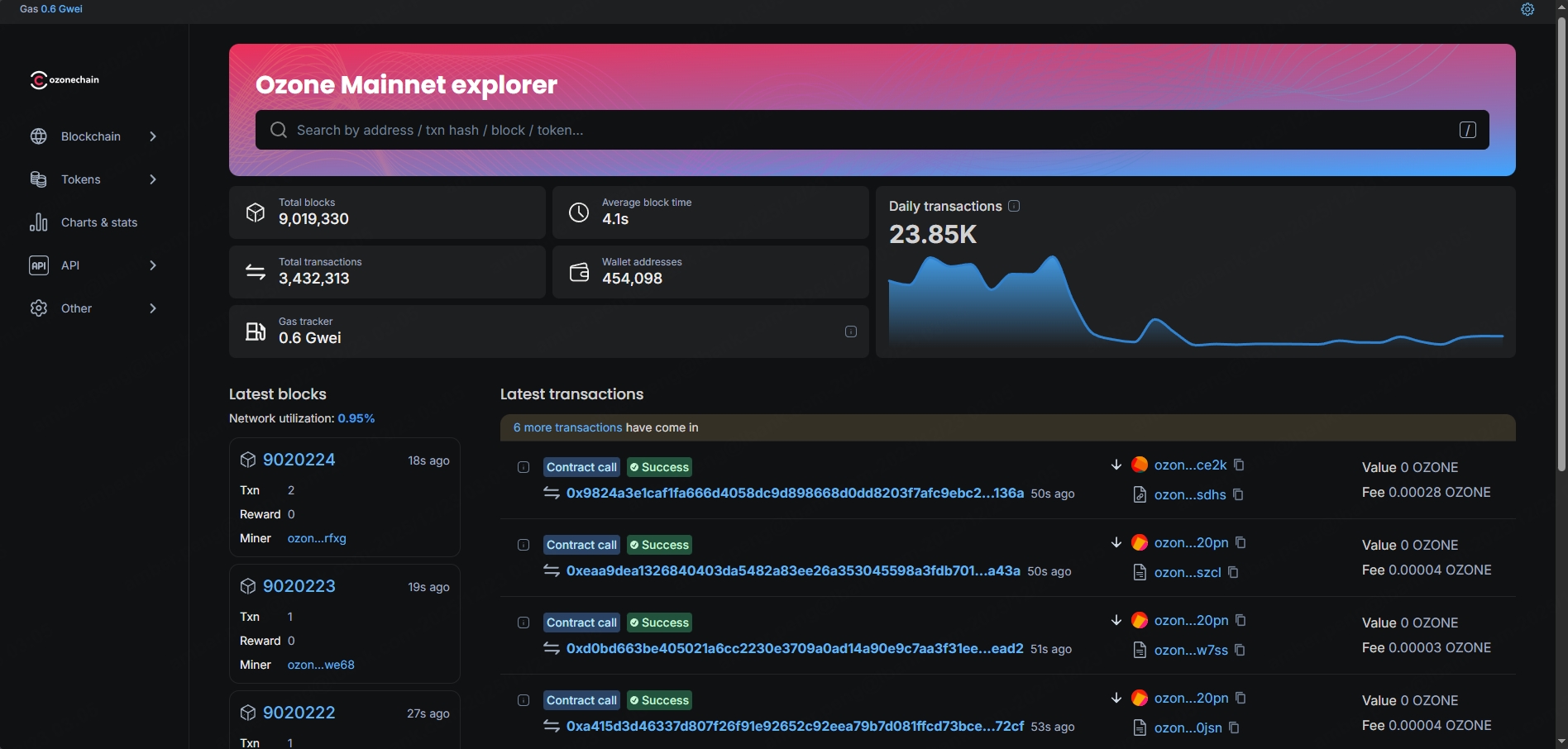
Ozone Mainnet explorer, source: ozonescan.com
Key network metrics:
- Network utilization: Under 1% of capacity
- Registered wallet addresses: Over 450,000
- Daily transactions: Approximately 23,800
- Gas prices: 0.6 Gwei (very low)
- Block rewards: None visible in recent blocks
Transaction quality raises additional concerns. Most recent activity consists of successful contract calls with zero token value transferred. This pattern suggests automated system-level interactions rather than organic user activity. Real economic activity would involve actual value transfers between users.
The low gas prices of 0.6 Gwei result from limited competition for block space. This is not evidence of superior efficiency. It simply means few people are trying to use the network. Performance under actual load remains untested.
What Ozonechain's Low Network Usage Means
Think of Ozonechain as a massive, multi-story luxury shopping mall built in a newly developed district. The mall has state-of-the-art security systems and high-speed elevators representing the dPOSA consensus and OVM. The developers have promised it will eventually house everything from banks to travel agencies.
But the mall's corridors are nearly empty right now. Most of the "activity" is just automated security systems and maintenance robots running diagnostic checks. These are the zero-value contract calls appearing in on-chain data. Actual customers buying goods would look very different.
The absence of visible block rewards is particularly concerning. Validators need incentives to secure any blockchain network. If rewards are not visible, questions arise about the sustainability of the current model. Who is running nodes and why?
The structure is stable. Blocks are produced consistently at low gas costs. But long-term survival depends on whether actual users eventually arrive. A beautiful empty mall eventually closes if shoppers never come.
For the roadmap products to succeed, they need users. OzoPay needs people sending payments. Flyzone needs travelers booking flights. The products and the network usage form a chicken-and-egg problem that the team must solve.
Is OZONE token a Good Investment?
Several factors should inform any investment decision about Ozonechain. The project presents both opportunities and significant risks.
Potential positives:
- Five-layer architecture provides technical foundation
- Ethereum compatibility lowers developer barriers
- Ambitious roadmap with real-world use cases
- Token has recovered from all-time low
- Low current prices if network gains adoption
Significant concerns:
- Network operates at under 1% utilization
- Trading volume extremely low at $1,244 daily
- Token down 97.8% from all-time high
- Conflicting information about maximum supply
- No visible block rewards raises sustainability questions
- Zero-value transactions suggest limited organic activity
- Roadmap products remain undelivered
The conflicting supply information deserves attention. The white paper describes a capped supply with auto-burn. Market data suggests no cap exists. Investors should seek clarification before committing funds.
The roadmap products sound useful but remain largely undelivered. The Secured Trade insurance platform scheduled for 2026 is particularly ambitious. Executing on these promises while building network adoption presents substantial challenges.
Low trading volume creates practical problems. Entering or exiting a position of any meaningful size will likely impact the price. Liquidity risk is very real with this token.
For advanced users evaluating Ozonechain, the gap between marketing materials and on-chain reality is the central concern. The technology exists and functions at a basic level. But without real users generating real economic activity, the network's value proposition remains theoretical. Only invest what you can afford to lose completely.