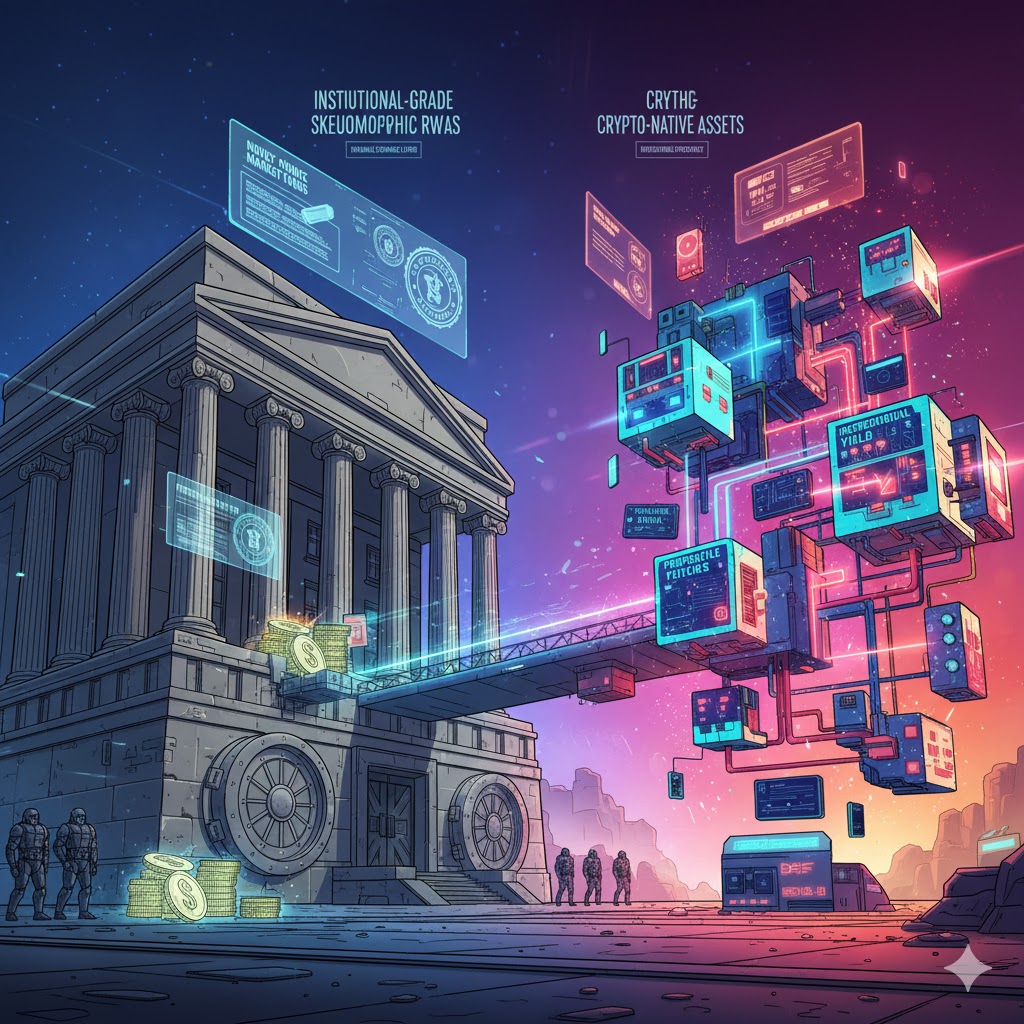
The RWA tokenization market is being affected by many different factors, but most importantly, it will have a shifting conceptual fault line in 2026. A major factor contributing to this will be what type of tokenization we're really building. As cited by the crypto research team at Andreessen Horowitz in their 2026 predictions, tokenization is overwhelmingly backword looking (skeuomorphic); that is, it is rebasing on our conceptualization of RWA as they exist in today's (open) world while not being built to take advantage of the unique intrinsic value of crypto assets/technology (crypto-natively) while moving existing assets into the chain. There is much more than a simple difference between the meaning of skeuomorphic versus crypto-native, it points a way forward for true innovation in this sector, and creates a barrier for distinguishing between protocols building only to digitize the established norm and those protocols that are developing infrastructures that will be relevant ten years out.
What Skeuomorphic RWA Tokenization Actually Means
Skeuomorphic Design is the creation of a new design that closely resembles the old design in both appearance and function. Examples can be found in a digital calendar app that imitates a desk calendar made of paper, or a mobile phone app that makes a shutter sound when a picture is taken. Skeuomorphic RWA Tokenization is the representation of a traditional financial instrument on a distributed ledger (blockchain) while maintaining the same features and restrictions of the traditional financial instrument. These restrictions include the same issuer control over redemption methods, settlement periods, legal wrappers and access restrictions. Thus, the representation of the asset in a digital form on the blockchain is not providing any of the real-world advantages of using a blockchain. Rather, the token is a digital layer on top of the traditional representation of the asset.
According to RWA.xyz data, the bulk of the $24.8 billion in tokenized assets currently stored on-chain belongs to this category of assets. The ownership record is stored on Ethereum, but essentially these funds are money-market funds sponsored and issued by a respected asset manager (BlackRock), with redemption terms set by them, only available to qualified investors using an operational model that closely approximates traditional fund mechanics. The same goes for Franklin Templeton's BENJI Fund, which operates similarly on the Stellar network. These are both institutional-grade products with large capital backing; however, they operate as if they were traditional finance (TradFi) instruments with blockchain tokens. Even though they offer attractive yields and provide evidence of institutional credibility, they do not leverage the unique structural benefits offered by blockchains.
The Scale of Skeuomorphic Dominance in 2026
When considering the need for an easy entry point for institutions into blockchain (especially when it comes to custodial institutional-grade blockchains), it is no surprise that all of the current institutional-grade liquidity on-chain (total value locked, or TVL) can be attributed to skeuomorphic RWAs. The first will continue to be the "cohort" of institutional participants because of the need to use already-existing (traditional) financial institution templates as a point of reference (for legal, regulatory and transactional compliance). In this case, the best examples of real money products built on these well-known, recognizable templates are institutional-grade private credit products like lending pools from Maple Finance, tokenized money market funds and tokenized US Treasuries (which are valued at over $10 billion).
While there are many different rules governing investor whitelisting, required redemption logic, limitation on the permitted transfer of funds (and/or use of third parties), are specifically met by using compliance frameworks, like ERC-3643 and T-REX protocol, which govern how each of these tokens are issued. By making these tokens operate under exactly the same way that traditional securities do, and by complying with all applicable laws (like the ones listed above), these tokens are now considered a low-risk/secure financial product that institutions can purchase.
The dominance of short-term issues does not have an influence on long-term issues. The majority of the $24.8 billion total value locked (TVL) on the RWA blockchain is made up of the traditional way (skeuomorphic). The TVL has only increased (1.2 billion) over the past ten months, showing that there is now enough legitimacy for the institutional investors in crypto to believe that there is truly a reason to move toward a more widespread tokenization of assets, which is what the tokenization thesis suggests.
The acceptance of RWA via a more traditional, or skeuomorphic, procedure has already led to JPMorgan processing billions in tokenized assets using their Kinexys platform and Standard Charterd CEO Bill WInter has projected that the vast majority of future transactions will be settled via blockchain technology. These products are what have established a precedent whereby crypto-native models will now use these products as evidence that regulatory compliant assets can be utilized to the chain without the potential for serious disruptions to the market or firm operations through catastrophic events.
What Crypto-Native RWA Tokenization Looks Like
Crypto-native RWA design begins with assessing what characteristics of the blockchain (e.g., composability, real-time yield distribution, programmability, unrestricted access, and 24/7 settlement) allow for the potential creation of financial products that could never have been created within the confines of TradFi. Instead of asking how a bond looks when copied onto the blockchain, this design instead examines how a bond will look given the capabilities of the blockchain's inherent characteristics. This is accomplished, for example, by examining how the lending process changes from its current state of having Origination, Compliance, Yield Distribution and Secondary Trading occur off-chain prior to the completion of the credit instrument, to having all of these occur natively on-chain the moment the Credit Instrument is established.
Thinking of RWAs as crypto-native assets, there are now two well-known examples: perpetual futures markets and yield tokenization protocols. In A16Z's 2026 research paper titled "Perpification," perpetual futures were found to be the most attractive crypto-native alternative to skeuomorphic tokenization methods for various asset classes. With enhanced liquidity, round-the-clock trading, no expiration time, and no counterparty dependency on an off-chain custodian, perpetual futures offer synthetic exposure to swings in real-world asset prices.
These instruments could only exist in a crypto-native market system and are therefore not tokenized forms of traditional derivatives.
An additional example of a crypto-native approach is the Pendle Finance yield tokenization protocol, which allows investors to disaggregate and trade the yield portion of their tokenized Treasuries or private credit. This outcome creates an inaccessible, unique yield futures market to traditional finance and one that cannot be replicated without successful smart contract compatibility.
Why the Shift to Crypto-Native Matters for the Ecosystem
The distinction between skeuomorphic and crypto-based RWAs consists of how the RWA token ecosystem's value is accumulated. Due to the issuer's retained authority over the RWA's financial logic, the majority of potential value from a skeuomorphic RWA will ultimately accrue to the issuer, whether that is a company like BlackRock, Franklin Templeton, or an intermediary institution like a bank. The utilization of the blockchain to distribute and record transactions does not change the fundamental relationship between the RWA and its underlying legal documentation.
In contrast, while crypto-based RWAs utilize the blockchain to create value for token holders, liquidity providers, and all of the smart contract ecosystems that enable their utilization through algorithmic scaffolding, they also produce long-term economic value at the protocol level through the actions of protocols such as Plume Network and Centrifuge. For example, Plume Network is developing a composable credit infrastructure to generate and distribute yield on programmable debt assets across chains, while Centrifuge is enabling on-chain credit origination rather than just converting pre-existing loans from the off-chain world to the on-chain world.
Both models will coexist and both will expand in 2026, which has practical implications for crypto players monitoring this sector. TVL will continue to be dominated by skeuomorphic RWAs because they cater to institutional capital, which is huge and requires familiar structures. McKinsey's $2 trillion by 2030 estimate encompasses the entire market, not only crypto-native instruments.
However, the protocols that are currently creating truly blockchain-native financial instruments—on-chain origination, composable yield markets, perpetual synthetic exposure, and programmable compliance that facilitates rather than limits financial access—are the ones that will determine where the crypto RWA market develops over the next ten years. Finding initiatives that are actually re-architecting finance on blockchain rails against those that are just putting digital wrappers on TradFi products and calling it tokenization is now the most important alpha in the RWA field.