Security Best Practices for Crypto Users on Centralized Exchanges (CEXs)
 Premalynn2026-03-17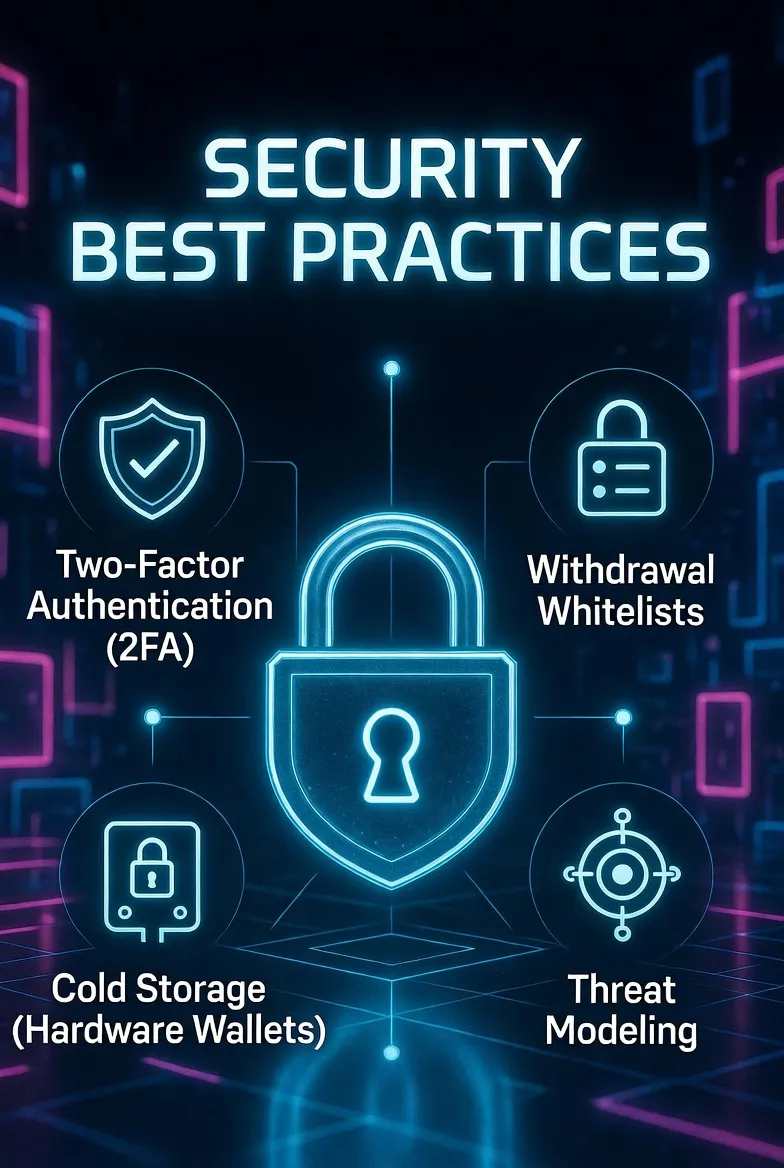
This article highlights the essential security tailored for CEX users, focusing on two-factor authentication (2FA), withdrawal whitelists, cold storage strategies, and comprehensive threat models.
In today's dynamic cryptocurrency world, centralized exchanges (CEXs) continue to play an important role in trading, staking, and maintaining digital assets.
However, their convenience comes with heightened security threats such as phishing, account takeovers, and exchange-level hacks, with a prominent example being the 2025 vulnerability on a mid-tier CEX that resulted in $150 million in stolen assets.
Although CEXs invest enormous resources in platform security such as cold storage for 95%+ of assets and regular audits, users are mostly responsible for safeguarding their accounts.
By putting these security measures into use, individuals can manage risks in an ecosystem where threats evolve rapidly, from phishing attacks powered by artificial intelligence to quantum computing vulnerabilities.
Two-Factor Authentication (2FA): The First Line of Defense
Two-factor authentication has become a must-have for CEX users. It has transitioned from a recommended feature to a mandatory requirement on most platforms by 2026. Beyond passwords, 2FA provides a second layer of verification by requiring something you know (a password) as well as something you have (a device or app).
According to cybersecurity research, activating two-factor authentication reduces account penetration threats by up to 99% by preventing credential-stuffing attacks (a process where hackers utilize disclosed credentials from previous breaches). The most secure 2FA method is app-based, with apps such as Google Authenticator or hardware keys such as the YubiKey producing time-based one-time passwords (TOTPs).
Avoid SMS-based 2FA due to SIM-swapping vulnerabilities, which allow hackers to obtain phone numbers via social engineering carriers (a method that accounted for more than 20% of 2025 cryptocurrency thefts).
For advanced users, Universal 2nd Factor (U2F) hardware tokens offer phishing-resistant authentication by confirming the domain upon login.
Implementation stages include enabling 2FA immediately after account setup, storing recovery codes in a secure offline location (not on your phone or in the cloud), and monitoring related devices on a regular basis.
On some centralized exchanges, 2FA is required for logins, trades, and withdrawals, with options for biometric integration on mobile apps.
It is also important that users turn on anti-phishing codes, which are unique phrases shown in legitimate emails, to help identify phishing attempts.
Despite the effectiveness of 2FA, it doesn’t guarantee total safety, hence, it is important to use it in conjunction with other measures to ensure security against sophisticated attacks.
Withdrawal Whitelists: Controlling Asset Outflows
As a precaution against unauthorized transfers, most leading CEXs have introduced the withdrawal whitelist feature.
This feature restricts cryptocurrency withdrawals to only pre-approved wallet addresses and helps prevent hackers from withdrawing funds even after they have compromised an account. In a setting where phishing attacks resulted in over $1.2 billion in stolen cryptocurrency last year, whitelists have proven essential in preventing impulsive or malicious transactions.
To set up a whitelist, users add trusted addresses (e.g., personal hardware wallets) via the exchange's security settings, often requiring 2FA confirmation and a waiting period of 24-48 hours for activation to deter time-sensitive attacks.
For instance, LBank needs email and Google Authenticator verification when adding addresses to the whitelist (address book) while also offering an optional 24-hour withdrawal lock (cooldown) on newly added addresses when enabled. Best practices include whitelisting only self-custody addresses, avoiding shared or exchange-owned ones, and periodically auditing the list for relevance.
This control extends to fiat withdrawals, where users can whitelist bank accounts. Whitelists are integrated with multi-signature setups by advanced users, necessitating several approvals for modifications. However, over-reliance on whitelists can lead to lockouts if addresses are lost. For this reason, users should maintain secure backups of their wallet details when setting up security measures.
Whitelists also provide an additional robust layer of security by implementing the concept of least privilege, thereby minimizing the damage in case the credentials are compromised in the future.
Cold Storage: Minimizing Exposure on Exchanges
Cold storage refers to the storage of cryptocurrencies entirely offline and away from the internet, thereby making them less susceptible to remote hacking attacks.
For CEX users, this means treating exchanges as temporary hubs for trading rather than long-term vaults, transferring assets to cold wallets post-transaction. Centralized exchange breaches continue to happen even though they have decreased by 40 percent since 2023, thanks to stronger protocols. Experts therefore advise keeping no more than 10 to 20 percent of holdings on any exchange.
Hardware wallets like Ledger Nano X, Tangem, or Trezor Model T are gold standards for cold storage, using air-gapped signing to approve transactions without exposing private keys online.
Users should generate seeds offline, store them in tamper-evident envelopes or metal backups, and avoid digital photos. When interacting with CEXs, employ "watch-only" wallets to monitor balances without risk.
Integration strategies include using CEX APIs for automated transfers to cold storage after trades, or leveraging multi-sig wallets for added redundancy.
For high-net-worth individuals, enterprise-grade cold storage solutions with geographic dispersion mitigate physical theft risks.
Always keep to the mantra: "Not your keys, not your crypto." Regular audits, such as verifying wallet addresses before transfers, prevent errors like sending to the wrong networks.
Threat Models: Identifying and Mitigating Risks
A threat model is an efficient and appropriate approach to assessing potential vulnerabilities specific to your setup, helping prioritize defenses.
For CEX users, common threats include phishing (e.g., fake login pages), malware (keyloggers stealing credentials), insider attacks (rogue employees), and supply chain compromises (hacked exchange software).
AI-enhanced threats, such as deepfake voice or video calls used to support fraud, increase these dangers in 2026.
Rate the likelihood and impact of each threat. High-value accounts warrant stricter measures such as using dedicated devices for crypto activities.
Effective mitigating strategies include limiting API keys, putting up real-time notifications to check for anomalous account behavior, and employing a VPN when accessing public Wi-Fi.
Advanced modeling incorporates zero-trust principles, assuming breaches and layering controls. Using a reputable password manager such as Bitwarden and antivirus software with specific protections against clipboard hijacking and crypto-targeted malware is highly recommended.
Regularly update models as threats evolve, such as preparing for quantum risks with post-quantum wallets.
Additional Best Practices for Comprehensive Security
In addition to the safety measures mentioned, users should use strong, unique passwords that are generated by managers, avoid logging in with public devices, enable login notifications, diversify across exchanges to spread risk, and participate in bug bounty programs for proactive threat hunting.
Social engineering defenses, like verifying URLs and ignoring unsolicited contacts, are also crucial, and finally, consider insurance options offered by some CEXs for added peace of mind.
Conclusion
To protect cryptocurrency on centralized exchanges, focus and a multi-layered approach are required. Users can significantly reduce their risk within the threat landscape by becoming experts in 2FA, whitelists, cold wallets, and threat modeling.
With the evolution of the industry, these processes not only protect assets but also empower confident participation within the digital economy.