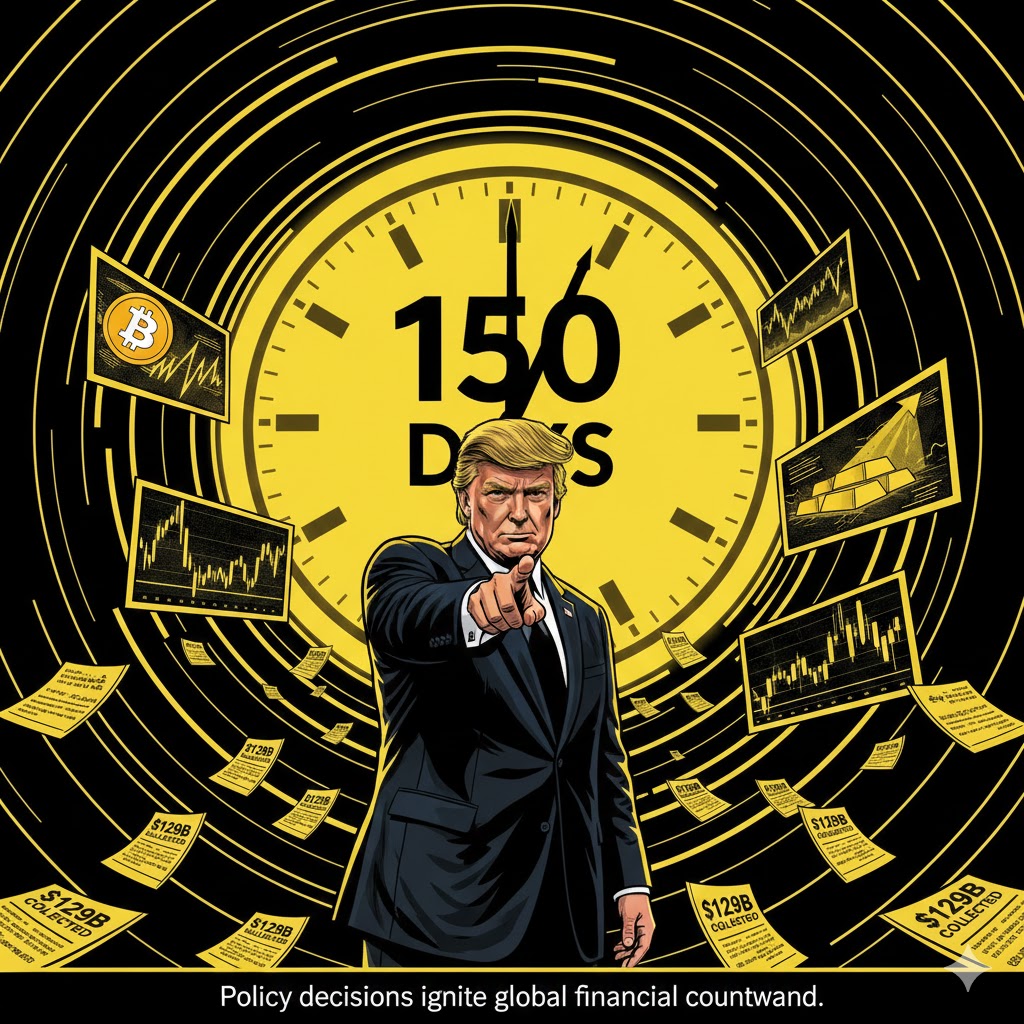
The U.S. Supreme Court issued a 6-3 ruling on February 20, 2020, voiding President Trump's "Liberation Day" Tariffs. The Court found that Trump lacked independent authority to impose tariffs without Congressional approval pursuant to the International Emergency Economic Powers Act, under which he had imposed tariffs. Justices Gorsuch, Barrett (right-leaning), along with three left-leaning Justices; Roberts (Chief Justice), assumed this decision to void the "Liberation Day" tariffs.
The declared total of tariffs collected in the previous thirteen (13) months was $129 billion. Immediately upon receiving this ruling, President Trump executed a Proclamation that implemented Sec. 122 of the Trade Act of 1974, as a blanket 10% worldwide duty, which had never been previously utilized in the history of the Trade Act in its 50 years prior to this date. Therefore, commencement of THIS NEW tax is effective February 24, 2020.
Cryptocurrencies have the tendency to behave similarly to other asset classes when major economic news occurs; immediately respond (that is, major market movements) and then experience a great deal of chaos following that initial movement. The recent announcement of a Supreme Court ruling was an excellent example of this phenomenon. Following this announcement, we saw Bitcoin increase approximately 2% to just shy of $68,000; however, within minutes it fell back down to around $67,000.
At the same time, both the Nasdaq composite and S&P 500 were both up roughly 0.9% and 0.69%, respectively. The lack of stability demonstrated by cryptocurrencies, versus the relative strength shown by equities during the same announcement, provides us with an illustration of the risk profile of assets in the digital currency space today. As such, we have no doubt that cryptocurrencies are not functioning as stores of value, and are instead being treated more like macro leverages bets compared to traditional financial products.
What the Supreme Court Actually Ruled
Cryptocurrencies are usually very reactive to macroeconomic uncertainty at first, but after their initial reaction, you can expect a prolonged period of uncertainty and confusion. The way Bitcoin's price moved after the SCOTUS announcement shows that it has once again gained almost 2%, reclaiming $68,000, before losing that gain and falling back down to $67,000. Meanwhile, stocks on both the Nasdaq and S&P 500 rose by only 0.90% and 0.69%, respectively, meaning that overall, cryptocurrencies are also showing less strength than traditional investments (stocks). This indicates that there are major changes occurring within the risk hierarchy of digital assets: bitcoin will no longer be considered a store of value, rather bitcoin will be treated more like an infinitely-leveraged macro hedge.
The President does not have the power to impose tariffs under AIEEPA, which is another critical yet small piece of evidence that demonstrates how damaging executive authority over trade is. The intent of AIEEPA is to ensure that there will be limitations on finances and sanctions imposed during a declared emergency, specifically stopping transactions from being processed, freezing assets, etc. No president has used AIEEPA to impose tariffs on imports prior to Donald Trump.
The Roberts Court determined that the executive branch's use of AIEEPA would constitute an expansion of Presidential authority over tariff policy that has been reserved specifically to Congress by the United States Constitution. The Roberts Court determined that the use of the significant question doctrine, which requires Congressional approval for laws that have economic implications on this scale, is applicable here.
The ruling said the various Country-Specific IEEPA Taxes and the Reciprocal Tariffs for "Liberation Day", announced in April, 2025, as well as the Duties on China, Mexico, and Canada for Drug Trafficking Related Tariff Items are void. Any other Tariffs that have been assessed or paid under different Acts (Ex: China, Section 301 Tariffs, Section 232 Steel and Aluminum Tariffs) are not impacted by this ruling. The ruling does not address whether refunds will be granted (only lower courts that are yet to hear cases on this issue will decide that) but economists at Penn-Wharton estimate refunds for tariffs collected in excess of $175 billion will be available. Justice Kavanaugh, in dissent, voiced that returning these funds may be a "mess".
Section 122: The 150-Day Clock
While the legal basis for Trump's Proxy Tariff is somewhat imperfect, the Proxy Tariff itself is very creative. Under Section 122 of the Trade Act of 1974, the President can implement a tariff of up to 15% for 150 days due to a "large and serious" balance of payments deficit. The only requirement to impose a tariff under this section is that the President must declare that there is a balance of payments deficit; there is no requirement for other institutions to perform an investigation or participate in an inter-agency process. That made it attractive because it allowed a timely response.
But there are limitations on the Tariff itself: the Tariff must apply uniformly across nations, it cannot be greater than 15%, and the Tariff terminates immediately unless Congress extends it.
Late summer 2026 marks the end of the purported 150-day time limit on the first stage of additional tariff increases under section 301. However, as Secretary of Treasury Bessent indicated to reporter(s), the type of formal investigations that the USTR would conduct will take many months and be far from the timetable specified for those proceedings under sections 301 and 122. The USTR investigation is also critical to support the Secretary of Commerce's national security findings required by Section 232.: IEEPA "could only have provided a very small portion of what was provided at this time would not have provided anything near the extent of what IEEPA could provide."
Therefore, this administration has directed the USTR to commence additional investigations under Section 301. These ongoing investigations may be viewed as a precursor to an indefinitely permanent tariff regime. Hence, this ongoing tariff situation for the cryptocurrency market is not only continuing;, but is also likely to get increasingly complicated and unpredictable in nature.
How This Reshapes the Crypto Macro Picture
The immediate report suggests there are more reasons to be bullish on Bitcoin now due to a broad-based removal of IEEPA tariffs eliminating many supply chain issues, and reducing fears of retaliatory trade conflicts...which supports the value of the U.S. dollar and lowers overall risk appetite for assets like Bitcoin as a result. MV Sigel, from VanEck, recently tweeted this could lead to substantially lower receipts from tariffs speeding up the devaluation of the U.S. dollar through increased money printing, which supports the thesis of Bitcoin being utilized as a hedge against inflation. This same type of logic can be seen with gold having also increased $90 or 1.8% to $5,090 per ounce.
This slight short-term bullishness will fade. Similar trade friction issues are again more pronounced by the replacement tariffs, only to a lesser extent. If retaliation occurs by either China or the EU then macroeconomic pressure would be put on all parties. At this time the Fed is grappling with an already stubbornly high 3% year-over-year Core PCE and a decelerating economy that has increased at 2.2% in 2025; therefore, many traders are thinking of this refund question—$150B back to importers—as possible "accidental" stimulus; if this influx of liquidity gets into risk assets, then Bitcoin should increase. If it causes worries about inflation that push the Fed to become more hawkish, then that could decrease the value of Bitcoin. The only determinant of direction will be in what order these events take place.
The Political Overhang on Crypto Policy
The tariff decision directly impacts rules that govern cryptocurrency law. CoinDesk calculated that if the tariff dispute consumes significant floor time in the Senate, cryptocurrency users could miss their opportunity to advance their market structure bill due to a lack of bandwidth in the Senate during their bill process. So far, the only major comprehensive regulatory bill from the industry—the CLARITY Act—has stalled out in Congress. If midterm politics shift toward tariff-related economic messaging, then the way Congress approaches cryptocurrency may shift dramatically following the 2026 elections—as Democrats are already defining tariff-related economic messaging as a success for consumer protection.
Senator Bernie Moreno, who supports cryptocurrency, said that it was terrible for Senate to make that decision. Senator Elizabeth Warren praised it but then switched focus to consumer dissatisfaction with the Tax Foundation estimating the cost of the tariff for households is $1,300 this calendar year. If Democrats win the House of Representatives, the chances of crypto legislation passing will be slim because prediction markets give Democrats a very big advantage. As a result of all the political calories spent regarding tariffs, there was inadequate political calories available for Strategic Reserve, Bitcoin Market Structure and Stablecoin Frameworks and all of the aspects have been affected.
What Crypto Investors Should Actually Watch
The 150-day clock is one of the main triggers. Unless Congress action extends Section 122 duties will be set to expire in late July creating a deadline for legislative action or escalation to other trade authorities. The outcome from the refund lawsuit hearing to take place in March and April is expected to determine if $150 billion or more will be re funded back to importers which could significantly impact the expectations for liquidity. The indicator representing the institutional mood continues to be the spot Bitcoin ETF flow which, after Friday's surge in price, still experienced ETF net outflows of $165 million on the day before Friday; resulting in three consecutive days of redemption, as well as total outflows of over $4 billion in the prior five weeks from spot ETFs.
Tariffs are now considered a continuous source of volatility in the cryptocurrency market instead of being seen as a one-time event. Every new executive order, legal dispute, or retaliation against a trading partner will act as a macroeconomic stimulus that moves Bitcoin in line with equities. The tariff narrative will remain a crypto narrative until it detaches from its conventional risk sentiment as nothing in the current state of the marketplace suggests this will take place in the near future. Section 122 has given the administration 150 days' worth of time to pay cryptocurrency traders equally across all trades.