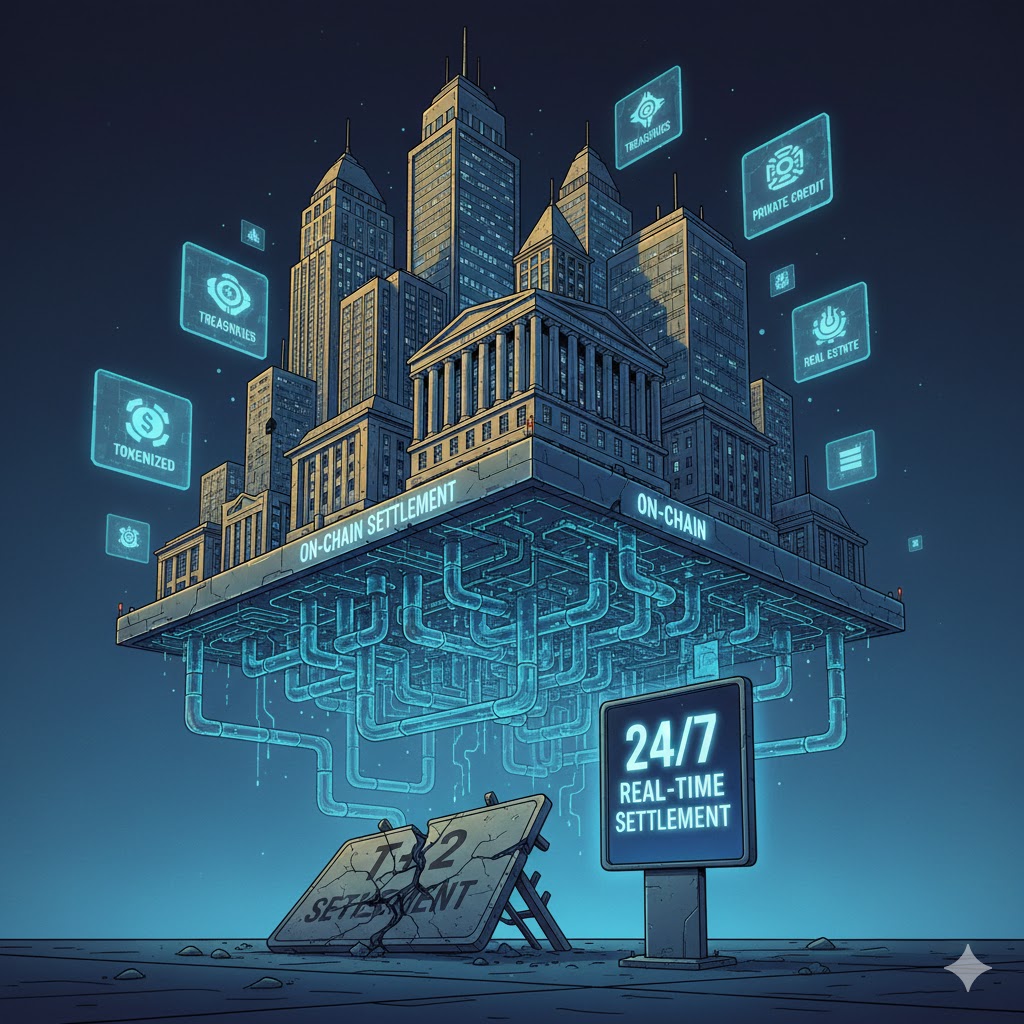
The way conventional finance operated through this long-standing system originated by and for the institutions who developed it is now given an entirely different face in the form of long settlement cycles, time-limited markets, and specific regions and minimum amounts per class of assets. Conversely, blockchain technology was created to challenge this particular framework of operating. The blockchain universe will become synergistic with the traditional one at the large scale level and manner in which we operate (in 2026), through RWA (Real World Asset tokenization) and the impact on cryptocurrencies will surpass current expectations of most players in the industry.
Why the Old Financial System Needed a Rethink
With traditional methods of settling sales of securities; two business days are still required; many different players take a piece for their service; and most of these transactions close on weekends. This can create billions in idle cash that is not earning a return and is in limbo within the clearing process for institutional capital managers. Also, this type of settlement process is not available to retail investors due to restrictions placed on the way governmental debt instruments, real estate funds, and high-yield private loans can be accessed.
Most of this friction from retail investors will be eliminated by the almost-instant settlement of transactions that takes place on blockchain technology - transactions will take place around-the-clock; and compliance standards will be directly embedded into smart contracts on the blockchain so investors do not have to rely on a centralized counterparty for performing their obligations to other investors.
What Actually Changed Between 2023 and 2026
The spark of clarity within regulations. The GENIUS Act was enacted in the United States of America on 7/1/2025; the GENIUS Act will allow for legally binding rules to be created, held and redeemed for all digital assets. This type of institutional capital will be necessary before committing any actual balance sheet resources to blockchain technology. The EU's MiCA law, which became effective in 1Q2024, created another jurisdiction where there was legal certainty to conduct business within that jurisdiction.
The change in institutional investors occurred rapidly, as soon as the risk of non-compliance was mitigated. BlackRock created the first Tokenized money market fund backed by short-duration U.S. government securities (Treasuries) – the total amount of dividends from Treasury assets was over $100 million by the end of the year 2025. JP Morgan created the first Tokenized Private Equity Fund on its own blockchain network (October 2025). Franklin Templeton created the first fully on-chain money market instrument with real-time settlement (December 2025). These were production-grade financial products and not tests creating by the blockchain infrastructure.
The Market Numbers Behind the Narrative
Tokenized Real-World Assets (RWA), which include on-chain assets (excluding stablecoins), will range from $19 billion to $36 billion in January 2026, having expanded by over 300% compared to the previous period. The U.S. Treasury is a significant contributor to this category with a value of over $8.7 billion, or 45% of all tokenised RWAs. Total tokenised US Treasury values rose from $5.5 billion in 2024 to mid-2025, to $5.5 billion (539% increase) and kept increasing as well. Based solely on the Ethereum platform, the total value of tokenised RWAs on-chain has a total value of $65 billion; therefore, Ethereum makes up roughly 65% of the total value in this space. According to Boston Consulting Group (BCG), the overall market for tokenized RWAs could reach $10 trillion by 2030, while McKinsey says it could reach only $2 trillion by 2030.
Why This Is Critical for Crypto, Not Just TradFi
RWA Tokenization is Solving One of DeFi's Greatest Structural Challenges: Sustainable, Non-Speculative Yield.
Historically, protocol yields have been primarily supported by leveraged speculative trading and inflationary token emissions, both of which have proven to be unviable for long-term institutionally required capital investment.
The introduction of tokenized US Treasuries that generate 4%-5% government-backed interest yields and are usable through DeFi lending protocols has therefore completely changed the opportunity for capital previously lacking any motivation to transact on-chain infrastructure.
A key new growth vector for DeFi will be the establishment of permissioned RWA collateral markets created by DeFi lending protocols, where institutions will submit tokenized assets in exchange for stablecoin liquidity. This type of convergence in financial instruments was nearly non-existent just two years ago.
The Expanding Scope of What Gets Tokenized
No longer am U.S. Government Issued Bonds the Only Asset Class Represented in Real Time through a Blockchain Based Financing Mechanism! Active onboarding and lending to Private Credit will become an important part of the growth plan for on-chain lending; Private Credit already has more than $18.9 Billion in Outstanding Receivables, a compound annual growth rate (CAGR) exceeds 100% over the past 12 months.
The tokenization of gold has seen tremendous growth with triple-digit percentage returns since March 2021, reaching over $3.8 Billion. Deloitte projects that by mid-next year, digital currencies that are collateralized by commodity assets will continue to be represented by approximately $1.9 Billion. Additionally, the fractionalization of real estate has played a significant role in driving forward the overall adoption of real estate tokenization; Deloitte projects that by 2035 there will be Approximately $1.0 Trillion in Tokenized Private Real Estate; 2026 marks the beginning of a tremendous technological infrastructure renovation for the capital marketplace. Tokenization initiatives and projects for corporate bonds, short-term corporate debt instruments, trade receivables, supply chain assets, and Green Bonds are getting underway today.
The Challenges Still on the Table
Yes, there is still some friction on this path, but real progress is happening. Market activity in the secondary market continues to depend largely on issuers redeeming their tokenised products and the market infrastructure for these tokenised products remains relatively fragmented, with liquidity often forced onto one chain. So, if you have a tokenised asset on one blockchain network, it cannot directly interact with protocols on another blockchain network if there are no bridging layers (which introduce additional security concerns), making the challenge of achieving cross-chain interoperability a separate engineering problem that is yet unsolved.
According to a 2025 academic study, while there are over $25 billion worth of tokenised rwAs on the blockchain, the bulk of them still exhibit low levels of secondary market trading and extremely long average holding times. Furthermore, the enforceability of smart contracts that exist within blockchain technology across legal jurisdictions is also at issue.
The Bigger Meaning for Crypto in 2026
The most obvious evidence to date that blockchain infrastructure has evolved from a speculative tool to a utility-grade financial plumbing system is RWA tokenization. The discussion about what cryptocurrency is shifts forever when big international banks, pension funds, and asset managers start using blockchain technology to address decades-old settlement and liquidity inefficiencies rather than to pursue crypto tales.
As the second half of 2026 approaches, the question is not whether traditional financial capital will continue to move on-chain, but rather which blockchain networks and DeFi protocols will be most valuable. RWA tokenization is now the best data-supported solution available for anyone seeing the origins of the next sustainable phase of crypto development.