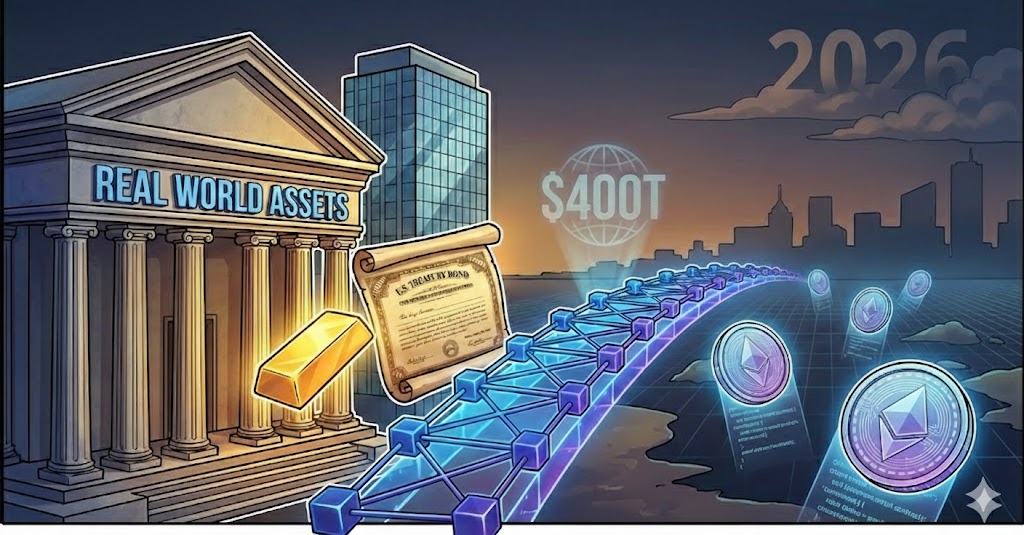
Over the past several years, the cryptocurrency industry has invested many years into establishing a complete financial ecosystem free from reliance upon traditional finance. And now that traditional asset markets have begun to transition over to the blockchain, it's hardly surprising that Real World Asset (RWA) tokenization represents one of the top crypto stories leading into 2026. RWA tokenization is the closest direct connection we have created between DeFi and the world of traditional assets ($400 trillion+).
What Does "Tokenization" Actually Mean?
Tokenization is when you convert your ownership rights (of a physical asset) into a digital token that lives on a blockchain. For example, issuing a digital certificate stating "this token represents a fractional ownership of this building, bond, or bar of gold". Once you have created this token you may use it as collateral, trade it, sell it, or transfer it; all using the blockchain and eliminating any additional overhead for processes such as real estate transactions.
Tokens are designed to represent shares of physical non-liquid assets. The only change being made by tokenizing an asset is in how we record and transfer ownership. The smart contract's code running on the Ethereum blockchain (or similar blockchains) manages this entire process automatically, removing the need for paper contracts, centralized registries, and banks to clear transactions.
What Assets Are Being Tokenized?
The RWA groups encompass a wide number of different categories, and the US is by far the most active. RWA.xyz predicts that by late 2025, the total value of tokenized Treasuries will be $8.7B or 45% of the total on-chain RWA market. Private credit represents the largest single sector presently, with over $18.9B of active on-chain lending provided through firms such as Maple Finance, Centrifuge and Goldfinch.
In addition to debt instruments, we will see tokenized real estate, commodities such as gold (PAXG, XAUT), and individual stocks becoming available for purchase, with the entire volume transacted since launch of Backed Finance's xStocks product surpassing $457M in the past year. The list of available items to be tokenized continues to expand at a rapid pace.
Why Does It Matter for Crypto?
RWA tokenization is important in the world of cryptocurrency because it helps to solve one of the long-standing problems with DeFi: yields based purely on speculation in digital currency. Tokenized Treasuries let DeFi protocols offer very real interest based on U.S. government bonds, in place of inflated token supply, which leads to more stable DeFi capital that can attract institutional capital that would have otherwise stayed away from on-chain infrastructure.
In addition, it greatly expands the size of the total addressable market for blockchain. According to McKinsey, the market for RWA tokenization could reach $2 trillion by 2030. The CEO of Standard Chartered Bank has predicted that the majority of cross-border payments will eventually be handled using blockchain by late 2025. These estimates are no longer speculative; they reflect the active flow of institutional capital into this space and the use of DeFi systems built on the blockchain.
Who Are the Key Players?
In late November, when BlackRock launched its BUIDL tokenized money market fund on Ethereum, it created the largest tokenized Treasury fund in the market. Then Franklin Templeton launched its own on-chain money market fund, and subsequently, portions of Hamilton Lane and KKR private equity funds have been tokenized. JPMorgan has used its Onyx blockchain platform to facilitate settlement of advances against collateral for institutional customers for years.
Ondo Finance is a leading crypto-native protocol that offers tokenized exposures to short-duration Treasuries and other yield-bearing investments. The on-chain institutional credit markets are managed by Maple and Centrifuge. The year 2026 will be pivotal for RWAs as different protocols integrate with well-established names from traditional finance on the same infrastructure.
What Are the Risks?
There are still significant hurdles when it comes to Tokenizing RWAs. One of the largest issues is the regulatory classification of tokens; most tokenized assets are considered to be securities, meaning that issuers must obtain licensing to issue tokens and individuals looking to invest need to go through KYC and AML checks prior to making an investment. Furthermore, due to the lack of compatibility between blockchains, that same tokenized RWA cannot necessarily be traded between different blockchain networks—this creates cross-chain fragmentation and results in a diminished ability to trade tokenized RWAs.
While there has been over $25 billion worth of tokenized RWAs on-chain since 2018, according to a recent academic paper published in 2025, up until the time of that publication very little of that value has been exchanged—which means that the vast majority of tokenized RWAs are trading on the secondary market very infrequently (eg, held for long periods of time).
Despite ongoing efforts from industry participants, the overall depth/strength of liquidity in the tokenized RWA marketplace does not yet exist, however the needed infrastructure is actually available today. Legal enforceability related to on-chain contracts, custody risks associated with tokenized assets, and risks associated with smart contracts are still being worked out within the industry as well.
How Can Crypto Investors Get Exposure?
RWA-focused coins and protocols are the most straightforward method. One of the top tokenized yield platforms is accessible through ONDO, the governance token of Ondo Finance. On-chain gold exposure backed one-to-one by physical reserves is provided by PAXG and XAUT. Protocols such as Maple Finance enable eligible investors to profit from on-chain private credit in terms of yield.
Since Ethereum owns almost 65% of the total on-chain RWA value, the rise of this sector contributes genuine economic activity and fee revenue to the Ethereum ecosystem, which indirectly benefits broader crypto portfolios as well. The crypto networks that house tokenized assets stand to gain a great deal of value as their value rises from $19 to 36 billion now to an estimated $100 billion or more by the end of 2026.
The Bottom Line
RWA tokenization is not a concept of the future. With institutional players, auditable on-chain data, and actual yield associated with it, it is already functioning at a significant scale. This is one of the most straightforward responses available in 2026 for cryptocurrency investors attempting to comprehend the source of long-term, sustainable demand for blockchain infrastructure.