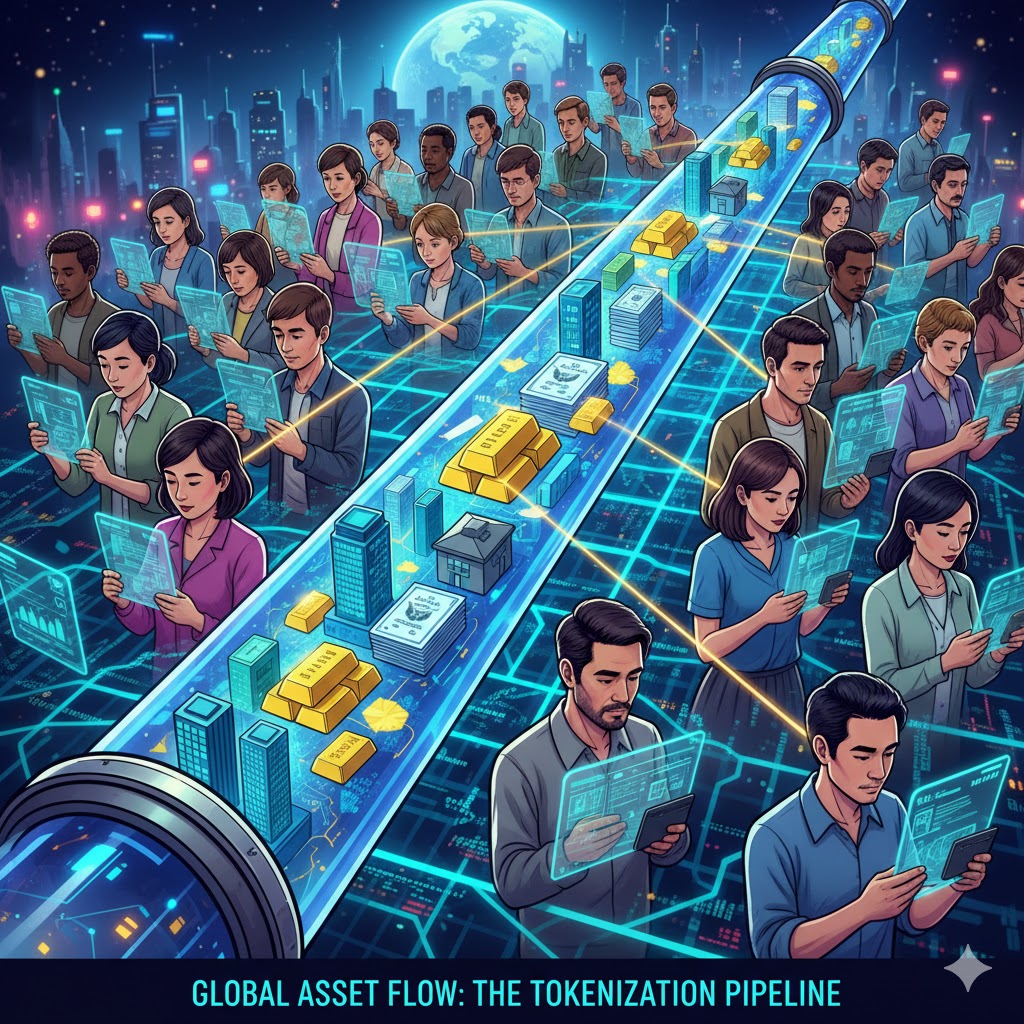
For many years, barriers to accessing high front investments have largely excluded most global investors from these types of investments. For example, private equity funds, commercial office buildings, U.S. Treasury notes portfolios, and fine art collections are out of reach for everyone but the wealthiest investors as a source of wealth creation for them and their institutional counterparties for decades. However, blockchain-enabled fractional ownership of real-world assets using tokenization of real-world assets will eliminate these access barriers and be demonstrably broken with actual working solutions, quantifiable adoption and use cases of multiple on-chain examples of the model working by 2026.
What Fractional Ownership Actually Means On-Chain
With regard to the RWA cryptocurrency market, fractional ownership of a high-value physical asset is accomplished through the issuance of hundreds or millions of blockchain tokens. Each token represents a fractional interest in the economic rights of that physical asset — meaning that you will receive a share of any revenue generated from that asset and any appreciation/proceeds resulting from its sale — so if you own one token of a total of one million tokens, you will have a fractional interest in the economic rights of that physical asset.
When you hold a token in this way, all that means is that you have a fractional ownership interest in that asset. However, you will not be able to hold to the physical asset itself. Instead of keeping records of ownership in a paper certificate located at a physical law firm (as is the current practice), you will hold a digital record of ownership directly on the blockchain.
When you want to transfer your ownership interest to another party, you will send your token to that person's digital wallet, which creates a completed transaction within seconds. This process eliminates the need for a broker, a notary public, and the lengthy process of closing on a physical asset. Because of this unique design feature, an asset class that is inherently illiquid behaves much more like a crypto token while continuing to have real-life value.
Real Estate: The Clearest Democratization Example
There is nothing more clear than how profoundly fractional RWA (real-world assets) tokenization will democratise real estate investment opportunities. Historically, residential and commercial property investments have required access to private real estate debt funds, which require the investor to be accredited or have to put in an entire purchase amount (often in the hundreds of thousands or millions of dollars) before they can purchase their property.
One of the first, and best known, examples of the fractional real estate tokenization is RealT, where investors can purchase fractional interests in rental properties throughout the United States with entry points starting at $50, and token holders receive daily stablecoin payments from the rental income generated by the underlying property. RealT was able to give international retail participants access to a class of assets that were previously only available to institutional investors when they tokenised a large commercial building in New York and created tokens to represent the fractional ownership of the building. So this is not some proof of concept, rather they are fully-functional, revenue-generating positions that exist on-chain, and are open to everyone with a cryptocurrency wallet.
Tokenized Treasuries: Bringing Government Yield to DeFi
In the past, investing in the U.S. Treasury was something that few people could do. For most people, it was possible to invest in U.S. Treasuries through traditional means, such as by opening a brokerage account and making a minimum investment. As a result, access to this form of government-backed fixed-income investment was limited. However, by creating a tokenized version of short-duration U.S. Treasury bonds, Ondo Finance has made it possible for anyone with a compatible digital wallet to invest in U.S. Treasuries by purchasing OUSG tokens. These tokens, which represent fractional ownership in U.S. Treasuries, give people access to the same daily yields associated with having a direct account at a U.S. Treasury Department. At the end of the 2025 reporting period, there was over $8.7 billion worth of on-chain tokenized U.S. Treasuries. Tokenized U.S. Treasuries enable those who have stablecoins sitting idle to turn them into income-generating assets by remaining entirely within the DeFi space.
Private Credit: Opening an Institutional Asset Class
Private credit has historically been considered one of the least accessible forms of investment available to non-institutional investors. Private credit assets are typically made up of trade receivables, invoices, and structured loans made to small and medium-sized businesses. Traditional private credit funds typically have minimum investment requirements in the millions, have long lockup periods, and offer little information regarding the underlying lending portfolio. Tokenizing actual cash flows, such as business loans, invoices and trade receivables, allows Centrifuge to allow on-chain lenders to allocate funds to pools that have yields ranging from 8% to 12% on their funds. Currently, the total value of active on-chain private credit is over $18.9 billion, with the total amount lent in this ecosystem being over $33 billion. The fractionalized structure allows a participant to join into a pool with other on-chain lenders in the same financial transaction, and then paid for their portion of earned interest from the actual borrower of the loan that the pool funded.
Tokenized Gold: Fractional Ownership of a Physical Commodity
Owning real gold has historically come with operational costs from the process of buying gold and selling gold on the commodity markets, to logistics around the custody of physical gold, and to storage costs. With tokenization of real gold—such as Pax Gold (PAXG) or Tethered Gold (XAUT)—the on-chain user has fractional ownership of real gold in professionally managed vaults through a token representing a portion of the physical commodity. By the end of 2023, the cumulative on-chain value of tokenized gold products was over $2.9 billion, with gold accounting for more than 80% of the tokenized commodity market. When holding real gold outside of the blockchain ecosystem, it is not operationally feasible for a user to have an amount equal to a fraction of a single troy ounce, to trade that position at any time without having to arrange for access to the vault where their physical gold is stored, or to use it as collateral in DeFi lending.
Cross-Border Access: Geography Is No Longer a Barrier
Geographical considerations are one of the least discussed yet most critical aspects of fractional ownership of real assets (RWA). With current traditional methods of investing in foreign real estate, international bonds, and commodity markets, most retail investors are unable to obtain exposure through cross-border transactions due to currency translation, regulatory/compliance barriers, local broker requirements, and legal complexities involved with foreign investment.
However, with the advent of fractional on-chain ownership, the geographical factor is no longer relevant. For example, investors with a crypto wallet based in South East Asia can hold fractional interests in tokenized U.S. commercial properties and receive rent in stablecoins through decentralized marketplaces without working with U.S.-based brokers, using wire transfers, or dealing with currency exchanges.
The ability to gain access to various high-profile real estate development projects that only wealthy direct investors could participate in is illustrated by the Trump Organization's tokenization of its Maldives resort project allowing investors to purchase blockchain-based digital shares.
What It Means for Crypto's Long-Term Value Proposition
The fractionalization of real-world assets (RWAs) via tokenization is an important expansion of how we can use the crypto-based financial system networks beyond just as tools for asset management. With blockchain technology, it is no longer a question of whether cryptocurrencies can be classified as financial infrastructure, rather than just speculation. Using blockchain technology, a retail investor can hold shares (that is, fractional ownership) in RWA income-producing assets (like real estate) in a single portfolio that exists on the blockchain. This represents the most definitive proof of the financial infrastructure model of cryptocurrency. Every fractional ownership stake created in RWAs generates utility and revenue for the blockchain network on which it Page | 3 operates. By holding 65% of the total RWA value on the Ethereum network, a material portion of the economic value generated by tokenized RWA assets is supporting the existing infrastructure. Therefore, the potential for democratizing access to RWAs via fractional ownership is not only the most socially impactful contribution of this technology, but it is also one of the most significant long-term factors driving the demand for public blockchain infrastructure.