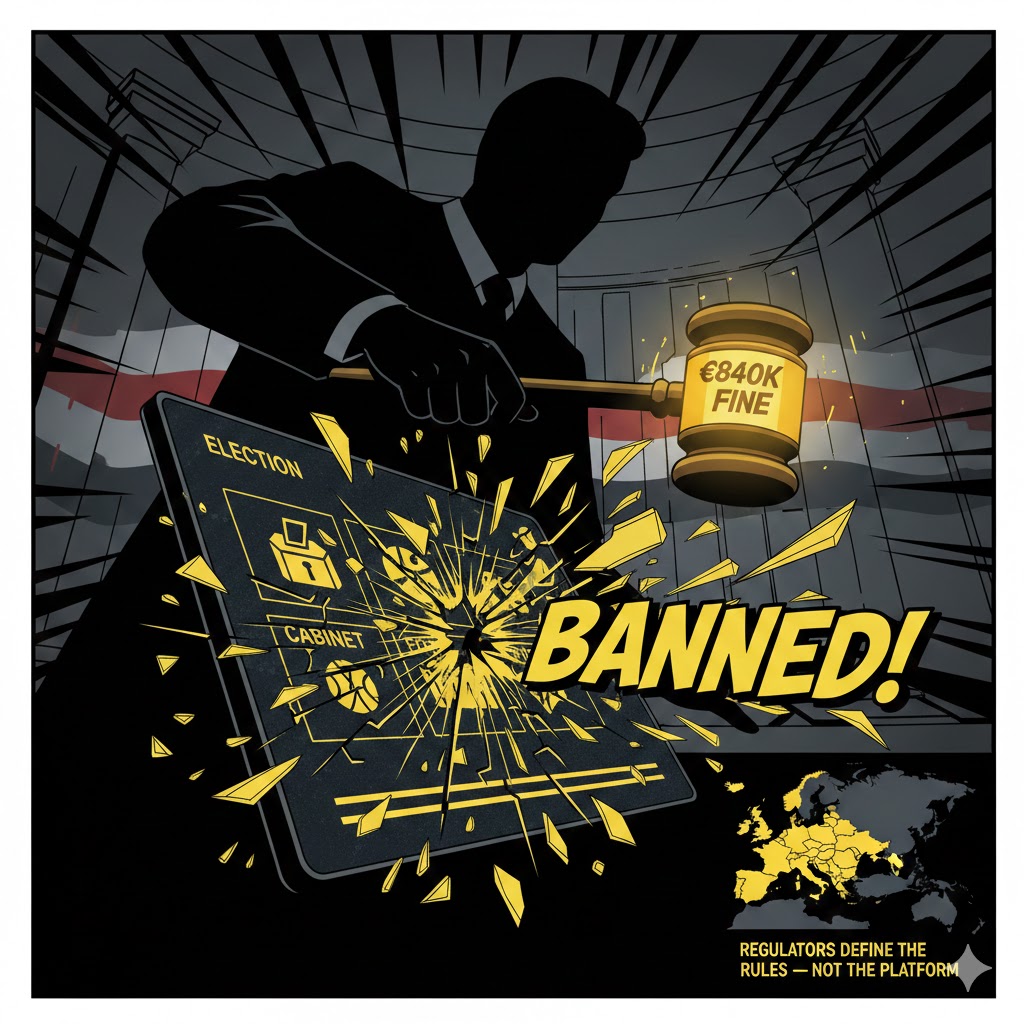
The Dutch government has recently ordered Polymarket to either close its operations in the country or begin complying with Dutch law by paying taxes to the Netherlands. This order comes after Polymarket's parent company, Adventure One QSS Inc., was penalized by the Dutch Gaming Authority (Kansspelautoriteit or Ksa) for providing illegal gambling services without a Dutch license. The Ksa has given Polymarket four weeks to stop accepting Dutch customers. Failure to comply with this order may result in fines of up to €420,000 per week and could also result in additional penalties based upon the company's revenues.
The Ksa issued this ruling on February 17, although it was dated January 20, so it was expected; the Ksa had already conducted an investigation of Polymarket's website, found Dutch residents could register using their local IP addresses, deposit funds using a MasterCard issued by a Dutch bank, and place wagers on events that involved everything from the swearing in of the next Dutch cabinet to the outcome of the next presidential election in the U.S.; in particular, the fact that bets were being placed on the entire U.S. political system, not just the presidential election, raises significant concerns because even licensed operators are prohibited from facilitating betting on lines of credit based on political events in the Netherlands.
In other words, Polymarket was not just conducting its operations illegally but was also facilitating illegal wagers that had no other factual basis than the availability of a license.
The Regulator's Case: Prediction Markets Are Gambling
KSA has made it absolutely clear: in the Netherlands, Prediction Markets=Gaming . The game is over! The name that Polymarket uses for itself as a Prediction Market and not a Betting Game makes no difference! That users can swap positions on those various events also makes no difference! In the eyes of Dutch Law, if you are able to wager your money on an uncertain outcome in the Real World and are able to receive a "payout" when you are right, then that IS a Game of Chance.
All points of access were traced back to the Ksa. There were IP Addresses being used to access Polymarket from the Netherlands. Euro deposits were able to be placed. There was Dutch-language AI chat support available. The Terms of Service imposed by Polymarket did NOT exclude The Netherlands as a permissible jurisdiction for use of the Polymarket Platform. In fact, to see how seamless this process worked, a KSA Inspector placed a wager on Rob Jetten, the D66 Leader. The Polymarket Platform continued to operate. The Polymarket Markets remained open. Ksa continued to move forward with its enforcement actions despite having previously communicated with Polymarket regarding the Dutch-based operations.
Polymarket's Defense: We're a Market, Not a Casino
Polymarket's response across all jurisdictions has been the following. Polymarket claims that rather than being a random process created by an operator, its platform allows users to trade positions on a market based on their understanding and use of market dynamics. Instead of creating an edge for themselves over users, pricing and settlement are determined by the logic contained within the contracts created pursuant to its protocol. Thus, according to Polymarket, it is less a sports book and much more a means of conducting a financial transaction.
The Ksa did not accept the argument. Under the Dutch law, using a product's offered functionality is more important than how the product is labelled. Betting occurs when a user wagers their money on uncertain events and receives money based on whether or not they have made the correct bet. The underlying legal classification does not change (even though the underlying product has been developed on a platform that employs blockchain technology, is settled through the polygon, and is considered a crypto-native product). In all jurisdictions, the primary conflict that prediction markets encounter is that the developers of the products view them as financial instruments while regulators view them as gambling.
A Growing List of Bans
The Netherlands is by no means the first country to take action. Late in 2024, Polymarket was geoblocked by France. The platform was prohibited in Portugal and Hungary. Internet service providers in Belgium completely ban access. In January 2022, Polymarket was fined $1.4 million by the CFTC in the United States for providing event-based binary options without registering. At the state level, Nevada and Massachusetts have contested whether contracts for sporting events and sports amount to unlawful betting. The primary rival of Polymarket, Kalshi, is presently defending itself against a class action lawsuit in New York that claims it is an unregulated sportsbook. Separate lawsuits have been launched by Native American tribes alleging that licensed casinos lose money to prediction markets.
The regulatory map is coming to an end. By the end of 2025, it was estimated that over 43 million transactions would have been completed on the basic prediction markets and that the combined total monthly trading volume would be over 13.5 billion dollars. Such growth attracts attention. As Polymarket continues to operate, it is now a target of regulators in every jurisdiction it enters that does not have a license. As Jan Scheele of Blockchain Netherlands Foundation stated, Dutch regulators "adopt a proactive enforcement stance" and prioritize consumer safety over innovation-first approaches. This creates an existential crisis for a crypto-native platform that has scaled by operating beyond their previous borders.
Why This Matters for Crypto Beyond Polymarket
Prediction markets have become the most clear and concrete product-market fit in crypto. Prediction markets create price signals that out-perform surveys and expert forecasts regularly, they operate on-chain, and they settle automatically. Polymarket's markets for predicting the 2024 US presidential election provided more accurate estimates than most large-scale polling services. The result of this accuracy was an explosion of media coverage, interest from institutions and retail users who had never used a DeFi protocol before. Prediction markets have become the strongest connection between crypto and the real world; after NFTs, the regulatory push-back is similar to that of NFTs due to the increased visibility of prediction markets.
The main issue is that jurisdictional arbitrage is reaching its limitations. Polymarket was created for a borderless internet, is based on Polygon, and settles in USDC. However, local laws govern gambling. Each nation defines a game of chance differently, has its own licensing system, and has different enforcement priorities. The Netherlands is the most recent in a trend, not an anomaly. Additionally, every new ban reduces the market that can be addressed by a platform that makes money by having the world's most diversified and liquid event markets.
What Crypto Investors Should Watch
Polymarket will not be destroyed by Dutch law enforcement. Considering the size of the platform, the fines are minimal. However, precedent counts. The world's largest single market would lock out Polymarket jurisdiction by jurisdiction if all EU members adopted the Dutch approach, and Belgium has already blocked entry. A 36% capital gains tax proposal that is anticipated to apply to cryptocurrency assets is also being advanced by the Netherlands, indicating a wider tightening of the regulations around digital assets.
The Polymarket case is a test of whether onchain items may endure when regulators determine that the label does not correspond to the function for the broader crypto market. One could refer to Polymarket as a prediction market. It's known as gambling by the Ksa. The user experience is what the Dutch law is concerned with, not the blockchain below. That logic will apply to every crypto product that touches regulated activity, from stablecoins to tokenized securities to DeFi lending. Simply put, the polymarket argument is the one that regulators can win the most easily.