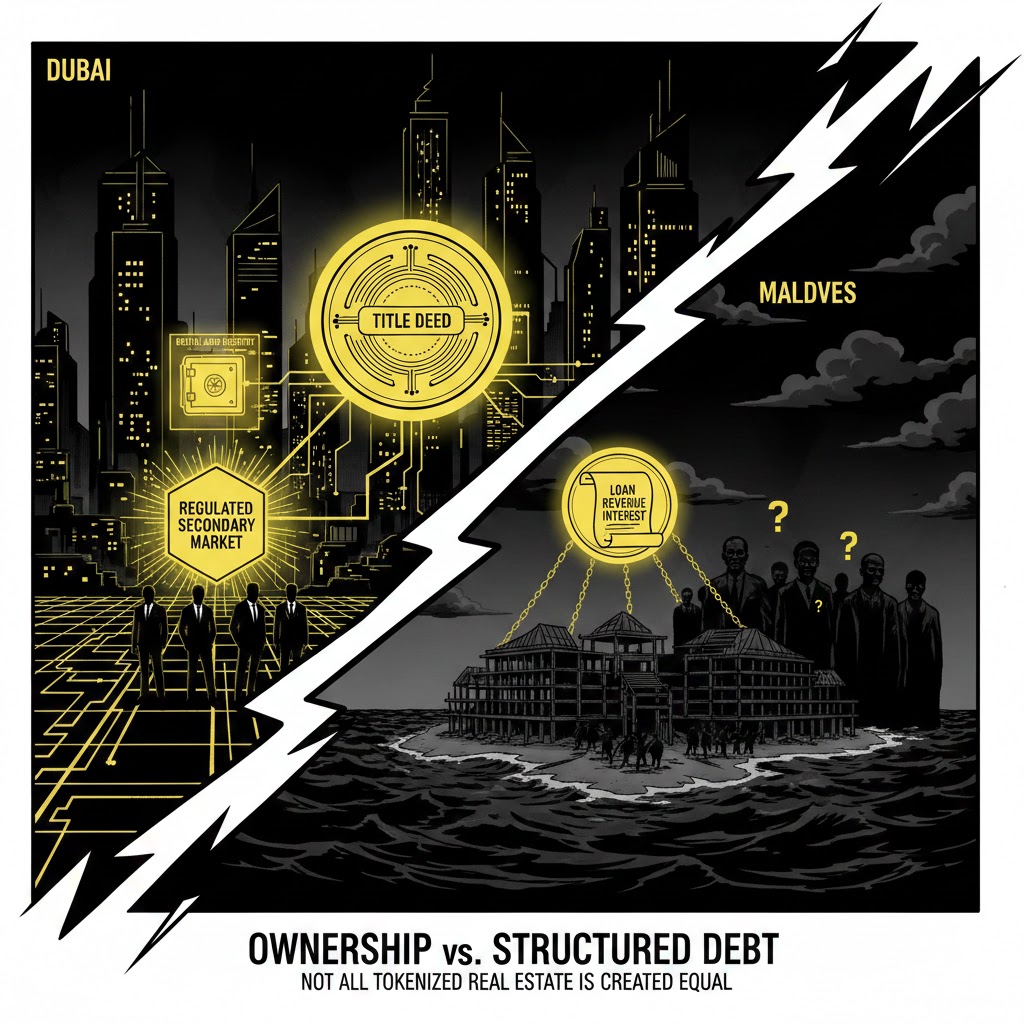
Two different types of tokenized property developments have announced initiatives within 48 hours of each other this week. On Friday, the Dubai Land Department launched Phase 2 of its real estate tokenisation initiative, which allows the 10 properties located in Dubai to trade in 7.8 million property tokens through an established regulated secondary market on the XRP Ledger with the backing from Ripple Custody. Two days earlier on Wednesday, the cryptocurrency company World Liberty Financial, backed by the Trump family, announced its intentions to tokenize loan revenue interest from a Trump-branded luxury resort in the Maldives through its relationship with DarGlobal and Securitize.
The first example is a government-sponsored pilot project with an official land registry system. The second is a private non-government sponsored project owned and operated by a family member of a sitting president that provides fixed yield tokens based on an unfinished hotel.
Therefore, all of these tokenisation examples represent the current state of Real World Asset (RWA) tokenisation in 2026, with massive amounts of physical infrastructure development occurring alongside projects where substantial conflict of interest issues remain. Both of these real estate tokenization models should be understood by current and prospective cryptocurrency participants.
Dubai: The Government-Backed Blueprint
There is evidence that Phase Two has begun in Dubai. Resale of fractional property tokens, which were produced by the $5 million Phase One tokenisation experiment, is now underway through a collaborative effort between the Dubai Land Department and the tokenisation company Ctrl Alt. Each Fractional Property Token is governed by VARA (Virtual Assets Regulartory Authority), linked to the Dubai Land Department's official real estate registry and backed by a legally valid Title Deed. The minimum investment to purchase one Fractional Property Token is AED 2,000, or approximately USD 545. Currently, only people in possession of a UAE Emirates ID can purchase Fractional Property Tokens, but officials have indicated that eligible purchasers from outside the UAE will be allowed to do so soon.
Architecture is key. The XRP Ledger mints onchain digital title to property title deeds and the second compliance layer is an Asset-Referenced Virtual Asset (ARVA) restricting participants' limits on trade and under what conditions. This token is not multiple held to an SPV. The government accepts blockchain-based ownership is legally equivalent (to traditional titles).
According to Dubai's Real Estate Sector Strategy 2033, 7% ($16 billion) of the emirate of Dubai's total real estate market will be tokenized by 2033. Deloitte estimates that at 27% a year, $4 trillion worth of global real estate will be funded via tokenization by 2035. Dubai has positioned itself for this opportunity to make a considerable claim.
The Maldives: Trump, WLFI, and the Political Complication
World Liberty Financial's partnership with the Maldives has a unique structure; those purchasing 'tokens' will not own real property. Instead they will receive loan revenue interests tied to the development of the Trump International Hotel and Resort, Maldives - an ultra -luxury development with 100 villas expected to be finished by 2030. Investors that meet accredited investor criteria will receive a return based on the performance of the loan in addition to receiving fixed interest rates during the loan period. Securitize utilizes secure compliance for issuance and sale which is done under D Regulation of U.S. Private Placements with an embedded prohibition to reselling.
The political ramifications of this arrangement are huge: Donald Trump and his family are involved through DT Marks Defi LLC, which is an ownership interest of 38% in a WLFI affiliate which would be entitled to participate in receiving token revenues. At a crypto-conference held at Mar-a-Lago, Eric Trump announced that the creation of the agreement would serve as the first mayor of many tokenization ventures made by WLFI. Congress has also seen Democrats work to draft legislation for the Clarity Act to include ethics-based restrictions such as those that would address crypto-related conflicts faced by the President. Regardless of whether the transaction structure was established appropriately, a resort with Donald Trump's name on it using tokenization and the fact that the resort is being built while Mr. Trump is in office will be the very type of arrangement to be subject to additional scrutiny by Congress.
Why the Structure Differences Matter for Crypto
In Dubai, property tokens are based on secure ownership via a properly registered and recorded deed and government record. In the Maldives, the tokenized debt is tied to an undeveloped property that won't be developed for four years, and cash flow from loan revenues from that property can support the debt token. The risks associated with these scenarios are not equal; there is a government-issued token (Dubai) that supports an existing asset, whereas the Maldives has no formal tokenization policy, and they are relying on recorded development loans from an existing cash-generating resort.
Because tokenization is used as a term in both instances, they can easily be conflated into one bucket (tokenization of real-world assets on the blockchain), resulting in a potential cost to investors due to the misclassification of security against the developer as opposed to a government system integrated into the land of Dubai.
The Liquidity Problem Nobody's Solved
Liquidity problems are present in even the best examples of tokenization through government initiatives like Dubai's Smart City. Secondary markets that lack liquidity make it difficult to trade tokens, particularly when regulations around token issuance are inconsistent. These are just a few of the many hurdles faced by multi-nationals creating new asset classes via tokenization. Elyse Prypco in Dubai experienced success in selling all 169 of their villas (a unique security) to 40 investors, but how much are these investors willing to pay if they cannot sell their tokens quickly at fair value and without high transaction costs? The same challenges apply to an ongoing project in the Maldives where regulatory restrictions on the transfer of tokens will limit secondary market activity; a token can be purchased but will be very difficult to transfer to another investor. This project exemplifies how a traditional credit transaction can be "wrapped" in blockchain technology without providing true liquidity or composability; both are extremely valuable attributes to a crypto-economy and should therefore be avoided at all costs when developing a new asset class.
What This Week Means for RWA Tokenization
In the last month, the value of tokenized RWA dispersed assets has increased by 11% to $24.8 billion. The number of holders increased by 30% throughout that time. However, the U.S. continues to dominate the sector. Commodities, private credit, and Treasury securities. According to rwa.xyz, real estate is ranked a distant tenth. The announcements this week represent a change, but they won't make it happen right now. Dubai is demonstrating the regulatory viability of registry-linked, government-integrated property tokenization. Tokenization will unavoidably become entangled with political power and presidential branding, as WLFI is demonstrating.
Crypto investors are informed by both projects that RWA tokenization is no longer merely a theoretical concept. It's active, generating actual funds, and drawing the most well-known figures from the public and commercial sectors. Whether or not real estate is tokenized is not the question. The question is whether liquidity, regulation, and infrastructure catch up before the hype cycle does what it always does.