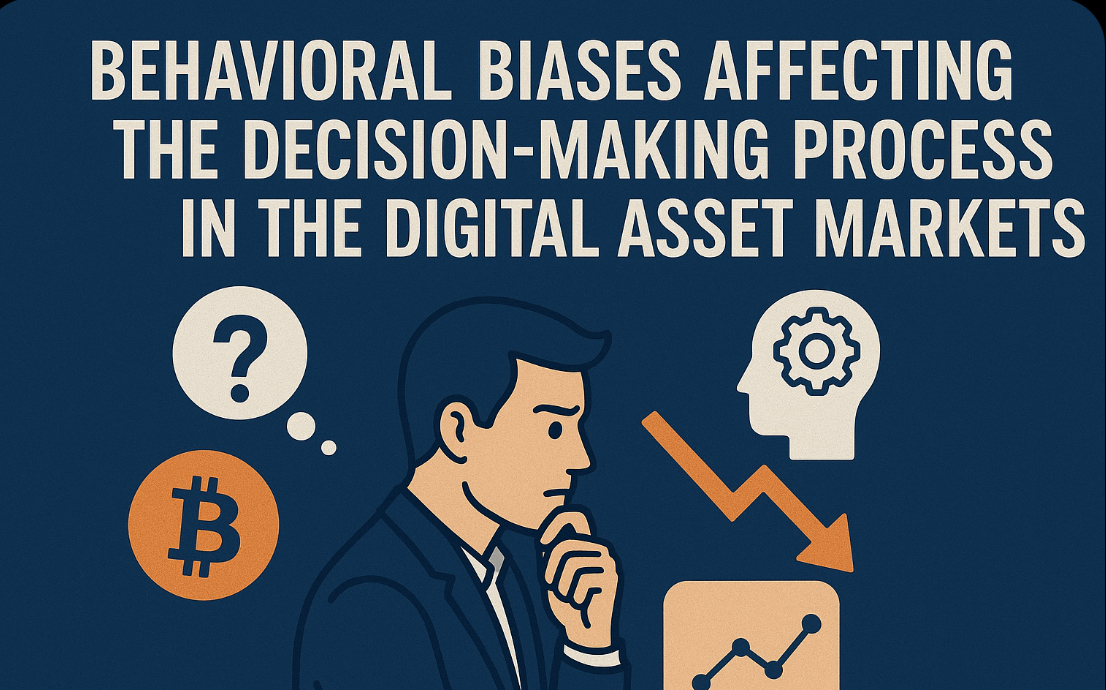
As with traditional financial markets, crypto markets have a behavioral aspect to them. Human behavior is the driving force behind any price movement that occurs on the crypto exchanges. The rapid movement in crypto prices due to high volatility combined with a 24/7 global access environment means that emotional responses often can outweigh rational thought when trading crypto assets.
Anyone who is interested in trading cryptocurrency must understand how to leverage the psychology of crypto traders to successfully navigate the digital asset marketplace. The technologies that allow people greater financial independence have also created an environment in which emotional responses distort perceptions of reality and therefore affect traders' decisions.
How The Psychology Of Crypto Trading Is Different
The differences between crypto markets and more traditional financial markets reflect:
- Crypto assets trade around the clock (without breaks),
- Crypto's much higher price volatility compared with equity investments,
- Retail investors dominate the market and tend to overshadow institutional participation,
- Social media is a driving force regarding the direction of the market,
- There are no long-term valuations of crypto assets.
All these factors cause a higher emotional intensity, and result in a lack of opportunities for traders to reflect on their emotions, as they are operating at full capacity due to both fear and greed.
Changing Emotions in Cryptocurrency Trading
Fear and greed exist in all financial markets, however in the case of cryptocurrencies, they tend to operate much more quickly and intensely.
Greed causes many traders to abandon their trading strategy in order to take advantage of quick profit opportunities (chasing prices up to new all-time highs or waiting for a significant drop in the asset to purchase). On the flip side, fear often results in a panicked sell-off of crypto, especially during significant price declines, even when the underlying fundamentals of the asset remain the same.
This emotional cycle creates exaggerated price booms and busts, and as a result creates greater price volatility.
Fear of Missing Out (FOMO) and Emotional Decisions
FOMO, or the fear of being left out, is one of the major biases affecting crypto trading yet it is often overlooked. The viral success stories of others and real-time price charts compel traders to act without thinking, leading to impulsive actions.
FOMO:
- "Buying at or near the top of the market."
- "Disregarding risk management principles."
- "Placing too much capital in trades rather than diversifying."
- "Entering trades without analysis."
The desire to be involved in the trade outweighs the desire to be correct.
Loss Avoidance & Panic Selling
Loss Avoidance makes traders feel a higher degree of pain associated with losses compared to an equal-sized gain (ie: in crypto markets, drawdowns can reach extreme levels). Because of this, traders often make irrational decisions when exiting trades when they experience panic selling, i.e. panic selling occurs from stress caused by fear of losing money.
Traders exit trades because they are feeling an intense level of emotional discomfort from the fear of losing (rather than exiting due to fundamental analysis showing deterioration of the market conditions), and so they lock in losses, which then prohibits them from being able to participate in market recovery.
Overconfidence & Illusion of Control
Many traders have experienced successful trades in their crypto trading careers and therefore irrationally consider themselves to have the ability to outsmart the market on a consistent basis. As such, they display excessive risk-taking behavior due to overconfidence.
When traders experience overconfidence, they:
- No longer consider potential downside scenarios & outcomes
- Increase leverage on their trades
- Fail to adhere to the established phases of market cycles
- Prefer their own subjective opinion to that of objective data analysis
The markets eventually punish traders for these types of behaviors.
FOMO (Fear of Missing Out)
One bias that affects many traders in the crypto marketplace is FOMO (Fear of Missing Out). The success stories that become viral and the real-time price charts create an impulse to act right then and there.
FOMO causes traders to:
- Buy closer to the top of the market.
- Mistake risk management as a waste of time.
- Over-allocation of their capital.
- Enter trades without doing any technical analysis.
The want to be a part of something larger became an overpowering desire than that of being correct.
Loss Aversion and the Emotion of Panic Selling
The emotional impact of losing money for a trader can be much greater than the happiness of making money. In crypto, where one can experience large price swings, loss aversion can lead to an irrational exit.
Traders will exit a trade not necessarily because things have worsened for them, but because they have reached a point of extreme emotional discomfort. This forced exit results in losses being locked in and removes a trader from any opportunity to recover.
Over-Confidence and the Illusion of Control
Many traders in the crypto marketplace have an over-confidence about their ability to outthink the market, based upon a few successful trades. This leads to over-confidence and increased risk-taking behaviour.
Over-confidence results in traders:
- Ignoring the potential downside.
- Taking on increased leverage.
- Ignoring the cycle of the market.
- Believing more in personal story-telling than in actual data.
Eventually, the market will punish this type of behaviour.
Confirmation Bias in Crypto Communities
The Crypto Community often forms around shared beliefs, as opposed to balanced analysis, so confirmation bias tends to lead crypto traders to look for information that confirms their existing beliefs and ignore information that contradicts them.
As a result, traders will experience:
- Echo Chambers on Social Media
- Ignoring red flags
- Blind loyalty towards a particular token or team
- Poor response to negative news developments
The narrative over everything else becomes the stronger, more attention-grabbing truth.
Anchoring on a Price Point
Traders will use the price anchors, whether it be on an entry point, previous high or even rounded number, as an excuse to hold a resistant position.
Traders display behaviour based on the anchor price of the market and include:
- Not selling due to expecting the price to recover
- Hanging onto losers for way too long
- Unjustifiable profit expectations
- Emotional connections to previously recorded highs
Your anchor price has no effect on how the market will perform at any time.
How Social Media Impacts our Trade Behaviour
Subsequent communication methods like ‘Twitter' in the form of Tweets and ‘Telegram' via Messenger Bots have intensified our psychological trading behaviours. Information on these platforms is very easily accessible and may spread in minutes, even hours, before a full fact-checking process is complete, resulting in the fast movement of ‘Hype’, ‘Panic’, ‘Rumours’ and 'Narratives' at a significantly faster rate than factual and legitimate information. Therefore, as a result of social media communication platforms, we will typically react emotionally to those ‘Trending Opinions’, rather than objectively to factual data, thus encouraging ‘herd behaviour’.
Market Cycles and Trading Behaviour
Both the Bull and Bear cycles within Cryptocurrency Markets are primarily based on the psychological behaviour of the Investor.
A Bull Market feeds a sense of optimism, over-confidence and speculatory excess in a Cryptocurrency Investment. Conversely, A Bear Market produces a sense of fear, regret and withdrawal. Both of these cycles repeat consistently, because our behavioural responses remain the same, regardless of changing Technology.
Discipline Building in Crypto Trading Psychology
Successful Crypto Traders place equal amounts of emphasis on ‘Mindset’, as well as on ‘Strategy’.
Essential Elements of a Successful Mindset
The following are key components to developing a successful mindset for Crypto Trading:
- Set defined parameters for your Risk Management
- Employ Position Sizing Discipline
- Develop a plan for Pre-planned Entries & Exits from the Market
- Avoid exposure to Noise
- Become Comfortable with Uncertainty
- Having Emotional Control is a distinct advantage.
Although blockchains remove most intermediaries, emotion cannot be removed; thus, those who are aware of their own biases, properly manage their Risk and remain detached from Hype will gain competitive advantages in an already highly volatile environment.
In Crypto Trading, your biggest competitor is rarely the Market, it is actually You.