



Ethereum scaling discussions often default to Layer 2 rollups. However, Ethereum’s long-term scalability strategy is rooted deeper in protocol design. Sharding has been part of the roadmap since the early research phase of the Ethereum Foundation. What began as a plan for execution sharding has evolved into data availability sharding optimized for rollups, fundamentally reshaping how Ethereum scales in practice. For real-time Ethereum market data, users can track live metrics on the ETH/USDT trading page or explore broader ecosystem analytics through the Ethereum price page on LBank.

1. What Is Sharding in Crypto?
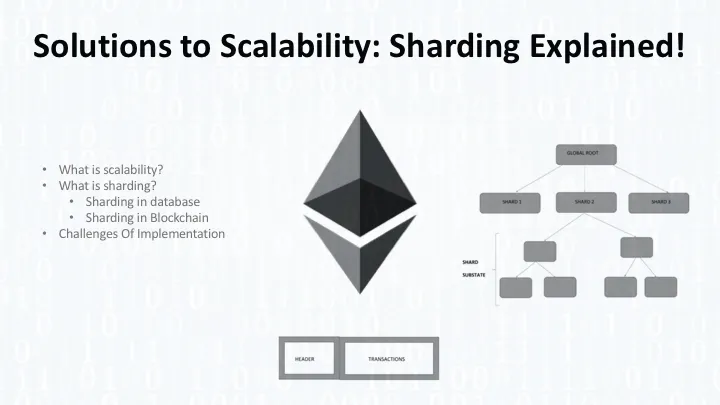
Sharding is a database scalability technique adapted to distributed systems. Instead of requiring every node to process every transaction and store all data, the network is partitioned into shards, each responsible for a subset of the workload. In traditional systems, sharding splits data across servers, parallelizes computation, reduces per-node load, and improves horizontal scalability. Investors monitoring Ethereum scalability narratives often analyze on-chain growth alongside derivatives metrics available on the LBank futures platform.
In blockchain systems, the model is significantly more complex because blockchains must preserve consensus integrity, cryptographic verification, data availability guarantees, and economic security alignment under adversarial conditions.
The theoretical benefits of blockchain sharding include parallel transaction processing, higher aggregate throughput, reduced per-validator resource requirements, and scalability without increasing block size. Market participants following Ethereum infrastructure developments frequently reference the LBank Explore research section for deeper ecosystem analysis.
Unlike conventional databases, blockchains must solve cross-shard transaction communication, atomic composability constraints, validator assignment randomness, shard takeover resistance, and provable data availability for light clients. These constraints significantly shaped Ethereum’s eventual architectural pivot.
Source: Etherworld
2. The Evolution of Ethereum’s Sharding Roadmap
Ethereum’s sharding strategy did not remain static. It moved from an ambitious plan to parallelize execution across multiple chains to a more focused design that prioritizes data availability for rollups. This shift reflects both technical lessons learned and the rapid advancement of Layer 2 architectures.
Execution Sharding: The Original Vision
Early Ethereum research proposed multiple execution shards, each processing its own transactions and maintaining its own state while a shared beacon chain coordinated consensus. This design effectively created parallel Ethereum chains secured under a unified validator set. Documentation of early research can still be found on Ethereum.org and research discussions hosted by the Ethereum community.
However, several structural issues appeared:
- Cross-shard composability introduced asynchronous contract interactions that undermined atomic DeFi design.
- Security fragmentation risk appeared because validator subsets would secure individual shards rather than the entire network uniformly.
- Developer overhead increased because applications would need shard-aware architectures.
- Latency and user experience complications became unavoidable when cross-shard transactions required multiple confirmation steps.
The Rollup-Centric Pivot
As rollups matured and gained production traction, particularly optimistic and zero knowledge designs, Ethereum’s research direction shifted. Rather than sharding execution, Ethereum would minimize Layer 1 execution and scale data availability to support rollups. This rollup-centric roadmap was articulated by researchers including Vitalik Buterin and discussed extensively in research forums such as EthResearch. Broader market reactions to this shift can be tracked through the ETH price tracking page.
The pivot reflected a strategic realization that rollups could handle computation more efficiently while Ethereum preserved security and settlement guarantees.

3. Proto-Danksharding and EIP-4844
The first production step toward full data sharding arrived through EIP-4844, introduced during the Dencun upgrade. The proposal is publicly documented at EIPs.ethereum.org. EIP-4844 introduced blob transactions, a new transaction type that allows rollups to post large data payloads at significantly lower cost compared to calldata.
Blob transactions provide temporary data storage rather than permanent state growth, operate under a separate fee market for blob space, reduce rollup operating costs, lower Layer 2 transaction fees, and avoid inflating Ethereum’s long-term state size. Blob data is not directly accessible to the EVM like calldata. It exists strictly for data availability and verification purposes.
Rollups such as Optimism, Arbitrum, and zkSync directly benefit from reduced data publication costs.
4. Ethereum Sharding Timeline: From Execution to Data Availability
5. How Full Danksharding Will Work
Full Danksharding significantly expands blob capacity and introduces data availability sampling. Instead of requiring every validator to download every blob, the protocol uses erasure coding to expand data into coded fragments and allows validators to sample random portions. If enough validators sample successfully, statistical guarantees confirm that full data is available. If data is withheld, sampling detects it with high probability and the block is rejected.
This model achieves scalability through probabilistic guarantees rather than full duplication. It integrates proposer builder separation and cryptographic commitments such as KZG commitments to ensure integrity. Academic discussions of these mechanisms appear in cryptographic literature and Ethereum research repositories.
6. Performance Impact of Sharding
Sharding does not increase Ethereum Layer 1 execution transactions per second. Instead, it increases data throughput capacity available to rollups. This improves rollup batching efficiency, raises Layer 2 scalability ceilings, enhances compression economics, and reduces transaction costs for users. Under full Danksharding, blob throughput expansion is expected to materially reduce Layer 2 fees and support higher frequency applications that were previously cost-prohibitive.
Ethereum transitions from competing on raw execution throughput to competing as a secure, high-bandwidth settlement backbone for a multi-rollup ecosystem.
How Ethereum Scales with Sharding and Layer 2 Rollups
This talk features Vitalik Buterin explaining how sharding and rollups fit into Ethereum’s long‑term scaling strategy, giving historical context and insights on why the pivot happened.
7. Security Model Under Data Sharding
Data sharding introduces potential risks including data withholding attacks, validator collusion, blob fee market manipulation, and edge-case sampling exploits. Mitigation strategies include randomized validator selection, cryptographic commitments, slashing penalties, and unified economic security under Ethereum’s consensus. Because rollups post transaction data to Ethereum, Layer 1 consensus remains the final settlement authority.
Conceptually, Ethereum provides security and data availability, while rollups provide execution and state logic. This separation preserves economic alignment while allowing specialization.
8. Implications for Professional Users
For developers and protocol designers, lower data costs improve rollup margins, simplify deployment of application-specific Layer 2 environments, and maintain settlement security anchored to Ethereum. For traders and capital allocators, increased rollup competition may compress fees and improve on-chain market efficiency while introducing liquidity fragmentation risks across Layer 2 domains. For infrastructure providers, bandwidth optimization, blob monitoring, and data availability verification become strategic priorities.
Ethereum no longer competes primarily on execution throughput metrics. It competes as the most secure modular settlement and data availability layer in the ecosystem.
9. Open Questions
Open questions remain regarding the full Danksharding rollout timeline, long-term blob fee market equilibrium, cross-rollup composability standards, decentralization impacts of increased bandwidth requirements, and MEV dynamics under high blob throughput. Proto-Danksharding represents a foundational milestone rather than the final architectural state.
Final Perspective
Sharding in Ethereum is no longer about splitting execution across parallel chains. It is about scaling data availability to sustain a rollup-dominant ecosystem while preserving unified economic security. Modular scaling enables specialization and positions Ethereum as secure data infrastructure. For professionals evaluating Ethereum’s scalability roadmap, the critical insight is clear: sharding does not compete with rollups. Sharding makes rollups economically sustainable at scale.