Author: LBank Research Analyst: Steven.fu
Trading Pairs:
Disclaimer: This article is compiled and analyzed from publicly available information and is intended solely for informational and research discussion. It does not constitute investment advice, a securities recommendation, a trading instruction, or any guarantee of returns. The company operations, valuations, market prices, and consensus expectations discussed herein may change over time. Readers should verify the data independently and make their own decisions.
This issue covers seven U.S.-listed technology and digital-economy companies that released their latest Q2 results on August 13: Nu Holdings (NU), JD (JD), GDS Holdings (GDS), Cellebrite (CLBT), Intuitive Machines (LUNR), Globant (GLOB), and StoneCo (STNE). They span digital banking, e-commerce and logistics, data centers, digital forensics, commercial space, IT services, and merchant financial services. This report does not force a ranking across industries; it assesses each company separately to determine whether the latest results improved its earnings, cash-flow, and valuation foundation. Prices use August 13 regular-session closing data, while market capitalizations come from Nasdaq's earnings calendar for that day. Quarterly annualization and guidance-midpoint multiples are valuation stress tests, not earnings forecasts.
I. Core Conclusion: Profit and Cash Delivery Deserve the Reward; Order Quality and Credit Costs Demand Caution
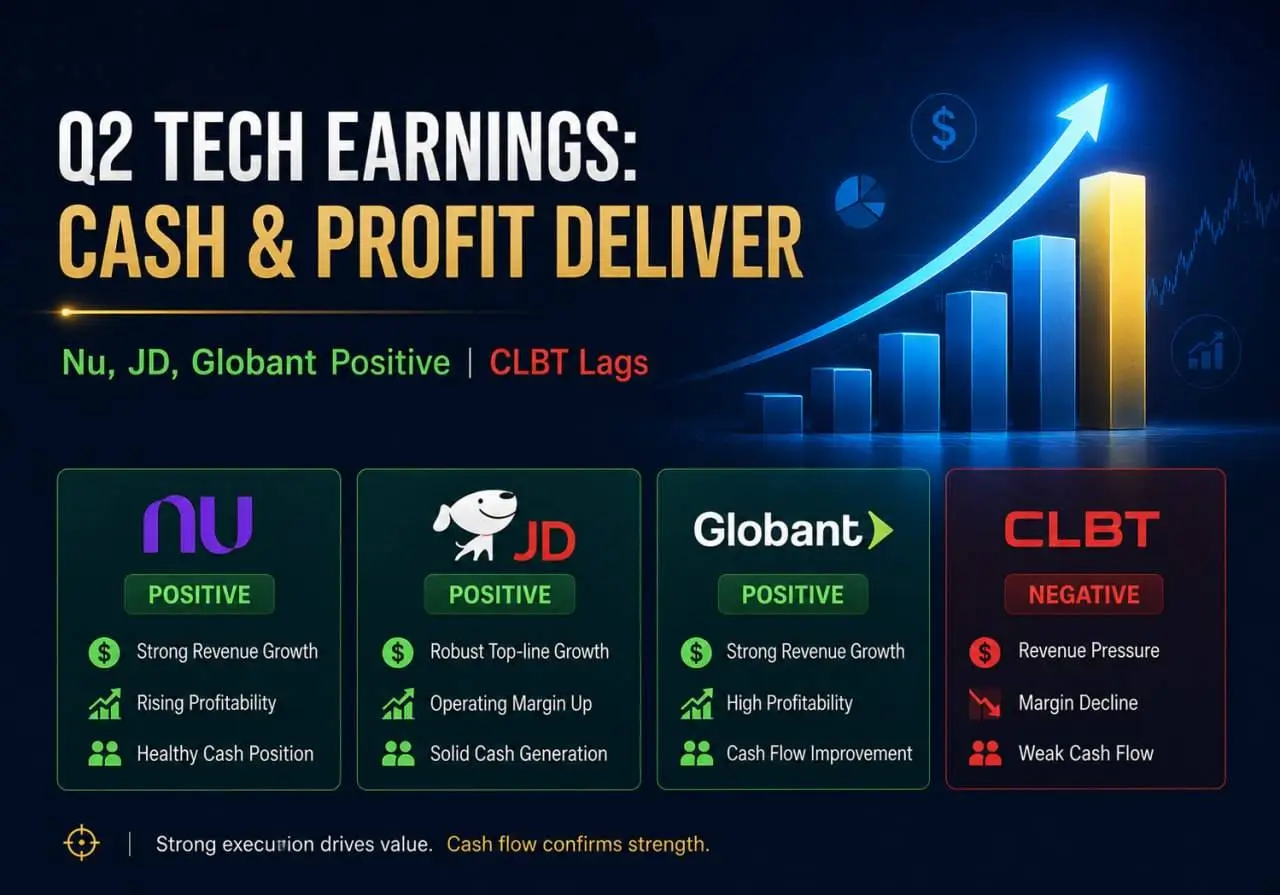
Overall view: This Q2 earnings cycle reveals three distinct qualities of technology-company growth. Nu and JD are converting scale into profit and cash, while Globant presents a valuation-recovery opportunity despite near-zero growth. GDS and Intuitive Machines have strong orders or backlog, but capital intensity and revenue-conversion risk still deserve discounts. Cellebrite's operating profitability remains sound, yet ARR below plan and a lower full-year outlook broke the valuation anchor. StoneCo looks cheap, but rising credit costs temporarily deprive the low multiple of a margin of safety. This report rates Nu, JD, and Globant Positive; GDS and Intuitive Machines Neutral-Positive; StoneCo Neutral; and Cellebrite Neutral-Negative.
|
Company
|
Latest Quarterly Revenue and Growth
|
Core Profit/Cash Signal
|
Valuation Stress Test
|
Rating
|
|
Nu
|
$5.876bn managerial revenue, +39% FX-neutral
|
$1.061bn net income and 33% ROE, but 90+ day NPL rose to 6.9%
|
About $65.84bn market cap and 15.5x quarterly net income mechanically annualized
|
Positive
|
|
JD
|
RMB346.40bn, -2.9%
|
Q2 FCF of RMB31.835bn; TTM FCF of RMB31.415bn
|
About $43.17bn market cap and 9.3x TTM FCF
|
Positive
|
|
GDS
|
RMB3.088bn, +6.5%
|
RMB1.406bn adjusted EBITDA, +2.5%; utilization 79.2%
|
About 13.5x quarterly EBITDA mechanically annualized, including net debt
|
Neutral-Positive
|
|
Cellebrite
|
$131.1mn, +16%
|
$507.8mn ARR, +21%; $144.2mn TTM FCF
|
About 6.8x FY2026 revenue-guidance midpoint and 3.8% FCF yield
|
Neutral-Negative
|
|
Intuitive Machines
|
$206.2mn, about +310%
|
$1.762bn backlog; H1 FCF of -$145.8mn
|
About 3.9x FY2026 revenue-guidance midpoint
|
Neutral-Positive
|
|
Globant
|
$614.4mn, broadly flat
|
Q2 FCF of $12.6mn; Glob.AI ARR of $52.8mn
|
About 6.9x FY2026 adjusted EPS-guidance midpoint
|
Positive
|
|
StoneCo
|
R$3.587bn, +2.5%
|
Adjusted net income -2.6%; 90+ day NPL rose to 8.60%
|
About 5.6x Q2 adjusted EPS mechanically annualized
|
Neutral
|
-
The best evidence in digital finance comes from unit economics and cash, not customer counts alone. Nu reached 138.9 million customers, ARPAC increased to $17.1, risk-adjusted net interest margin rose from 9.5% to 12.4%, and quarterly net income exceeded $1 billion for the first time. JD's revenue fell 2.9%, but service revenue grew 6.8% and Q2 FCF increased about 45%. Nu shows that low servicing costs, cross-selling, and credit pricing can create high ROE. JD shows that a mature e-commerce platform can release shareholder cash through mix and working capital even without top-line growth.
-
Order growth deserves a high rating only when the cost of capital is under control. GDS's area committed and pre-committed grew 18.2%, while area under construction grew 28.8%; at the same time, the company raised full-year capex guidance from about RMB9 billion to about RMB10 billion. Intuitive Machines' backlog increased from $213 million at year-end to $1.762 billion, but it includes $612.8 million acquired with Lanteris and a project estimated at more than $600 million for which only a $45 million authority to proceed has been received. The orders are real, but so are their funding requirements and the uncertainty around ultimate revenue recognition.
-
Cellebrite's one-day decline was not the market ignoring profit; it was the repricing of a growth promise. Q2 revenue grew 16%, adjusted EBITDA margin was 24.2%, and TTM FCF margin was 28%, so the operating foundation did not collapse. The problem was ARR below the company's previous Q2 target, full-year ARR and revenue midpoints reduced by about 2.6% and 1.8%, respectively, and a CEO transition on the same day. A high-quality subscription business can absorb one longer sales cycle, but its valuation cannot ignore repeated execution risk.
-
Globant's growth stagnation has been compressed into a near-trough-cycle valuation, shifting risk-reward to the positive side. The FY2026 revenue-guidance midpoint is about $2.445 billion and broadly flat year over year, while adjusted operating margin guidance remains 13.5%-14.5%. At the August 13 close of $40.99 and the $5.95 adjusted EPS-guidance midpoint, the stock trades at only about 6.9x. Glob.AI ARR remains a small share of revenue and cannot reverse the fundamentals by itself, but the current price no longer requires AI to become the main growth engine immediately.
-
Two frameworks from yesterday's roundup remain valid today. The CoreWeave section stressed that high backlog does not equal high shareholder cash; GDS's higher capex and the structure of Intuitive Machines' backlog reinforce that conclusion. The Rocket Lab section argued that commercial-space valuations must cover cash burn and milestone risk. Intuitive Machines' roughly 3.9x FY2026 revenue-guidance midpoint offers materially more tolerance than Rocket Lab's approximately 50x annualized Q2 revenue in yesterday's stress test, but rising H1 FCF consumption still caps the rating at Neutral-Positive.
II. Review of the Seven Companies' Results
Nu Holdings: $1 Billion in Quarterly Net Income Validates Digital-Bank Scale; Credit Cost Is the One Reversal Variable to Contain
Results. Nu ended Q2 with 138.9 million customers, up 13% year over year. Monthly activity reached 83.5%, and Brazil exceeded an 86% activity rate for the first time. Monthly ARPAC was $17.1, up 22% FX-neutral, while monthly cost to serve remained about $1 per active customer. Managerial revenue reached $5.876 billion, up 39%; gross profit was $2.441 billion, up 43%; and net income was $1.061 billion, up 49%. IFRS revenue was $5.513 billion. Risk-adjusted net interest margin rose from 9.5% in Q1 to 12.4%, while ROE increased from 29% to 33%, showing that customer scale, cross-selling, and credit yields are expanding equity returns together.
Credit, balance sheet, and valuation. The credit-card and loan portfolio reached $39.4 billion, up 37%, faster than 18% deposit growth. Deposits were still $45.3 billion, providing sound overall funding coverage. The warning signal is that the 90+ day NPL ratio increased from 6.5% both a year ago and in Q1 to 6.9%; the 15-90 day NPL ratio also rose from 4.5% a year ago to 4.8%. At the August 13 close of $13.93 and a market capitalization of about $65.84 billion, mechanically annualizing Q2 net income produces a multiple of about 15.5x. That valuation does not price in years of excessive growth, provided credit losses do not consume the improvement in risk-adjusted margin.
Research rating: Positive. Nu has progressed from a high-growth digital bank to a high-ROE digital bank, and this quarter provides the strongest validation yet of its scale economics. The positive view strengthens if ARPAC exceeds $18 over the next two quarters, risk-adjusted net interest margin remains above 12%, and the 90+ day NPL ratio stays at or below 7%. The rating should fall to Neutral if 90+ day NPL exceeds 8%, credit costs continue to grow faster than loans, or ROE drops below 25%.
JD: Revenue Decline Masks a Profit and Cash Inflection; Low Valuation Is Waiting for Core Retail to Grow Again
Results. Q2 revenue was RMB346.401 billion, down 2.9% year over year. Product revenue declined 5.4%, while service revenue grew 6.8%. JD Retail revenue was RMB295.383 billion, down about 4.7%, while JD Logistics revenue was RMB64.102 billion, up about 24.3%. Group GAAP operating profit swung from a RMB0.9 billion loss a year ago to a RMB4.5 billion profit, and non-GAAP operating profit rose from RMB0.896 billion to RMB5.483 billion. Net income attributable to ordinary shareholders was RMB7.129 billion, up about 15%, while non-GAAP net income was RMB8.9 billion, up about 21%. JD Retail operating margin increased from 4.5% to 4.6%, showing that the profit improvement came not only from narrower New Businesses losses, but also from core category mix and a higher platform-services contribution.
Cash and valuation. Q2 operating cash flow was RMB37.718 billion. After adjusting for consumer-finance receivables and capital expenditures, FCF reached RMB31.835 billion, up about 45% from RMB22.018 billion a year ago. TTM FCF was RMB31.415 billion, equivalent to about $4.63 billion. The company repurchased approximately 2.5% of ordinary shares outstanding during the first half. At the August 13 close of $29.30 and a market capitalization of about $43.17 billion, the stock trades at roughly 9.3x TTM FCF. The market punished the revenue decline with a 7.31% one-day fall, but this valuation already reflects a substantial absence of growth.
Research rating: Positive. JD is not a high-growth stock, but this quarter delivered a combination of profit, FCF, and repurchases sufficient to support shareholder returns. The positive view strengthens if service revenue continues to grow above 6%, JD Retail margin stays at or above 4.5%, TTM FCF remains above RMB30 billion, and group revenue returns to growth. If service-revenue growth falls below 3%, New Businesses losses widen again, or TTM FCF falls below RMB20 billion, the low valuation would become a value trap.
GDS Holdings: AI Demand Raises Committed Area and Guidance Together; Net Debt Determines the Upside
Results. GDS reported Q2 revenue of RMB3.088 billion, up 6.5% year over year. Adjusted EBITDA was RMB1.406 billion, up 2.5%, while margin declined from 47.3% to 45.5%. GAAP gross margin fell from 23.8% to 21.5%, mainly because utility costs represented a higher share of revenue. Net income of RMB837.6 million appears to mark a major turnaround, but it includes about RMB959.9 million of investment dilution gain related to DayOne's financing and should not be annualized. The operating evidence is more reliable: area committed and pre-committed reached 784,802 square meters, up 18.2%; utilized area grew 13.2%; utilization rose from 77.5% to 79.2%; area under construction reached 170,355 square meters, up 28.8%; and the pre-commitment rate reached 89.2%.
Guidance, leverage, and valuation. The company raised FY2026 revenue guidance from RMB12.4-RMB12.9 billion to RMB12.7-RMB13.0 billion and adjusted EBITDA guidance from RMB5.75-RMB6.0 billion to RMB5.9-RMB6.1 billion. It also increased capex guidance from about RMB9 billion to about RMB10 billion. Quarter-end cash was RMB14.927 billion, short- and long-term debt totaled about RMB46.131 billion, and net debt was approximately RMB31.204 billion. Using a $6.560 billion market capitalization, net debt, and mechanically annualized quarterly EBITDA, enterprise value is about 13.5x annualized adjusted EBITDA. AI orders improve growth visibility while simultaneously raising the financing and construction-execution burden.
Research rating: Neutral-Positive. Committed area, utilization, and full-year guidance all moved higher, providing enough operating momentum for a positive bias. Net debt and higher capex prevent an outright Positive rating. The rating can rise to Positive if full-year revenue reaches at least RMB13.0 billion, EBITDA margin returns above 46%, utilization exceeds 80%, and net debt begins to decline. It should fall to Neutral-Negative if utilization drops below 77%, capex exceeds RMB10 billion while revenue remains below RMB12.7 billion, or new financing costs rise materially.
Cellebrite: Product Demand Is Still Growing, but Slower ARR and a CEO Transition Force a New Valuation Anchor
Results. Q2 ARR was $507.8 million, up 21%, but below the company's previous $510-$513 million target. Revenue was $131.1 million, up 16%; subscription revenue was $119.5 million, also up 16%; and dollar-based net retention was 117%. GAAP and non-GAAP gross margins were 80.8% and 85.5%, respectively. Adjusted EBITDA was $31.79 million, with a 24.2% margin, while TTM FCF was $144.2 million, with a 28% margin. Operating quality remains sound. The real shortfall came from weaker-than-expected expansion during Inseyets conversions, longer sales cycles, and a smaller near-term contribution from new products than previously planned.
Guidance reset and valuation. Cellebrite lowered FY2026 ARR guidance from $567-$573 million to $550-$560 million, cutting the midpoint by about 2.6%. It reduced revenue guidance from $565-$571 million to $555-$561 million, lowering the midpoint by about 1.8%. At the same time, adjusted EBITDA guidance increased from $149-$155 million to $153-$159 million, showing that cost discipline can protect profit but cannot substitute for growth delivery. Shiven Ramji became CEO on the same day, adding uncertainty to the execution reset. The stock fell 29.18% on August 13 to $10.80, leaving a market capitalization of about $3.804 billion. That equals roughly 6.8x the revenue-guidance midpoint and a 3.8% TTM FCF yield. The valuation has cooled substantially, but it is not yet cheap enough to ignore ARR risk.
Research rating: Neutral-Negative. Profit and cash prevent an outright Negative rating, but ARR below plan, the full-year reduction, and the management transition leave risks skewed to the downside. The rating can return to Neutral-Positive if Q3 ARR reaches at least $528 million, FY2026 ARR reaches the $560 million upper bound, net retention stays at or above 117%, and FCF margin remains above 25%. It should fall to Negative if Q3 ARR is below $524 million, net retention drops below 113%, or the CEO transition leads to further sales and product delays.
Intuitive Machines: Fourfold Revenue and $1.76 Billion of Backlog Stand Out, but Contract Quality and Cash Burn Still Deserve Discounts
Results. Q2 revenue was $206.2 million, up about 310% from $50.31 million a year ago. Based on revenue less operating cost of revenue, gross profit was approximately $35.87 million and gross margin about 17.4%, turning positive from a gross loss a year ago. Operating loss widened from $28.64 million to $47.14 million, while adjusted EBITDA loss narrowed from $25.37 million to $13.80 million. The company booked $920 million of awards during the quarter and another $300 million quarter-to-date in Q3. Quarter-end backlog reached $1.762 billion, far above $213 million at year-end.
Backlog quality, cash, and valuation. The $1.762 billion backlog includes $612.8 million acquired with Lanteris. A three-satellite commercial GEO program has an estimated total value above $600 million, but only a $45 million authority to proceed has been received, so not all stated backlog merits the same degree of valuation certainty. H1 operating cash flow was -$111.9 million and FCF was -$145.8 million; cash declined from $582.6 million at year-end to $367.4 million. The company guides to FY2026 revenue of $900 million-$1.0 billion and positive adjusted EBITDA. At an August 13 market capitalization of about $3.695 billion, the stock trades at about 3.9x the revenue-guidance midpoint, far below yesterday's Rocket Lab stress-test multiple and therefore with materially more tolerance.
Research rating: Neutral-Positive. Orders, revenue, and adjusted EBITDA are all moving in the right direction, and the valuation does not price in long-term success. Acquisition integration, contract authorization, and cash burn still prevent an outright Positive rating. The rating can rise to Positive if full-year revenue exceeds $1.0 billion, adjusted EBITDA turns positive as guided, the $600 million-plus GEO program receives substantive follow-on authorization, and year-end cash remains above $300 million. It should fall to Negative if year-end cash drops below $250 million, H2 FCF consumption exceeds $200 million, or backlog is revised down materially.
Globant: AI Is Still Small, but Stagnation Has Been Fully Punished; a 6.9x Earnings Multiple Provides Reversal Optionality
Results. Q2 revenue was $614.4 million, broadly flat year over year. IFRS gross margin declined from 35.4% to 33.9%, non-IFRS adjusted operating margin fell from 15.0% to 13.2%, and adjusted EPS decreased from $1.53 to $1.40. Globant served 904 customers generating more than $100,000 of annual revenue, while the number of customers generating more than $1 million fell from 339 to 331, confirming continued weakness in traditional IT-services demand. The positive changes were Q2 FCF of $12.6 million, versus -$2.9 million a year ago, and Glob.AI ARR of $52.8 million, up 61% sequentially. The company expects exit-2026 Glob.AI ARR of at least $110 million.
Guidance and valuation. Q3 revenue guidance of $607-$615 million implies a year-over-year decline of 1.6%-0.3%. FY2026 revenue guidance is $2.428-$2.462 billion, implying a 1.1% decline to 0.3% growth, while adjusted operating margin guidance is 13.5%-14.5% and adjusted EPS guidance is $5.75-$6.15. Even if Glob.AI reaches $110 million of ARR by year-end, that equals only about 4.5% of group annual revenue and cannot offset traditional-services weakness by itself in the near term. At the August 13 close of $40.99 and a market capitalization of about $1.673 billion, the stock trades at approximately 0.68x the FY2026 revenue-guidance midpoint and 6.9x the adjusted EPS-guidance midpoint. That is a recessionary valuation for a company that still has positive margins, positive FCF, and repurchase capacity.
Research rating: Positive. The rating rests on extremely low expectations and improving cash, not on an assumption that revenue rapidly returns to high growth. The recovery thesis strengthens if Q3 revenue exceeds $615 million, adjusted operating margin tops 14.5%, exit-2026 Glob.AI ARR reaches $110 million, and the number of million-dollar customers stabilizes. If revenue declines more than 2% for two consecutive quarters, million-dollar customers fall below 320, or adjusted margin drops below 12.5%, the low valuation will have been justified.
StoneCo: The Low Multiple and Repurchases Are Attractive, but Surging Delinquencies Show Credit Expansion Has Not Passed the Stress Test
Results. Q2 total revenue and income was R$3.587 billion, up 2.5% year over year. Active clients reached 4.82 million, up 6.4%, but ARPAC declined 6.6% to R$251.1 per month. TPV grew 4.3% to R$142.2 billion, with PIX QR Code volume up 44.3% and traditional card TPV down 3.1%, showing a shift in the payments mix. Adjusted net income was R$582.7 million, down 2.6%, yet adjusted EPS rose 8.6% to R$2.40, mainly because R$3.0 billion of repurchases over the past twelve months reduced the share count by about 40.3 million.
Credit risk and valuation. The credit portfolio reached R$3.752 billion, up about 108%, while credit revenue increased 153% to R$348.5 million. The fast growth came with visible credit pressure: the 15-90 day NPL ratio rose from 2.51% to 6.00%, the 90+ day NPL ratio increased from 4.67% to 8.60%, provisions grew about 128% to R$187.6 million, and the coverage ratio fell from 279.9% to 203.6%. At the August 13 close of $10.23 and a market capitalization of about $2.432 billion, translating Q2 adjusted EPS of R$2.40 at approximately R$5.1795 per U.S. dollar that day and mechanically annualizing it produces a multiple of about 5.6x. The multiple is very low, but it also reflects the market's discount for further credit-loss transmission.
Research rating: Neutral. Repurchases, low valuation, customer growth, and rising PIX share provide downside support; deteriorating credit quality offsets the upside. The rating can rise to Positive if TPV returns to double-digit growth, 90+ day NPL falls below 7%, cost of risk drops below 18%, and adjusted net income returns to growth. It should fall to Negative if 90+ day NPL exceeds 10%, coverage falls below 180%, or provisions continue to grow faster than credit revenue.
III. Key Risks and Methodological Limitations
-
Quarterly annualization and guidance midpoints are not complete valuation models. Nu, GDS, and StoneCo's quarterly profit or EBITDA is exposed to seasonality, currencies, and credit cycles. LUNR, Globant, and CLBT guidance may also change with contracts, foreign exchange, or sales cycles. The multiples in this report identify expectations embedded in prices; they do not forecast the next four quarters.
-
Non-GAAP and managerial measures are not interchangeable. Nu reports both managerial and IFRS revenue. CLBT and Globant adjust for share-based compensation, acquired intangibles, and optimization costs. GDS net income includes an investment dilution gain. The ratings prioritize sustainable operating profit, cash flow, and balance-sheet strength over any one adjusted metric.
-
Orders, backlog, and committed area carry conversion risk. GDS's pre-committed area requires construction, power delivery, and customer acceptance. LUNR backlog includes acquired contracts and projects that are not yet fully authorized. Delays, cancellations, price reductions, or cost overruns can separate stated orders from ultimate cash returns.
-
Credit expansion can reverse fintech profits. Nu and StoneCo are both expanding credit. A weaker macroeconomy, higher unemployment, interest-rate changes, or collection inefficiency would first raise delinquencies and provisions, then reduce net interest margin, net income, and valuation multiples.
-
Customer budgets and sales cycles remain constrained. Cellebrite has explicitly identified weaker-than-expected Inseyets expansion and longer sales cycles. Globant's million-dollar customer count declined and full-year revenue growth is near zero. Further project delays by corporate and government customers could leave near-term revenue behind even if AI-product adoption increases.
-
Capital-allocation and dilution risk. JD, Globant, and StoneCo are increasing per-share value through repurchases. GDS and LUNR remain dependent on high capital investment or external funding. Acquisitions, debt refinancing, equity issuance, and large construction commitments can alter the residual cash rights of common shareholders.
-
Currency and market-data conventions. Nu, JD, GDS, Globant, and StoneCo operate in different currencies, so dollar translations and ADS valuations are exposed to exchange rates. Nasdaq market capitalization may also differ from company-reported weighted-average or fully diluted share counts.
IV. Monitoring Checklist
-
Nu: Whether ARPAC exceeds $18, risk-adjusted net interest margin remains above 12%, 90+ day NPL stays at or below 7%, and ROE remains around 30%.
-
JD: Whether group revenue returns to growth, service revenue grows above 6%, JD Retail margin stays at or above 4.5%, and TTM FCF remains above RMB30 billion.
-
GDS: Whether full-year revenue reaches the RMB13.0 billion upper bound, EBITDA margin returns to 46%, utilization exceeds 80%, and about RMB10 billion of capex drives net debt lower rather than higher.
-
Cellebrite: Whether Q3 ARR reaches the upper end of the $524-$528 million range, dollar-based net retention remains at 117%, FY2026 ARR reaches $560 million, and the CEO transition affects product or sales cadence.
-
Intuitive Machines: Follow-on authorization for the $600 million-plus GEO project, actual revenue conversion of the $1.762 billion backlog, positive full-year adjusted EBITDA, and year-end cash above $300 million.
-
Globant: Whether Q3 revenue exceeds $615 million, adjusted operating margin tops 14.5%, the million-dollar customer count stabilizes, and exit-2026 Glob.AI ARR reaches $110 million.
-
StoneCo: Whether TPV returns to double-digit growth, 90+ day NPL falls below 7%, cost of risk drops below 18%, and credit-revenue growth again exceeds provision growth.
V. Sources