Author: LBank Research Analyst: Steven.fu
Disclaimer: This report is compiled and analyzed from publicly available information and is intended solely for informational and research purposes. It does not constitute investment advice, a securities recommendation, a trading instruction, or any guarantee of returns. The company's operations, valuation, market price, and consensus expectations discussed herein may change over time. Readers should independently verify the data and make their own decisions.
1. Core Conclusion: K3 Has Brought the Technology into the First Tier, but Capital Has Already Priced It as a Long-Term Winner
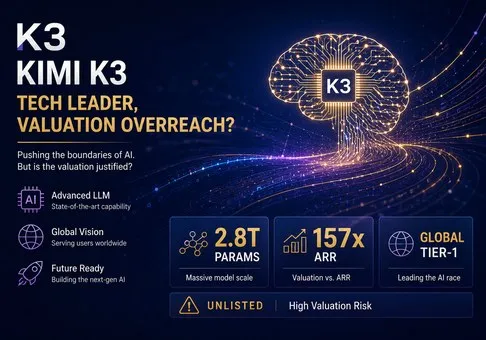
Overall view: Moonshot AI is one of China's large-model startups with the greatest depth of model technology. With 2.8 trillion total parameters, 104 billion activated parameters, native multimodality, and a 1-million-token context window, Kimi K3 has entered the global frontier first tier. However, the company remains private, and public information does not support a definitive claim that it is “about to list in the A-share market.” Available reporting points more consistently to preparations for a Hong Kong listing under Chapter 18C, with no formal filing yet. Mechanically dividing the reported US$31.5 billion pre-money valuation by reported ARR of more than US$200 million in April produces a valuation of approximately 157.5x ARR. Current risk-reward is skewed to the downside, and the primary variable is whether K3's model advantage can convert into sustainable API, subscription, and agent-workflow revenue over the next 12 months without being consumed by compute costs and the next model cycle.
-
Model quality is excellent, but the proper conclusion is “first tier,” not “the undisputed global leader.” In the official comparison table, K3 scored 93.5 on GPQA Diamond, 77.8 on ProgramBench, 91.2 on BrowseComp, 91.1 on OmniDocBench, and 42.0 on SWE-Marathon. It led the strongest peer in the same table by 0.2-2.0 percentage points on ProgramBench, BrowseComp, OmniDocBench, and SWE-Marathon, but trailed GPT-5.6 Sol by 0.6 points on GPQA and 5.5 points on DeepSWE, and trailed Claude Fable 5 by 5.4 points on FrontierSWE. The investment implication is clear: K3 has earned a ticket to world-class products but has not established sustained dominance across tasks and leaderboards.
-
Kimi's R&D path has evolved from a single breakthrough in long text to a general-purpose agent system. Kimi Chat entered the market with a 200,000-Chinese-character context in 2023 and expanded the public product capability to 2 million characters in 2024. In 2025, k1.5, Kimi-VL, and K2 successively added long-chain reasoning, multimodality, MoE, and tool use. In 2026, K2.5, K2.6, K2.7 Code, and K3 continued advancing native multimodality, Agent Swarm, long-horizon coding, and end-to-end knowledge work. Relative to K2, K3 increased total parameters from 1 trillion to 2.8 trillion, activated parameters from 32 billion to 104 billion, and context from 128K to 1,048,576; the company says overall scaling efficiency improved by approximately 2.5x. This is a continuous, interpretable technology curve rather than a one-off marketing leap.
-
Commercial entry points are in place, but unit economics still lack audited proof. The company now spans Kimi web/app subscriptions, enterprise subscriptions, APIs, Kimi Code, Kimi Work, and an open-source ecosystem. K3 API pricing per 1 million tokens is RMB2 for cache-hit input, RMB20 for cache-miss input, and RMB100 for output. A task with 1 million uncached input tokens and 100,000 output tokens mechanically generates about RMB30 of revenue; with the same prefix cached, revenue falls 60% to approximately RMB12. This also shows why caching and sparse architecture are central to potential gross margin. The company has not disclosed K3 inference cost per token, paid conversion, retention, revenue mix, or gross margin, so ARR growth should not be equated directly with high-quality software revenue.
-
Capital pricing is far ahead of financial disclosure. 36Kr's republication of Zhidx reported that Moonshot AI's ARR exceeded US$200 million in April and its valuation reached US$20 billion after a May financing. July reports then cited a US$31.5 billion pre-money valuation and a US$50 billion target valuation for a pre-IPO round. Those levels equal approximately 157.5x and 250x ARR, respectively, while ARR, financing completion, and valuations all come from media or financial-adviser accounts rather than audited prospectus figures. Even if ARR doubled to US$400 million, US$31.5 billion would still equal 78.8x ARR. The market is paying for a compound option on “sustained frontier-model ownership plus emergence as a global agent platform,” not existing operating cash flow.
-
Listing claims require restraint, while reversal conditions can be quantified. As of August 12, 2026, public channels showed no A-share tutoring filing, exchange acceptance, or prospectus for Moonshot AI. A July 24 report explicitly said it had neither formally filed nor obtained overseas-listing registration and that “as soon as six months” was only an ideal scenario. The current negative view could shift to neutral-to-positive if the company formally files a Hong Kong prospectus within the next 12 months and discloses ARR above US$400 million, net revenue retention above 120%, K3 inference gross margin above 50%, the top three customers below 30% of revenue, and K3 ranking in the top three on at least half of the core third-party coding and agent benchmarks. Conversely, if valuation reaches US$50 billion while ARR remains near US$200 million, K3 capacity again forces service suspensions, or next-generation competitors pull ahead broadly, the overvaluation conclusion would strengthen.
2. Company Overview, Business Structure, and Core Operating Indicators: From a Long-Text Assistant to an Open Agent Platform, the Model Has Become the Engine of Product Distribution
Moonshot AI was founded in 2023 by Yang Zhilin and others; Kimi is its core brand for users and developers. Across the large-model value chain, the company simultaneously acts as a foundation-model developer, consumer-application operator, API cloud provider, and agent-tool vendor. Unlike a laboratory that sells only model calls, Moonshot AI distributes the same model capabilities through Kimi's web and mobile products, enterprise subscriptions, open-platform APIs, the Kimi Code command-line tool, the Kimi Work local office agent, and open-source ecosystems on GitHub and Hugging Face. It is attempting to build a loop of “better models -> better product experience -> user and developer growth -> feedback and revenue reinvested in training.”
The consumer assistant is the brand and demand entry point. Kimi initially differentiated itself through ultra-long text, document reading, and web search, targeting students, researchers, lawyers, programmers, and knowledge workers. The free product acquires users, while memberships and enterprise subscriptions monetize them. Its advantage is that users can experience model upgrades directly, with both K2.5 and K3 entering the product interface alongside release. The weakness is low switching cost in consumer AI: if a competitor leads on speed, price, or model quality for one iteration, paid retention can change quickly.
The open API platform serves developers and enterprises, charging for input and output tokens and using context caching to reduce the cost of repeated prefixes. K3 supports OpenAI- and Anthropic-compatible interfaces, tool calling, structured output, dynamic tool loading, and image and video input. This reduces migration friction, but it also weakens lock-in. The most important KPIs for the API business are not total calls but paid tokens, cache-hit ratio, inference cost per token, service reliability, and customer retention. The company discloses prices but not gross margin or customer mix, making it impossible to determine whether low pricing reflects architectural efficiency or financing-funded subsidies.
Kimi Code, Kimi Work, and agent capabilities are the product layer most likely to raise average revenue per customer. Kimi Code embeds the model in real codebases, terminals, and tool calls; Kimi Work attempts to decompose tasks locally, operate a browser, create files, and deliver documents, spreadsheets, and presentations. Knowledge-work and coding tasks often require long context, repeated tool calls, and high output-token volumes, making them more valuable than ordinary Q&A but also making each error more costly. K3's improvements in long-horizon coding, documents, search, and multimodality are intended to turn model scores into billable workflows.
Open-weight models and infrastructure provide ecosystem acquisition and technical validation. K2, K2.5, and K3 weights are open, alongside training- and inference-related projects such as MoonEP and FlashKDA, attracting researchers, cloud providers, and inference-framework integrations. Open models reduce direct lock-in to a closed API, but they expand distribution, lower third-party adoption friction, and allow enterprises to self-host in data-sensitive settings. Moonshot AI's central commercial challenge is balancing adoption created by openness with monetization through APIs and enterprise services.
|
Business/Product Layer
|
Product, Customer, and Charging Model
|
Latest Verifiable Scale or KPI
|
Model Dependency
|
Research View
|
|
Kimi consumer assistant
|
Web, app, and membership; personal knowledge work, search, writing, documents, and multimodal tasks; free plus subscription
|
MAU, paid users, ARPU, and retention undisclosed; demand exceeded capacity within 48 hours of K3's release
|
Experience depends directly on the latest flagship model
|
Strong brand entry point; switching costs and unit economics unproven
|
|
Enterprise subscription/Kimi Work
|
Enterprise seats and a local general-purpose agent; decomposes natural-language tasks and delivers office outputs
|
Kimi Work began beta testing on 2026-06-03; revenue not reported separately
|
Requires long context, tool use, files, and vision
|
Most likely path to higher customer spend, but still in product validation
|
|
Kimi API
|
Developers and enterprises pay per token; compatible with major API formats
|
K3: RMB2 cache-hit input, RMB20 cache-miss input, and RMB100 output per million tokens; 1M context
|
Model quality, caching, inference efficiency, and reliability jointly determine gross margin
|
Transparent pricing and low integration friction; gross margin and concentration unknown
|
|
Kimi Code and Agent SDK
|
CLI, IDE/agent integrations, and development frameworks for software teams and developers
|
K2.7 Code high-speed version delivers about 180 tokens/s in normal coding and up to 260 tokens/s in short contexts, roughly 5-6x the standard version
|
Coding benchmarks, long-horizon execution, and tool orchestration
|
One of K3's clearest commercialization entry points
|
|
Open models and infrastructure
|
K2/K2.5/K3 weights, MoonEP, FlashKDA, and others; free adoption supports ecosystem growth and potential enterprise services
|
K3's official GitHub had approximately 8,300 stars and 650 forks as of August 12; not a revenue metric
|
Public validation of model and engineering quality
|
Supports global distribution; must prove conversion into paid revenue
|
|
Company overall
|
Consumer, enterprise, API, and open-source channels in parallel
|
Secondary reporting: April ARR above US$200 million; unaudited
|
K3's iteration speed is the growth engine
|
High-quality technology assets; commercial-quality disclosure trails valuation badly
|
The model and product history shows a continuous shift in strategic focus. The 2023-2024 phase was “productizing long context,” using readable lengths of 200,000 and 2 million Chinese characters to establish recognition. The 2025 phase filled gaps in reasoning, multimodality, and foundational agent capabilities. The 2026 phase became “open frontier models plus end-to-end workflows.” The truly valuable asset has grown from a single Kimi Chat traffic entry point into a combination of models, products, APIs, coding tools, and open infrastructure. The key risk is that each lead may last only months; model-release velocity is also model-depreciation velocity.
Core Operating Indicators and Changes
This issue was triggered by K3's July launch, the opening of its weights on July 27, and financing and listing reports in the same period. The legal status must be clear: Moonshot AI is not publicly listed and has no stock ticker, public share price, statutory market capitalization, or audited prospectus financials. Public reports point to preparations for a Hong Kong Chapter 18C listing, not a confirmed A-share IPO. This report therefore uses model specifications, products, API prices, reported ARR, and private financing valuations as core indicators rather than fabricating revenue, profit, or cash-flow statements.
|
Indicator/Event
|
Latest Value or Development
|
Comparison with Predecessor/History
|
Measurement Basis
|
Implication for Model, Revenue, and Valuation
|
|
K3 architecture
|
2.8T total parameters, 104B activated parameters, 16 of 896 experts selected per token, 1M context
|
K2 had 1T total parameters, 32B activated, and 128K context
|
Official company model card
|
Materially raises training and inference ceiling, but also deployment and compute requirements
|
|
Representative K3 benchmarks
|
GPQA 93.5; ProgramBench 77.8; BrowseComp 91.2; OmniDocBench 91.1
|
Difference versus the strongest peer in the same table ranges from -5.5 to +2.0 points
|
Official summary mixing internal and third-party results
|
Global first tier, but not first on every task
|
|
API pricing
|
RMB20 uncached input, RMB2 cached input, RMB100 output per million tokens
|
K2.6: RMB6.5 uncached input and RMB27 output
|
Domestic open-platform list price
|
K3 output price is about 3.70x K2.6 and must be justified by higher task success
|
|
Commercial scale
|
Secondary reporting: April ARR above US$200 million
|
No comparable audited history disclosed
|
Financial-adviser/media account
|
Evidence of commercialization, but revenue quality and gross margin remain unknown
|
|
Financing and valuation
|
July reporting: US$31.5 billion pre-money valuation; US$50 billion pre-IPO target
|
Reported US$20 billion valuation in May; US$4.3 billion at year-end 2025
|
Media reports; completion not fully verified
|
A roughly 6-12x valuation increase in six to seven months pulls expectations forward sharply
|
|
Listing status
|
Preparing a Hong Kong Chapter 18C listing; as of July 24, reportedly no formal filing or overseas-listing registration
|
No public evidence of A-share tutoring or acceptance
|
Media and public regulatory search
|
“About to list in the A-share market” and fixed listing timelines are unsupported
|
K3's product upgrade creates a reproducible transmission chain. From K2 to K3, total parameters rose 2.8x, activated parameters 3.25x, and context length 8x. Combined with KDA, AttnRes, and higher MoE sparsity, representative official agent and coding scores moved into the frontier range. Better capabilities support longer, more complex API tasks and permit output pricing of RMB100 per million tokens. If 1 million uncached input tokens plus 100,000 output tokens generates RMB30 of revenue, the customer must obtain value well above RMB30 from the task, while the company must keep inference costs below revenue. Model success rate, task length, cache-hit ratio, and cost per token jointly determine whether ARR becomes gross profit; parameter count alone does not.
Capacity pressure after K3's launch validated both demand and risk. International Finance News, republished by The Paper, reported that call volume within 48 hours strained the compute cluster, and the company temporarily paused new consumer paid subscriptions to prioritize existing members. This demonstrates genuine model appeal but also shows that supply and costs have not fully caught up with demand. For a model company valued above US$30 billion, “users want it” is only the first step; “deliver reliably, preserve margin, and improve retention” is the second step required by the valuation.
3. Fundamental Quality: The Technology Iteration Curve Is Steep, but Financial Auditability Remains the Largest Weakness
|
Item
|
2023-2024
|
2025
|
1H26
|
After K3 Release/As of 2026-08-12
|
Research View
|
|
Core products
|
Kimi Chat; long-text capacity expanded from 200,000 to 2 million Chinese characters
|
k1.5, Kimi-VL, K2, Researcher
|
K2.5, K2.6, K2.7 Code, Kimi Work
|
K3, Kimi Code, and open weights
|
Excellent iteration speed and roadmap continuity
|
|
Model scale/context
|
No disclosure on a consistent basis
|
K2: 1T/32B, 128K
|
K2.5/2.6: 1T/32B, 256K
|
K3: 2.8T/104B, 1M
|
Higher capability ceiling, but greater inference capital intensity
|
|
Revenue/ARR
|
No audited data obtained
|
Financing accelerated after year-end 2025
|
Secondary reporting: April ARR above US$200 million
|
K3 incremental ARR undisclosed
|
Evidence of revenue, but no detail on mix or quality
|
|
Gross margin/net profit
|
Undisclosed
|
Undisclosed
|
Undisclosed
|
Undisclosed
|
Profit quality cannot be assessed on listed-software-company standards
|
|
Cash/financing
|
Multiple US-dollar rounds
|
Reported year-end 2025 valuation of US$4.3 billion
|
Reported May valuation of US$20 billion after financing
|
Reported US$31.5 billion pre-money valuation and US$50 billion target
|
Liquidity appears ample; cash consumption and transaction completion require prospectus confirmation
|
|
Cash flow/capital expenditure
|
Undisclosed
|
Undisclosed
|
Undisclosed
|
Capacity pressure after K3 launch
|
FCF cannot be estimated without cash-flow and compute-commitment disclosure
|
|
Listing and governance
|
Private company
|
Private company
|
Reports of a Hong Kong IPO began to appear
|
No formal filing; no evidence of A-share acceptance
|
Valuation liquidity and governance have not entered public-market audit
|
Note: For a private large-model company, unavailable items remain “undisclosed.” Financing proceeds are not used to infer cash balances, ARR is not used to infer revenue or profit, and media-reported valuations are not presented as public market capitalization.
Growth and product quality. Moonshot AI's growth quality is first visible in its density of R&D output: within three years it progressed from a long-text assistant to reasoning, multimodality, MoE, Agent Swarm, coding models, and an open 3T-class model, while continuously putting models into products and APIs rather than leaving them in papers. BrowseComp rose from 60.6 on K2.5 to 91.2 on K3, an increase of 30.6 points. However, the two versions were tested against different generations of competitors and under different settings. The change demonstrates a rapidly rising internal capability curve, but it cannot be interpreted mechanically as a 50.5% improvement in real commercial task success.
Pricing, cost, and cash flow. K3 output pricing of RMB100 per million tokens is about 3.70x K2.6's RMB27, while uncached input pricing is 3.08x higher. This gives model improvements a monetization channel but also raises the customer's ROI threshold. The company says K3 improves overall scaling efficiency by approximately 2.5x relative to K2 and uses MXFP4 weight and MXFP8 activation quantization, but it does not disclose training cost, inference cost per token, utilization, depreciation, or GPU lease commitments. Without those figures, investors cannot determine whether higher prices deliver higher margins or merely pass through the cost of a larger model.
Balance sheet and capital allocation. Media reports of large and frequent financing rounds in 2026 imply strong near-term compute-purchasing power; they also imply higher expectations from the next investors. If the US$50 billion pre-IPO target valuation is achieved, it would equal 250x the currently reported US$200 million ARR. Capital-allocation tolerance would be extremely low: one flagship training run that fails to create product advantage, prolonged idle compute, or expensive user acquisition could consume hundreds of millions of dollars without creating durable revenue. The most important value of an IPO is not merely liquidity for early shareholders, but turning the capital required for the model race into an auditable, sustainable source of funding.
Fundamental conclusion. The technology fundamentals are strong; the financial fundamentals are not auditable. The most accurate assessment is not that the company is impossible to judge because it lacks operating data. Existing evidence is sufficient to establish excellent model and product quality, but insufficient to support the long-term cash flow implied by a valuation above US$30 billion. The single variable that determines whether strong technology becomes a strong enterprise is whether K3-driven paid workflow revenue can grow faster than inference costs, R&D spending, and model depreciation.
4. Industry and Competitive Landscape: Kimi Is Winning in Open Frontier Agents, While Closed-Model Breadth and Domestic Distribution Remain in Competitors' Hands
Large-model competition cannot be ranked simply by “more parameters is better.” The value chain includes pretraining and post-training, inference infrastructure, APIs, consumer entry points, enterprise workflows, and developer ecosystems. Investors should compare five dimensions: cross-task model capability, inference cost and speed, context and multimodality, distribution and retention, and open-source or ecosystem strategy. Benchmark scores sample capability but do not replace real-task success; active users sample distribution but do not replace revenue; ARR samples commercialization but does not replace gross margin and cash flow.

Note: Models may use different agent harnesses. Some peer data comes from third-party leaderboards, while some K3 results were measured by Moonshot AI, so the comparison is not an independent comprehensive ranking.
|
Competitive Dimension
|
Moonshot AI's Verifiable Position
|
Share/Scale Basis and Limitations
|
Main Competitors or Alternatives
|
Implication for Growth, Cost, and Valuation
|
|
Frontier-model capability
|
K3 leads in coding, search, documents, and selected agent benchmarks, but trails in reasoning and some software-engineering tasks
|
No unified global denominator; the official table mixes internal and third-party results
|
OpenAI, Anthropic, Google DeepMind, DeepSeek
|
Has earned a frontier ticket but not a durable dominance premium
|
|
Long context and multimodality
|
Native text/image/video, 1M context, KDA, and AttnRes
|
Maximum window does not guarantee effective retrieval, speed, or cost advantage
|
Gemini, Claude, GPT, Qwen, GLM
|
Well suited to knowledge work and large codebases; value depends on long-task success
|
|
Open weights and ecosystem
|
K2/K2.5/K3 weights and training infrastructure are open; supports major APIs and inference frameworks
|
GitHub stars and downloads do not map directly to revenue
|
DeepSeek, Qwen, GLM, MiniMax; closed camp includes GPT, Claude, and Gemini
|
Kimi is a net winner in open frontier models, but commercial recapture remains weak
|
|
Product and distribution
|
Multiple entry points across Kimi assistant, API, Kimi Code, and Kimi Work
|
MAU, paid conversion, enterprise customers, and net retention undisclosed
|
ByteDance Doubao, Alibaba Tongyi, Tencent Yuanbao, Baidu ERNIE, ChatGPT
|
Strong product completeness; weaker than large platforms in domestic super-app and cloud distribution
|
|
Inference economics
|
MoE activates only 104B parameters, quantized training, cached input priced as low as RMB2 per million tokens
|
Actual cost, latency, throughput, and gross margin undisclosed; K3 output pricing is high
|
DeepSeek's low-cost efficiency, cloud providers' own models, open self-hosting
|
Architecture supports lower cost, but K3 scale and capacity pressure may offset the benefit
|
|
Capital and listing
|
Reported US$31.5 billion pre-money valuation and more than RMB37 billion cumulative financing; preparing for Hong Kong Chapter 18C
|
Unaudited valuation, no formal filing, and no public market capitalization or liquidity
|
Publicly listed Zhipu and MiniMax; continuously financed OpenAI and Anthropic
|
Capital availability is an advantage, but the extreme valuation capitalizes the technology lead early
|
Note: This table does not infer exact market share because model calls, subscribers, enterprise seats, and self-hosted deployments have no consistent public denominator. Kimi's global position is proxied by same-table benchmarks, product coverage, and its open ecosystem.
|
Company/Model
|
Latest Comparable Generation
|
Verifiable Model/Operating Metrics
|
Product and Capital Status
|
Strengths and Weaknesses
|
Competitive Conclusion
|
|
Moonshot AI / Kimi K3
|
2026-07
|
2.8T/104B, 1M; ProgramBench 77.8, BrowseComp 91.2, DeepSWE 67.5
|
Assistant + API + Code + Work + open weights; reported US$31.5 billion pre-money valuation
|
Strong in long-horizon coding, documents, and open ecosystem; distribution, margin, and service capacity undisclosed
|
Net winner in open frontier agents, with the greatest valuation risk
|
|
OpenAI / GPT-5.6 Sol
|
Peer in K3's official comparison table
|
GPQA 94.1, DeepSWE 73.0, Terminal-Bench 88.8; ahead of K3 on multiple metrics
|
Global consumer, enterprise, API, and Codex loop
|
Strong breadth and distribution; closed model with pricing and governance controlled by the platform
|
Winner in comprehensive capability and commercialization
|
|
Anthropic / Claude Fable 5
|
Peer in K3's official comparison table
|
HLE 53.3/63.0, FrontierSWE 86.6, GDPval-AA v2 1747; ahead of K3 on multiple metrics
|
Strong enterprise and developer workflows; Claude Code provides distribution
|
Strong long-horizon engineering and knowledge work; closed, with fallback in some tests
|
Leader in high-value workflows
|
|
DeepSeek
|
Open-model camp
|
In K2.5's official table, DeepSeek V3.2 scored HLE 25.1, BrowseComp 51.4, and SWE-Bench Verified 73.1
|
Global recognition through open weights and low price; limited financial data
|
Strong cost efficiency and open-model brand; K3 has stronger latest agent and multimodal metrics
|
Main competitor on the low-cost open path
|
|
Alibaba Qwen
|
Open multimodal-model camp
|
In K2.5's official table, Qwen3-VL-235B-A22B scored MMMU-Pro 69.3 and OCRBench 87.5
|
Strong Alibaba Cloud, enterprise channels, and open community
|
Strong distribution, cloud ecosystem, and model portfolio; K3 leads on most agent metrics in K2.5's table
|
Winner in domestic distribution and ecosystem
|
|
Zhipu/GLM and MiniMax
|
Domestic independent model companies
|
K3's official table lists GLM-5.2 at GPQA 91.2 and DeepSWE 46.2; public comparable data for MiniMax is incomplete
|
Entered public capital markets, with diversified products and APIs
|
Greater financial transparency than Kimi; latest frontier-model narrative pressured by K3
|
Winners in listing progress, with frontier-model narrative under pressure
|
Note: The peer table prioritizes results in the same official K3 or K2.5 table to avoid splicing different leaderboards. This does not eliminate differences in harness, reasoning effort, tool configuration, or release timing. GPT, Claude, and other names follow the competitor labels in K3's model card as of July 2026 and should not be extrapolated to versions from other periods.
The answer to “who is winning” depends on the layer. Moonshot AI is winning the narrow but important field of open frontier agent models: K3 approaches or exceeds the strongest closed peers on selected coding, browsing, document, and multimodal tasks, while releasing weights, APIs, and coding tools together. OpenAI and Anthropic still lead in cross-task stability, enterprise distribution, and high-value workflows. Alibaba, ByteDance, and other Chinese platforms lead in cloud, traffic, and channels. DeepSeek continues to set the industry benchmark for cost efficiency and open-model branding. Kimi is not a net loser, but its lead remains concentrated in models and developer products rather than auditable commercial dominance.
In capital markets, Zhipu and MiniMax lead in public-listing progress, while K3 has allowed Moonshot AI to redefine the upper bound of technology valuation for independent model companies. The problem is that model share shifts much faster than enterprise-software share: a five-point lead today can become a five-point deficit in the next generation. Paying more than 150x ARR for technology leadership requires Kimi to defend the model, lower cost, expand distribution, improve retention, and stabilize service simultaneously. If any link fails, the valuation multiple can fall before revenue does.
5. Principal Risks
-
The technology-lead cycle may be shorter than the valuation payback period. If the next GPT, Claude, Gemini, DeepSeek, or Qwen generation surpasses K3 broadly by more than five points on coding, agents, and long-context tasks, Kimi's API pricing and subscription conversion would come under pressure. A 157.5x ARR valuation requires years of leadership, while industry iterations occur monthly.
-
Benchmark advantages may not convert into real task success. K3's official comparison mixes harnesses, internal measurements, and third-party results. If independent tests or enterprise proofs of concept show frequent interruptions, hallucinations, failed tool calls, or excessive latency on long-horizon work, leaderboard leadership will not generate enterprise renewals, leaving the R&D advantage at the marketing layer.
-
Inference cost and capacity limits may consume revenue. K3 activates 104 billion parameters per token, about 3.25x K2. Even with efficiency gains from MoE, KDA, and quantization, long-context and high-output service remains capital intensive. Another pause in new-user intake, worsening latency, or low GPU utilization could cause ARR growth to coincide with falling gross margin and rising cash burn.
-
Open adoption may dilute direct monetization. Enterprises can self-host K3 through vLLM, SGLang, and other frameworks, while cloud providers can capture inference value. If Moonshot AI cannot capture value through hosted APIs, enterprise support, Kimi Code, or a data flywheel, open-source popularity may create more revenue for third parties than for the company itself.
-
Distribution is constrained by large platforms and global incumbents. Domestic consumer entry points compete with Doubao, Yuanbao, Tongyi, and ERNIE; the enterprise side competes with Alibaba Cloud, Tencent Cloud, and Volcano Engine; overseas markets face ChatGPT, Claude, and Gemini. If paid acquisition costs rise, app switching increases, or channel subsidies intensify, model quality alone may not preserve retention.
-
Financing valuation and disclosure quality may be mismatched. Both US$31.5 billion and US$50 billion are media-reported valuations, and ARR is unaudited. If a formal prospectus shows revenue below the ARR framing, customer concentration, low gross margin, high cash consumption, or complex preferred-share terms, private-market valuation may not transfer to the IPO.
-
Listing venue, timing, and regulation may be misunderstood. Current evidence points to preparation for Hong Kong Chapter 18C, not an imminent A-share listing. Red-chip restructuring, overseas-listing registration, Hong Kong filing, hearing, and market issuance remain separate steps. Delays in any one could weaken financing expectations, while data compliance, generative-AI registration, copyright, and model-safety requirements could raise costs.
-
Key talent and governance are concentrated. Frontier models depend heavily on a small number of research, systems, and product leaders. Loss of key personnel, over-allocation of resources to ultra-large models, or more complex governance and equity structures before an IPO could affect R&D pace, cost discipline, and minority-shareholder protection.
6. Monitoring Checklist
-
Legal listing status: Rely only on China Securities Regulatory Commission overseas-listing registration, a formal Hong Kong filing, or an exchange announcement. A formal filing would improve financial verifiability; continued reporting of only “as soon as six months” would reinforce the negative view.
-
ARR and revenue quality: ARR should reach at least US$400 million over the next 12 months, with any difference between prospectus revenue and ARR explained. If ARR remains near US$200 million, the US$31.5 billion valuation would still exceed 150x ARR.
-
Paid retention and customer mix: Net revenue retention above 120%, the top three customers below 30%, and a rising enterprise/API revenue share would strengthen the commercialization case. High concentration or dependence on short-term prepayments would weaken it.
-
Inference economics: K3 inference gross margin above 50%, a rising cache-hit ratio, declining unit token cost, and service availability above 99.9% are required to prove that architecture efficiency has become a financial advantage.
-
Third-party model ranking: K3 or its successor should remain in the top three on at least half of DeepSWE, FrontierSWE, Terminal-Bench, BrowseComp, and at least one independent knowledge-work leaderboard. Falling more than five points behind the leader in three or more would require reducing the technology premium.
-
Product conversion: Kimi Code and Kimi Work should disclose paid seats, monthly active users, task-completion rates, or enterprise renewals and produce measurable revenue. Downloads, stars, and call peaks alone would not change the valuation conclusion.
-
Capacity and experience: New model launches should no longer require pauses in paid registration, and latency, error rates, and interruptions on long tasks should improve consistently. Renewed throttling would show that compute planning and unit economics remain immature.
-
Competitor progress: Track OpenAI and Anthropic's enterprise agents, DeepSeek's inference cost, and the open models and cloud distribution of Qwen and GLM. Any competitor simultaneously delivering “stronger capability, lower price, and broader channels” would weaken Kimi's net-winner position.
7. Sources