Author: LBank Research Analyst: Steven.fu
Trading Pairs:
Disclaimer: This article is compiled and analyzed from publicly available information and is intended solely for informational and research discussion. It does not constitute investment advice, a securities recommendation, a trading instruction, or any guarantee of returns. The company operations, valuations, market prices, and consensus expectations discussed herein may change over time. Readers should verify the data independently and make their own decisions.
This issue covers seven U.S.-listed technology companies that released their latest earnings between August 10 and 12: Cisco (CSCO), Coherent (COHR), Lumentum (LITE), CoreWeave (CRWV), Super Micro Computer (SMCI), Cerebras Systems (CBRS), and Rocket Lab (RKLB). Cisco, Coherent, Lumentum, and Supermicro reported fiscal quarters ending around July 2026, while the other companies reported calendar Q2, so the reporting periods are not fully aligned. This report does not force a ranking across industries. Instead, it rates each company separately based on demand, profitability, cash generation, balance-sheet strength, and valuation. Prices use publicly available market data around the August 12 regular-session close. Mechanical annualization is used only as a valuation stress test, not as an earnings forecast.
I. Core Conclusion: Orders Are Growing Across the Board, but Who Funds the Capital Determines Stock Quality
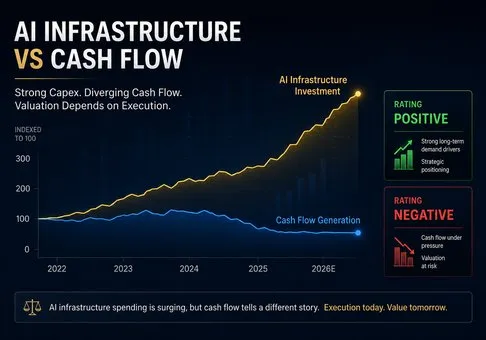
Overall view: Demand for AI infrastructure has not cooled. It continues to spread across switches, optical modules, GPU clouds, servers, and specialized inference systems. The real distinction among the ratings is not whether a company has AI orders, but how much additional inventory, equipment, debt, or equity it must fund after those orders turn into reported profit. This report rates Cisco Positive; Coherent and Lumentum Neutral-Positive; Supermicro Neutral-Negative; and CoreWeave, Cerebras, and Rocket Lab Negative. This is not a ranking of technological merit. It is an assessment of risk and reward at current prices.
|
Company
|
Latest-Quarter Revenue and Growth
|
Key Profit/Cash Signal
|
Valuation Stress Test
|
Rating
|
|
Cisco
|
$17.252bn, +18%
|
35.9% non-GAAP operating margin; FY CFO of $14.177bn
|
About 24x the midpoint of FY2027 non-GAAP EPS guidance
|
Positive
|
|
Coherent
|
$2.046bn, +33.8%
|
21.8% non-GAAP operating margin; FY CFO of only $79.5mn
|
Market cap of about $64.28bn, or roughly 9x FY2026 revenue
|
Neutral-Positive
|
|
Lumentum
|
$1.0063bn, +109.3%
|
36.6% non-GAAP operating margin; next-quarter guidance accelerates again
|
About 55.5x mechanically annualized next-quarter EPS
|
Neutral-Positive
|
|
CoreWeave
|
$2.575bn, +112.5%
|
59% EBITDA margin but only 5% adjusted operating margin; Q2 capex of $6.422bn
|
Market cap of about $59.36bn versus roughly $35.068bn of debt
|
Negative
|
|
Supermicro
|
$11.120bn, +93%
|
Q4 gross margin of 17.5%; FY CFO of -$6.810bn
|
Market cap of about $26.52bn; low revenue multiple but weak cash quality
|
Neutral-Negative
|
|
Cerebras
|
GAAP revenue of $180.1mn, +74%
|
41% core gross margin; first-half capex of $548.9mn
|
About 47x the midpoint of FY2026 core revenue guidance
|
Negative
|
|
Rocket Lab
|
$234.1mn, +62%
|
Backlog of $2.36bn; first-half CFO of -$134.4mn
|
Market cap of about $48.55bn, or roughly 50x annualized Q2 revenue
|
Negative
|
-
Networking and optical interconnects are the most direct earnings-conversion layer in this cycle. Cisco's Q4 AI infrastructure orders reached $4.0bn and totaled $9.3bn for the year. Coherent's data center and communications revenue grew 58.6%. Lumentum doubled revenue and raised both revenue and margin expectations for the next quarter. Demand has demonstrably moved from orders into revenue and earnings, but Coherent's and Lumentum's valuations also assume continued rapid capacity expansion, smooth yield improvement, and no customer delays.
-
EBITDA cannot substitute for shareholder cash after interest and capital expenditure. CoreWeave's 59% adjusted EBITDA margin is striking, but its adjusted operating margin was only 5%, while interest expense reached $640mn and capital expenditure totaled $6.422bn. High order visibility does not automatically create strong cash returns for common shareholders. The financing structure will determine whether value ultimately accrues to equity holders or creditors.
-
Explosive server-assembly revenue still requires working-capital validation. Supermicro's Q4 gross margin recovered from 9.9% to 17.5%, and operating cash flow turned positive for the quarter. Yet full-year operating cash flow was negative $6.810bn as both inventory and receivables expanded. The quarterly inflection deserves recognition, but the full-year cash evidence cannot be ignored.
-
Scarce technology and long-term contracts do not automatically justify any valuation. Cerebras's cloud revenue grew 281% and RPO reached $25.4bn. Rocket Lab's backlog increased 137%. Both companies have real products and demand, but one trades at roughly 47x guided revenue and the other at about 50x annualized quarterly revenue, while both still require sustained capital investment or external financing. Their stocks have very little room for error.
-
Some prior views have been validated. The July 22 Arista report treated Cisco's FY2026 AI order target of $9.0bn as evidence that the incumbent networking vendor was accelerating again. The actual result of $9.3bn validates that directional view. At the same time, the earlier Nebius report emphasized capex, customer concentration, and financing risk at AI cloud companies. CoreWeave's combination of high backlog, high EBITDA, heavy capex, and heavy interest expense again demonstrates that growth and shareholder cash returns are not interchangeable.
II. Company-by-Company Earnings Review
Cisco: AI Orders Exceeded the Previous Target, While Mature Cash Flow Provides the Best Margin of Safety in This Group
Earnings performance. FY2026 Q4 revenue was $17.252bn, up 18% year over year. GAAP and non-GAAP operating margins were 24.7% and 35.9%, respectively, while non-GAAP EPS increased 23% to $1.22. The most important forward-looking indicator was AI infrastructure orders from hyperscale customers: $4.0bn in Q4 and $9.3bn for the full year, above the company's previous $9.0bn target. Cisco also set an FY2027 AI infrastructure revenue target of approximately $7.5bn, indicating that orders are beginning to enter revenue according to delivery schedules rather than remaining merely long-dated intentions.
Cash, guidance, and valuation. FY2026 operating cash flow was $14.177bn, roughly flat year over year, showing that accelerating hardware demand has not yet translated into faster cash growth. Inventory rose to $5.694bn, which also indicates that procurement and supply commitments are consuming capital. FY2027 guidance calls for revenue of $72.2bn-$73.4bn and non-GAAP EPS of $5.05-$5.11. The August 12 closing price of $123.88 corresponded to a Nasdaq earnings-calendar market capitalization of about $474.67bn, or approximately 24.4x the midpoint of FY2027 EPS guidance. Compared with pure-play AI infrastructure companies, this valuation is supported by mature software, services, buybacks, and cash flow, but the stock is no longer deeply undervalued.
Research rating: Positive. Order outperformance, stable margins, and mature cash generation together provide the strongest risk-reward profile in this group. The Positive view would strengthen if FY2027 AI revenue reaches $7.5bn, total revenue exceeds $73.4bn, and operating cash flow returns to double-digit growth. The rating should move to Neutral if AI revenue falls below $6.5bn, non-GAAP operating margin drops below 33%, or inventory continues rising while CFO declines. The earlier Arista report argued that Cisco had become an active challenger in AI Ethernet. The delivery of $9.3bn in orders validates the direction, although investors must still determine whether those orders become revenue without sacrificing gross margin or cash generation.
Coherent: Data Center Photonics Has Entered a Volume-Ramp Phase, but Expansion Consumed Almost All Operating Cash
Earnings performance. FY2026 Q4 revenue was $2.046bn, up 33.8% year over year. Data center and communications revenue was $1.615bn, up 58.6%, making it the clear center of growth. GAAP and non-GAAP gross margins were 38.5% and 40.2%, respectively, while operating margins were 12.4% and 21.8%. These figures show that demand for high-speed transceivers, optical components, and lasers is generating operating leverage. The company guided FY2027 Q1 revenue to $2.2bn-$2.4bn, with the midpoint representing another approximately 12.4% sequential increase from Q4, as orders and the capacity ramp continue.
Cash, capital expenditure, and valuation. A strong income statement contrasted sharply with weak cash generation: FY2026 operating cash flow was only $79.5mn, while capital expenditure reached $1.103bn. Capacity investment can be rational when supported by visible demand, but it can also magnify depreciation and asset burdens if demand, yields, or pricing weakens. At the August 12 closing price of $355.64, Nasdaq's earnings calendar showed a market capitalization of approximately $64.28bn, or roughly 9x FY2026 revenue. That multiple can be supported by sustained growth above 30% and improving gross margins, but it cannot tolerate falling optical-module prices, delayed customer acceptance, or underutilized new capacity.
Research rating: Neutral-Positive. The operating trajectory is strong enough to retain a positive bias, but cash conversion and valuation prevent a fully Positive rating. The rating could move to Positive if Q1 revenue exceeds $2.4bn, non-GAAP gross margin rises above 41%, quarterly operating cash flow exceeds $400mn, and capex begins to decline. It should move to Neutral-Negative if revenue falls below $2.2bn, gross margin drops under 38%, or free cash flow remains materially negative over the next two quarters.
Lumentum: Revenue Doubled and Margins Jumped; Next-Quarter Guidance Remains Strong, but Valuation Has Moved First
Earnings performance. FY2026 Q4 revenue was $1.0063bn, up 109.3% year over year. Non-GAAP gross margin was 50.4%, operating margin was 36.6%, and EPS was $3.23, showing that AI data center interconnect demand, product mix, and scale benefits simultaneously drove the earnings breakout. FY2026 revenue reached $3.014bn, up 83.2%. The stronger signal came from the next quarter: FY2027 Q1 revenue guidance of $1.225bn-$1.275bn, non-GAAP operating margin guidance of 39.5%-40.5%, and EPS guidance of $4.05-$4.35. The midpoint of the revenue range implies sequential growth of approximately 24.2% from Q4.
Valuation and market expectations. At the August 12 closing price of $932.47, market capitalization was approximately $78.89bn based on Q4 diluted shares. The stock traded at about 55.5x mechanically annualized EPS using the midpoint of Q1 guidance and approximately 15.8x mechanically annualized Q1 revenue. A more complete enterprise-value calculation would produce an even higher revenue multiple. Both earnings and revenue multiples imply that the market already expects exceptional growth and margins to persist. Optical-component supply and demand, customer concentration, yields, and pricing can make simple annualization misleading, so a breakout quarter should not be mechanically extrapolated across multiple years.
Research rating: Neutral-Positive. The earnings surge is real, and next-quarter guidance provides near-term support for the high valuation. The rating could move to Positive if Q1 revenue exceeds $1.275bn, non-GAAP operating margin rises above 40.5%, and operating cash flow grows in parallel. If revenue falls below $1.225bn, gross margin drops under 48%, or a major customer delay causes a material inventory increase, the current valuation would quickly lose support. Lumentum's near-term profit conversion is stronger than Coherent's, but this is not a cross-company declaration of a winner; it means that Lumentum's own share price now demands greater persistence.
CoreWeave: A $104bn Backlog Is Powerful, but Interest and Capex Put Shareholders Behind the Capital Structure
Earnings performance. Q2 revenue was $2.575bn, up 112.5% year over year. Backlog reached $104bn, and the company added more than $25bn of commitments early in Q3, placing demand visibility among the strongest in this group. Adjusted EBITDA was $1.510bn, for a margin of 59%, but adjusted operating margin was only 5%, while GAAP net loss totaled $626mn. The enormous gap between the two profit measures is a reminder that heavily depreciating GPU and data center assets do not disappear simply because EBITDA excludes their cost.
Cash, debt, and valuation. Q2 operating cash flow was $679mn and capital expenditure was $6.422bn; first-half capex reached $14.117bn. Interest expense was $640mn, and total debt was approximately $35.068bn. At the August 12 closing price of $107.73, market capitalization was approximately $59.36bn based on 551mn weighted-average shares. Looking only at a price-to-sales ratio would understate the debt, leases, future capital commitments, and refinancing risk. The company's ability to build capacity on time, secure low-cost power, and make long-term contracts cover both asset and funding costs matters more than the nominal size of backlog.
Research rating: Negative. Demand is not the principal concern; financing dependence and conversion into shareholder cash are. The Negative view could ease if, over the next two quarters, adjusted operating margin rises above 15%, operating cash flow covers at least 25% of capex, interest expense falls below 15% of revenue, and net debt stops growing. If capex remains above twice revenue, debt and interest continue rising together, or a major customer delays capacity acceptance, downside risk to the common equity would increase further. The earlier Nebius report highlighted the capital-cost and customer-fulfillment risks of AI clouds. CoreWeave's latest results again validate that analytical framework.
Supermicro: Quarterly Margin and Cash Recovered, but the Full-Year $6.8bn Operating-Cash Deficit Has Not Disappeared
Earnings performance. FY2026 Q4 revenue was $11.120bn, up 93% year over year. GAAP gross margin recovered sharply to 17.5% from 9.9% in Q3, while GAAP EPS was $1.62. Q4 operating cash flow was $747mn and capital investment was only $25mn, indicating better project delivery and collections at quarter-end. The company issued strong FY2027 revenue guidance of $65bn-$72bn and Q1 guidance of $14.5bn-$15.5bn, as demand for AI servers, rack-scale systems, and liquid cooling remains robust.
Full-year cash and accounting risk. FY2026 revenue was $39.063bn, up 78%, but full-year operating cash flow was negative $6.810bn. Inventory rose to $12.896bn and accounts receivable increased to $6.125bn. The faster revenue grows while inventory procurement and credit sales expand, the greater the need for external financing. At the August 12 close of $37.61, market capitalization was approximately $26.52bn based on Q4 diluted shares. The headline revenue multiple appears low, but it reflects substantial discounts for working capital and execution. The financial figures remain preliminary and unaudited, while the board is reviewing export-control-related transactions. Investors should not extrapolate solely from the Q4 margin.
Research rating: Neutral-Negative. The Q4 recovery makes an outright bearish conclusion inappropriate, but the full-year cash drain, inventory, receivables, and compliance uncertainty remain unresolved. The rating could rise to Neutral-Positive if FY2027 Q1 revenue exceeds $15.5bn, gross margin remains above 17%, operating cash flow stays positive for two consecutive quarters, and inventory falls below $11bn. The negative bias should strengthen if inventory or receivables keep rising, Q1 gross margin falls below 14%, or the full-year audit or export review produces a material adverse finding.
Cerebras: Cloud Revenue Nearly Quadrupled and RPO Is Huge, but Accounting Adjustments and a 47x Revenue Multiple Leave Little Room for Error
Earnings performance. Q2 GAAP revenue was $180.1mn, up 74% year over year. Company-defined core revenue was $209.9mn, up 103%, including GAAP cloud-services revenue of $126.0mn, up 281%. Core gross margin was 41% and core operating margin was -16%, while GAAP operating margin was -265%. The large gap between the two frameworks means that both must be presented together. RPO reached $25.4bn, 600MW of capacity was operational or contracted, and the company planned to increase manufacturing capability by more than 10x during 2026, demonstrating genuine customer demand and expansion plans for wafer-scale systems and high-speed inference cloud services.
Cash, financing, and valuation. First-half operating cash flow was negative $47.5mn and capex was $548.9mn. Cash and other liquidity totaled approximately $8.6bn, primarily from the IPO. This provides substantial near-term funding but does not mean the business model is already self-funding. At the August 12 closing price of $262.06, market capitalization was approximately $39.56bn based on Q2 weighted-average shares, equivalent to roughly 47x the midpoint of FY2026 core revenue guidance. The market is pricing not only technological leadership, but also the simultaneous success of capacity expansion, customer delivery, margin improvement, and controlled dilution.
Research rating: Negative. The technology and orders can be genuine while the stock's risk-reward remains unfavorable. The rating could ease if GAAP revenue in each of the next two quarters exceeds the pace required by core revenue guidance, core gross margin rises above 50%, the gap between GAAP and core revenue narrows below 10%, and capex falls below 50% of revenue. Valuation-compression risk would increase if RPO is canceled or delayed, core adjustments continue expanding, gross margin falls below 40%, or the company raises another large round of capital.
Rocket Lab: Revenue and Backlog Both Set Records, but a 50x Annualized-Revenue Multiple Requires Nearly Flawless Neutron Execution
Earnings performance. Q2 revenue was $234.1mn, up 62% year over year. Backlog reached $2.36bn, up 137%, with demand supporting both launch services and space systems. GAAP and non-GAAP gross margins were approximately 36.1% and 41.5%, respectively. GAAP operating loss was $57.5mn and adjusted EBITDA loss was $8.8mn, indicating that operating losses are narrowing on a relative basis. Q3 revenue guidance of $250mn-$265mn implies sequential growth of approximately 10% at the midpoint, suggesting that near-term delivery remains strong.
Cash, equity issuance, and valuation. First-half operating cash flow was negative $134.4mn and capex was $53.1mn. The company raised $1.530bn through at-the-market equity issuance, strengthening its capital position while transferring part of the project risk to new shareholders. At the August 12 closing price of $81.17, estimated market capitalization based on period-end common shares was approximately $48.55bn, or roughly 50x mechanically annualized Q2 revenue. This multiple requires Electron to maintain launch reliability, space-systems contracts to convert on schedule, Neutron to enter commercial operation on time, and the proposed Iridium transaction or other capital allocation not to weaken the balance sheet.
Research rating: Negative. Record business progress and orders deserve recognition, but the combination of valuation, dilution, and major-project execution risk provides no margin of safety. The rating could move to Neutral if Q3 revenue exceeds $265mn, adjusted EBITDA turns positive, key Neutron milestones remain on schedule, and the company avoids another large equity issuance over the next twelve months. The Negative view would strengthen if revenue falls below $250mn, backlog conversion is delayed, the Neutron timeline slips again, or fully diluted shares increase by more than 10%.
III. Principal Risks and Methodological Limitations
-
Multiple compression at high valuations. Lumentum, Coherent, Cerebras, and Rocket Lab all embed expectations of rapid multi-year growth. Revenue merely reaching the low end of guidance, a decline in gross margin, or delivery delays could cause share-price moves far larger than the corresponding change in earnings.
-
Capital expenditure and financing costs. CoreWeave, Cerebras, Coherent, and Rocket Lab need to build data centers, manufacturing capability, launch systems, or optical capacity. Changes in interest rates, equipment prices, access to power, and financing windows will directly affect shareholder returns.
-
Customer concentration and order cancelability. AI cloud, optical communications, and specialized-computing orders may be concentrated among a handful of hyperscale customers. Backlog, RPO, and commitments are not always equivalent to noncancelable revenue. Customer self-builds, product substitutions, or changes in delivery acceptance can alter the recognition schedule.
-
Technology and supply-chain iteration. 800G/1.6T optics, Ethernet and proprietary interconnects, GPUs and wafer-scale engines, liquid-cooled servers, and launch vehicles are all evolving rapidly. Yields, component shortages, compatibility, or competitive pricing can affect revenue and gross margins simultaneously.
-
Accounting measures are not directly comparable. Fiscal years, non-GAAP adjustments, EBITDA, core revenue, capex, and share-count definitions differ across companies. The summary table is designed to locate each company's central tension quickly; it is not a standardized comparable-company model.
-
Preliminary figures and compliance risk. Supermicro's figures remain preliminary and unaudited, and transactions related to export controls are under review. Any restatement, control deficiency, or regulatory outcome could invalidate the current valuation framework.
-
Market-cap and mechanical-annualization limitations. Market capitalizations in this report primarily use closing prices multiplied by publicly disclosed weighted-average or period-end shares. They do not fully incorporate options, convertible notes, capital leases, or net debt. Multiplying quarterly revenue or EPS by four is only a stress test and does not represent a forecast for the next four quarters.
IV. Follow-Up Checklist
-
Cisco: Whether FY2027 AI revenue reaches $7.5bn, total revenue exceeds $73.4bn, non-GAAP operating margin remains above 33%, and CFO returns to double-digit growth.
-
Coherent: Whether FY2027 Q1 revenue exceeds $2.4bn, non-GAAP gross margin rises above 41%, quarterly CFO exceeds $400mn, and capex declines after the capacity expansion.
-
Lumentum: Whether Q1 revenue exceeds $1.275bn, non-GAAP operating margin rises above 40.5%, orders and inventory remain healthy together, and customer delays emerge.
-
CoreWeave: Whether adjusted operating margin rises above 15%, CFO/capex exceeds 25%, interest expense falls below 15% of revenue, and net debt stops increasing.
-
Supermicro: Whether Q1 revenue exceeds $15.5bn, gross margin remains above 17%, inventory falls below $11bn, operating cash flow stays positive, and the audit and export review conclude without material adverse findings.
-
Cerebras: Whether core gross margin exceeds 50%, the gap between GAAP and core revenue narrows below 10%, capex/revenue falls below 50%, and the $25.4bn RPO converts into actual revenue.
-
Rocket Lab: Whether Q3 revenue exceeds $265mn, adjusted EBITDA turns positive, Neutron milestones remain on schedule, and fully diluted share growth stays below 10%.
V. Sources
Note: Company earnings releases, regulatory filings, and investor-relations materials are the primary sources for operating and financial data. Nasdaq was used to cross-check the earnings calendar, closing prices, and market capitalizations. Because public pages, share-count definitions, and market prices change over time, readers should reverify the information before using this report. This report does not use undisclosed sell-side consensus estimates.